Review
. 2013 Nov;31(11):621-32.
doi: 10.1016/j.tibtech.2013.08.007. Epub 2013 Oct 2.

A tale of two specificities: bispecific antibodies for therapeutic and diagnostic applications

Affiliations
Review

A tale of two specificities: bispecific antibodies for therapeutic and diagnostic applications

Hannah Byrne et al. Trends Biotechnol. 2013 Nov.

Abstract

Artificial manipulation of antibody genes has facilitated the production of several unique recombinant antibody formats, which have highly important therapeutic and biotechnological applications. Although bispecific antibodies (bsAbs) are not new, they are coming to the forefront as our knowledge of the potential efficacy of antibody-based therapeutics expands. The next generation of bsAbs is developing due to significant improvements in recombinant antibody technologies. This review focuses on recent advances with a particular focus on improvements in format and design that are contributing to the resurgence of bsAbs, and in particular, on innovative structures applicable to next generation point-of-care (POC) devices with applicability to low resource environments.


Figures

Figure 1
Figure 1
Diagrammatic representations of antibody structure. (A) Classical Y-shaped IgG composed of two heavy (blue–red) and two light (gray–green) chains that are further divided into variable (VH in red and VL in green) and constant domains (CH in blue and CL in gray). The fragment variable (Fv) domain is the smallest fragment of an antibody required for binding and is composed of the VH and VL domains which house the complementarity determining regions (CDRs). (B) The introduction of a flexible linker to the VL–VH (or VH–VL) gives rise to the single chain fragment variable (scFv). (C) The fragment antigen binding (Fab) can be generated by both recombinant and enzymatic approaches as can the F(ab′)2 fragment (D), which is composed of two Fab fragments. The structures of the shark Ig-NAR (E) and camelid (F) VHH immunoglobulin differ from that of the IgG molecule and are composed of single variable heavy domains. The black circles indicate the antigen binding sites. Adapted from .
Figure 2
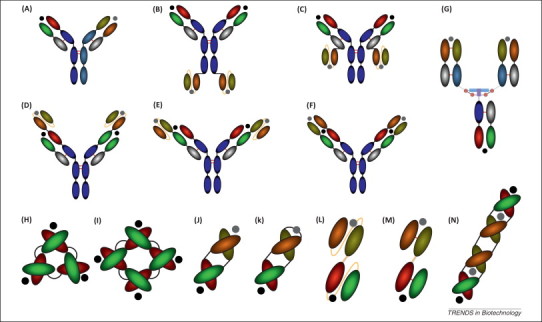
Figure 2
Bispecific antibody (bsAb) formats. Unique and diverse sets of bsAbs exist and can be described as IgG-like (A–G) and small bispecific (H–N) formats. The antigen-binding sites are indicated by the black and gray colored circles. A quadroma (A) is generated from the fusion of two different hybridomas and secrets a mixture of antibodies including a bispecific. Single chain fragment variable (scFv) can be linked to the Fc domain (B) and the constant light chain (C) of IgG molecules to generate the IgG–scFv format. Conversely, an scFv–IgG construct can be prepared through linkage of an scFv to the variable heavy (VH) (D) and variable light (VL) (E) of an IgG. The dual variable domain (DVD-Ig) bsAb (F) is created by fusion of a second VH–VL domain to the existing IgG VH–VL domain. The dock and lock (DNL) concept may be applied to multiple constructs through homodimerization dimerization of a DDD (blue) and AD (purple) sequence forming disulfide bonds (red circles) and a DNL-Fab is shown (G). A triabody (H) consists of three linked Fvs, whereas a tetrabody (I) consists of four Fv domains. The diabody (J) is a heterodimeric bsAb composed of two specificities and the stability the diabody is improved by encoding the construct as a single polypeptide chain (K). The bispecific T cell engager (BiTE) is a single polypeptide chain of two Fv molecules (TascFv) (L), whereas the tandem Fv (TaFv) (M) is a linked Fv molecule. The tandem diabody imparts avidity in addition to bispecificity (N). Adapted from .
Figure 3
Figure 3
Diagrammatic representation of a generalized assay format for a bispecific antibody (bsAb)-based immunoassay. The capture monoclonal antibody is immobilized on to a solid surface and binds to a specific epitope on its cognate antigen present in the test sample. Upon addition of the corresponding bsAb, one arm binds to a specific epitope on the antigen, while the other arm binds to a reporter molecule, such as horseradish peroxidase (HRPO), and converts the subsequently added substrate to a quantifiable signal or colored product. Adapted from .

Comment in

  • A two-pronged approach.
    Webster M, Kumar VS. Webster M, et al. Clin Chem. 2014 Apr;60(4):699-701. doi: 10.1373/clinchem.2013.221200. Clin Chem. 2014. PMID: 24682691 No abstract available.

References

    1. Ohlin M., Zouali M. The human antibody repertoire to infectious agents: implications for disease pathogenesis. Mol. Immunol. 2003;40:1–11. - PubMed
    1. Nelson P.N. Monoclonal antibodies. Mol. Pathol. 2000;53:111–117. - PMC - PubMed
    1. Birch J.R., Racher A.J. Antibody production. Adv. Drug Deliv. Rev. 2006;58:671–685. - PubMed
    1. Conroy P.J. Antibody production, design and use for biosensor-based applications. Semin. Cell Dev. Biol. 2009;20:10–26. - PubMed
    1. Köhler G., Milstein C. Continuous cultures of fused cells secreting antibody of predefined specificity. Nature. 1975;256:495–497. - PubMed

Publication types

MeSH terms