


Cognitive decline in short and long sleepers: a prospective population-based study (NEDICES)
- PMID: 24094933
- PMCID: PMC3839098
- DOI: 10.1016/j.jpsychires.2013.09.007
Cognitive decline in short and long sleepers: a prospective population-based study (NEDICES)
Abstract
Background: It is not clear whether cognitive decline progresses more quickly in long sleepers than in short sleepers or than in participants with usual sleep duration. We assessed cognitive decline as a function of self-reported sleep duration in a prospective population-based cohort (NEDICES).
Methods: Participants were evaluated at baseline and 3 years later. Baseline demographic variables were recorded and participants indicated their daily sleep usual duration as the sum of nighttime sleep and daytime napping. The average daily total usual sleep duration was grouped into three categories: ≤ 5 h (short sleepers), 6-8 h (reference category), and ≥ 9 h (long sleepers). At baseline and at follow-up, a 37-item version of the Mini-Mental State Examination (37-MMSE) was administered.
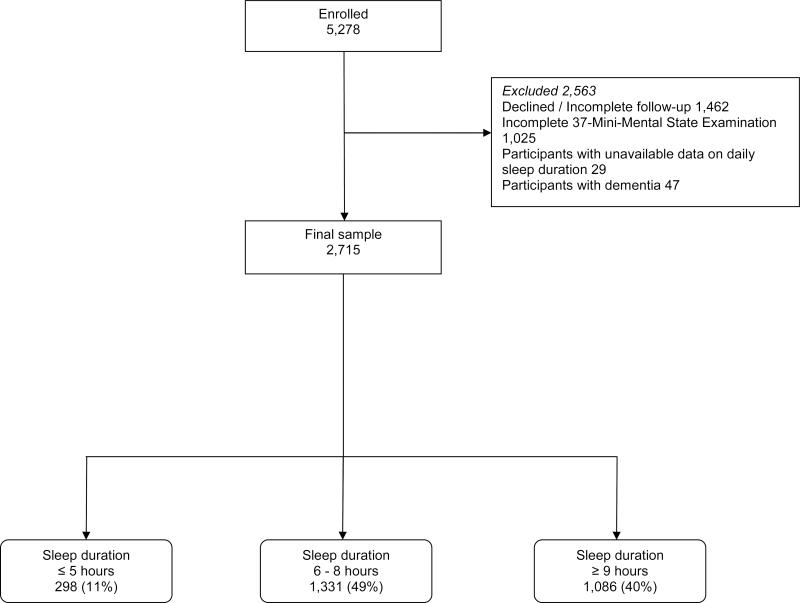
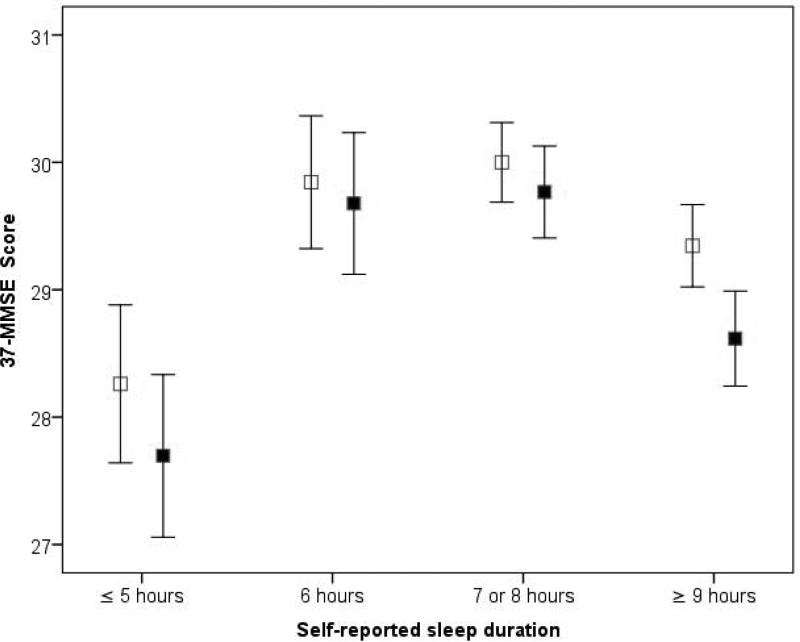
Results: The final sample, 2715 participants (72.9 ± 6.1 years), comprised 298 (11%) short sleepers, 1086 (40%) long sleepers, and 1331 (49%) in the reference group (6-8 h). During the three year follow-up period, the 37-MMSE declined by 0.5 ± 4.0 points in short sleepers, 0.6 ± 4.3 points in long sleepers, and 0.2 ± 3.8 points in the reference group (p = 0.08). The difference between short sleepers and the reference group was not significant (p = 0.142); however, the difference between long sleepers and the reference group was significant (p = 0.040). In analyses adjusted for baseline age and other potential confounders, this difference remained robust.
Conclusions: In this study, cognitive test scores among long sleepers declined more rapidly than observed in a reference group. Additional studies are needed to confirm these results.
Keywords: Cognitive function; Elderly; Epidemiology; Population-based study; Sleep duration.
Copyright © 2013 Elsevier Ltd. All rights reserved.
Figures
References
-
- Aevarsson O, Skoog I. A longitudinal population study of the mini-mental state examination in the very old: relation to dementia and education. Dement Geriatr Cogn Disord. 2000;11:166–75. - PubMed
-
- American Psychiatric Association., & American Psychiatric Association . American Psychiatric Association; Washington, DC: 1994. Task Force on DSM-IV. Diagnostic and statistical manual of mental disorders : DSM-IV.
-
- Bastien CH, Fortier-Brochu E, Rioux I, LeBlanc M, Daley M, Morin CM. Cognitive performance and sleep quality in the elderly suffering from chronic insomnia. Relationship between objective and subjective measures. J Psychosom Res. 2003;54:39–49. - PubMed
-
- Benito-León J, Bermejo-Pareja F, Louis ED. Neurological Disorders in Central Spain Study, G. Incidence of essential tremor in three elderly populations of central Spain. Neurology. 2005;64:1721–5. - PubMed
Publication types
MeSH terms
Grants and funding
- NINDS #R01 NS073872/NS/NINDS NIH HHS/United States
- NINDS #R01 NS36630/NS/NINDS NIH HHS/United States
- T32 NS007153/NS/NINDS NIH HHS/United States
- R01 NS039422/NS/NINDS NIH HHS/United States
- R21 NS077094/NS/NINDS NIH HHS/United States
- NINDS #R01 NS042859/NS/NINDS NIH HHS/United States
- NINDS #T32 NS07153-24/NS/NINDS NIH HHS/United States
- R01 NS042859/NS/NINDS NIH HHS/United States
- R01 NS036630/NS/NINDS NIH HHS/United States
- NINDS #R21 NS077094/NS/NINDS NIH HHS/United States
- NINDS #R01 NS39422/NS/NINDS NIH HHS/United States
- NIH R01 NS039422/NS/NINDS NIH HHS/United States
- R01 NS073872/NS/NINDS NIH HHS/United States
LinkOut - more resources
Full Text Sources
Other Literature Sources
Medical
