. 2013 Oct;141(3):409-20.
doi: 10.1007/s10549-013-2699-3. Epub 2013 Oct 6.

The molecular diversity of Luminal A breast tumors

Affiliations

The molecular diversity of Luminal A breast tumors

Giovanni Ciriello et al. Breast Cancer Res Treat. 2013 Oct.

Abstract

Breast cancer is a collection of diseases with distinct molecular traits, prognosis, and therapeutic options. Luminal A breast cancer is the most heterogeneous, both molecularly and clinically. Using genomic data from over 1,000 Luminal A tumors from multiple studies, we analyzed the copy number and mutational landscape of this tumor subtype. This integrated analysis revealed four major subtypes defined by distinct copy-number and mutation profiles. We identified an atypical Luminal A subtype characterized by high genomic instability, TP53 mutations, and increased Aurora kinase signaling; these genomic alterations lead to a worse clinical prognosis. Aberrations of chromosomes 1, 8, and 16, together with PIK3CA, GATA3, AKT1, and MAP3K1 mutations drive the other subtypes. Finally, an unbiased pathway analysis revealed multiple rare, but mutually exclusive, alterations linked to loss of activity of co-repressor complexes N-Cor and SMRT. These rare alterations were the most prevalent in Luminal A tumors and may predict resistance to endocrine therapy. Our work provides for a further molecular stratification of Luminal A breast tumors, with potential direct clinical implications.


Figures
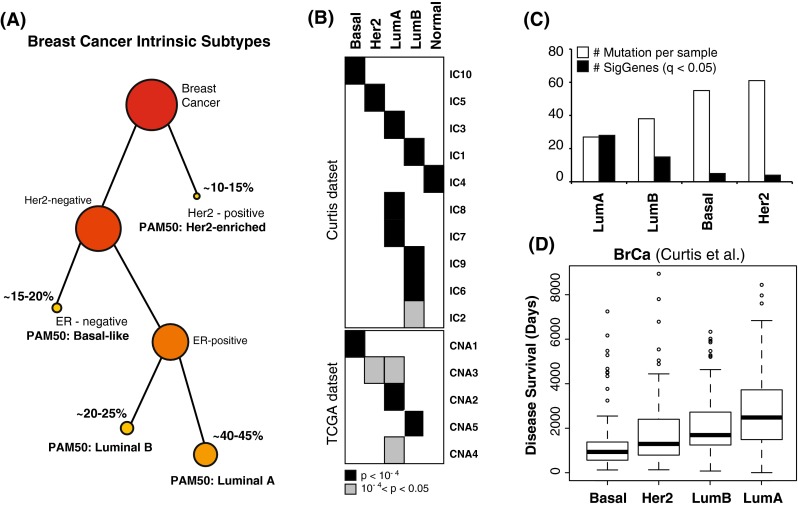
Fig. 1
Fig. 1
a Schematic stratification of breast cancer subtypes based on receptor status, ER and Her2, and PAM50 mRNA-derived signatures. b The table shows statistically significant intersections between the PAM50 subtypes (arranged horizontally) and copy number-driven clusters (arranged vertically) from the METABRIC and TCGA datasets. c Average number of mutations per sample (white) and number of recurrently mutated genes (black) are shown for the four major PAM50 subtypes. Luminal tumors have fewer mutations per samples, but they tend to affect similar genes. d Boxplot statistics of disease survival is shown for deceased patients from the METABRIC dataset across the four major PAM50 subtypes. While Luminal A tumors have the longest average survival, they also have the largest diversity
Fig. 2
Fig. 2
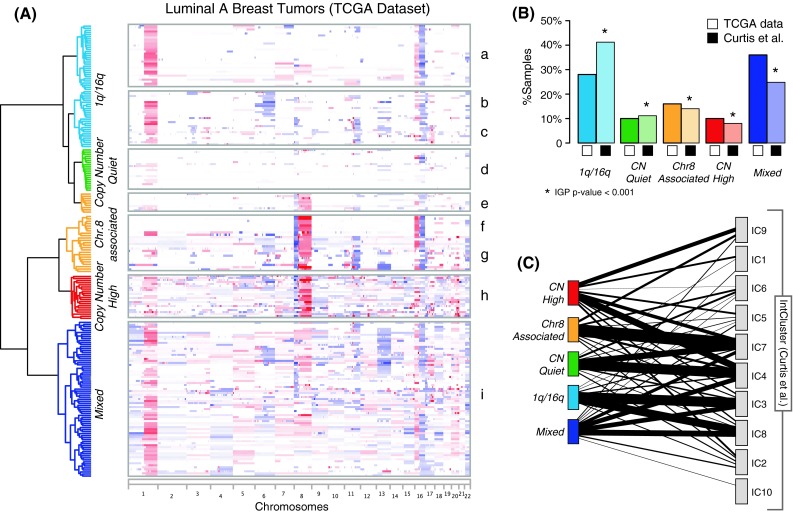
Copy number clustering of Luminal A breast tumors. a Hierarchical clustering of copy number data from 209 Luminal A tumors from the TCGA dataset reveals four distinct patterns of alterations, plus a mixed subgroup. Chromosomes are arranged from left to right, and tumors are arranged vertically and grouped according to cluster membership. Red indicates copy number gain, blue copy number losses, with color intensity proportional to absolute copy number values. b Cluster centroids were used to classify the METABRIC dataset (721 samples). Clusters in the METABRIC dataset show similar proportions to the TCGA counterparts, and the quality of the clusters is confirmed by statistically significant IGP. c Clusters determined from the METABRIC dataset are compared with the breast cancer subtypes proposed in [12]. Lines connect clusters with non-empty overlap with a thickness proportional to the extent of overlap
Fig. 3
Fig. 3
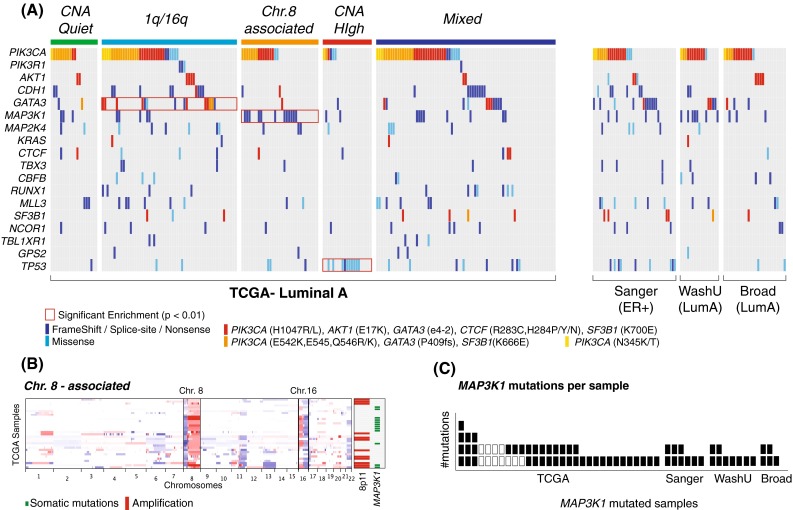
Landscape of Luminal A somatic mutations. a An unbiased enrichment analysis shows that PIK3CA mutations are significantly enriched in the 1q/16q subgroup, MAP3K1 mutations in the Chr8-associated, and TP53 mutations in the CNH subtgroup. All recurrent Luminal A mutations are displayed (one mutated gene per row). Mutations are color coded based on type (dark blue frame-shift, splice-site, and nonsense/light blue missense) and recurrent hotspots (red). All TCGA tumors, grouped by copy-number subtype, are shown in columns, together with mutated cases from the Sanger [13], WashU [11], and Broad [16] datasets. b MAP3K1 mutations are strongly associated with a subset of the Chr8-associated cluster characterized by 8p−/8q+/16p+/16q−. The heatmap shows copy number profiles for all the Chr.8-associated samples (arranged vertically). The panel on the right shows that high level amplification in 8p11 and mutations at MAP3K1 are largely mutually exclusive and characterize distinct subgroups of tumors in this Luminal A subtype. c Most patients affected by MAP3K1 mutations have more than one mutation, suggesting bi-allelic inactivation. The plot shows all samples with at least one MAP3K1 mutation (X axis), and the actual number of MAP3K1 mutations for each sample (Y axis)
Fig. 4
Fig. 4
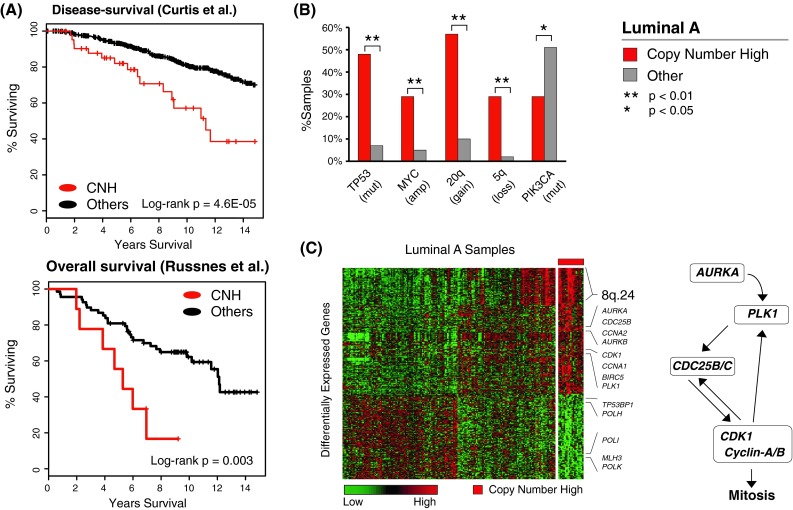
CNH tumors. a Survival analysis across two independent datasets shows significantly worse outcome for the CNH Luminal A tumors. b Unbiased enrichment analysis of genomic alterations found CNH tumors to be enriched for TP53 mutations, focal amplification of MYC, 5q loss, 20q gain, and depleted for PIK3CA mutations. c Differential expression analysis shows that significantly up-regulated genes in CNH tumors are enriched for regulators of mitosis and Aurora kinase pathway components. The heatmap shows all genes that are differentially expressed in CNH tumors when compared to other Luminal A samples (red indicates high expression, green low expression). Aurora kinase is a mitotic serine/threonine kinase that phosphorylates multiple proteins including PLK1 and Cdc25; it is required for CDK1 activation and regulates mitotic events
Fig. 5
Fig. 5
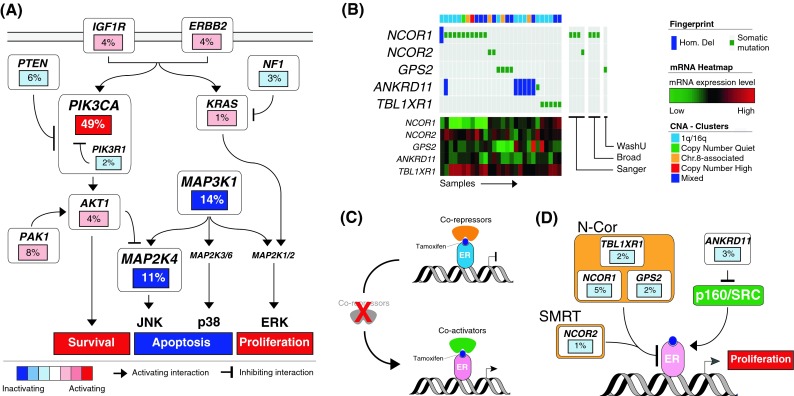
Pathway analysis. Altered pathways across Luminal A tumors identified by the MEMo algorithm. a MEMo identified multiple modules recapitulating Akt, MAPK, and Ras signaling. Gene activation is shown in shades of red, inactivation in shades of blue. b MEMo found network modules highlighting multiple alterations of nuclear co-repressors. Genes are arranged vertically, and altered tumors from left to right. c Nuclear co-repressors and co-activators regulate ER transcription and Tamoxifen anti-proliferative effects. d Alterations identified by MEMo compromise co-repressor activities and may predict response to therapy

References

    1. Paik S, et al. A multigene assay to predict recurrence of tamoxifen-treated, node-negative breast cancer. N Engl J Med. 2004;351(27):2817–2826. doi: 10.1056/NEJMoa041588. - DOI - PubMed
    1. Paik S, et al. Gene expression and benefit of chemotherapy in women with node-negative, estrogen receptor-positive breast cancer. J Clin Oncol. 2006;24(23):3726–3734. doi: 10.1200/JCO.2005.04.7985. - DOI - PubMed
    1. Romond EH, et al. Trastuzumab plus adjuvant chemotherapy for operable HER2-positive breast cancer. N Engl J Med. 2005;353(16):1673–1684. doi: 10.1056/NEJMoa052122. - DOI - PubMed
    1. Slamon DJ, Romond EH, Perez EA (2006) Advances in adjuvant therapy for breast cancer. Clin Adv Hematol Oncol 4(3 Suppl 7): suppl 1, 4–9; discussion suppl 10; quiz 2 p following suppl 10 - PubMed
    1. Perez EA, et al. Four-year follow-up of trastuzumab plus adjuvant chemotherapy for operable human epidermal growth factor receptor 2-positive breast cancer: joint analysis of data from NCCTG N9831 and NSABP B-31. J Clin Oncol. 2011;29(25):3366–3373. doi: 10.1200/JCO.2011.35.0868. - DOI - PMC - PubMed

Publication types

MeSH terms