


Assessing the phenotypic effects in the general population of rare variants in genes for a dominant Mendelian form of diabetes
- PMID: 24097065
- PMCID: PMC4051627
- DOI: 10.1038/ng.2794
Assessing the phenotypic effects in the general population of rare variants in genes for a dominant Mendelian form of diabetes
Abstract
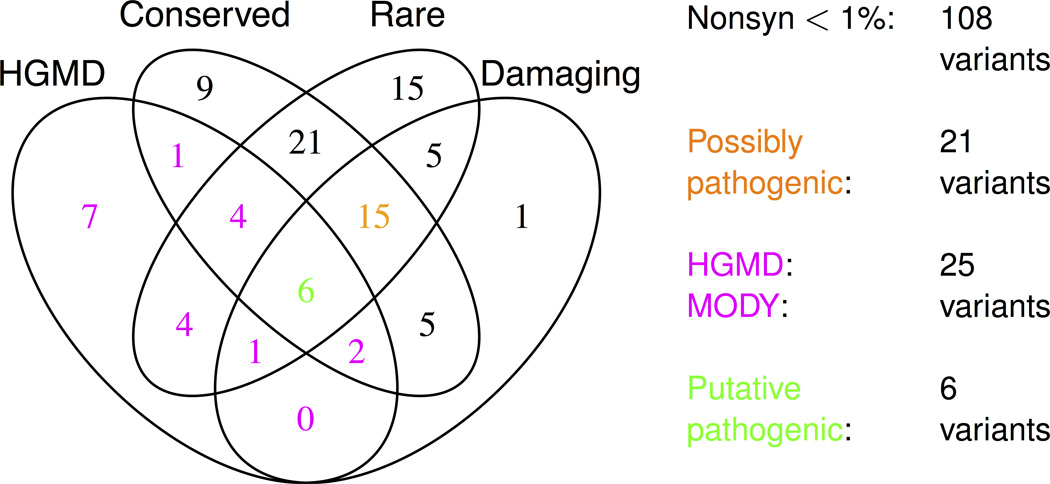
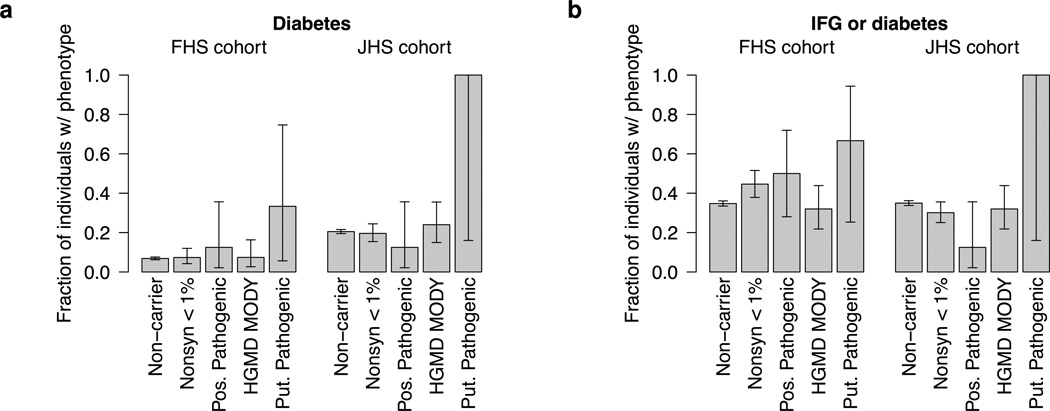
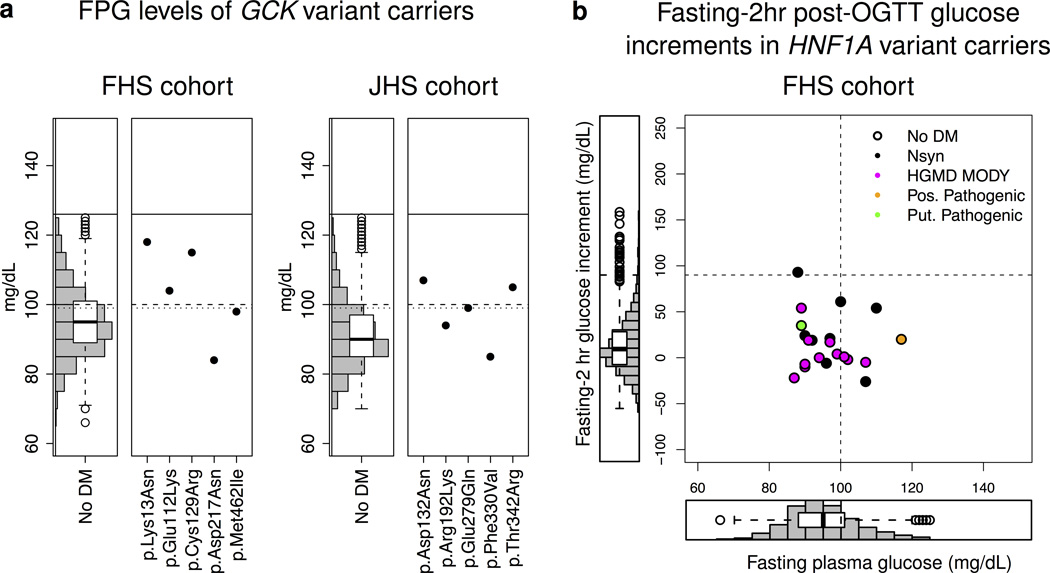
Genome sequencing can identify individuals in the general population who harbor rare coding variants in genes for Mendelian disorders and who may consequently have increased disease risk. Previous studies of rare variants in phenotypically extreme individuals display ascertainment bias and may demonstrate inflated effect-size estimates. We sequenced seven genes for maturity-onset diabetes of the young (MODY) in well-phenotyped population samples (n = 4,003). We filtered rare variants according to two prediction criteria for disease-causing mutations: reported previously in MODY or satisfying stringent de novo thresholds (rare, conserved and protein damaging). Approximately 1.5% and 0.5% of randomly selected individuals from the Framingham and Jackson Heart Studies, respectively, carry variants from these two classes. However, the vast majority of carriers remain euglycemic through middle age. Accurate estimates of variant effect sizes from population-based sequencing are needed to avoid falsely predicting a substantial fraction of individuals as being at risk for MODY or other Mendelian diseases.
Figures
References
-
- Collins FS. Shattuck lecture--medical and societal consequences of the Human Genome Project. The New England Journal of Medicine. 1999;341:28–37. - PubMed
-
- Collins FS. Genetics: an explosion of knowledge is transforming clinical practice. Geriatrics. 1999;54:41–47. quiz 48. - PubMed
-
- Roses AD. Pharmacogenetics and the practice of medicine. Nature. 2000;405:857–865. - PubMed
-
- Hall Y. Coming Soon: Your Personal DNA Map? National Geographic News. 2006
-
- Duncan DE. On a Mission to Sequence the Genomes of 100,000 People. New York Times. 2010
Publication types
MeSH terms
Substances
Supplementary concepts
Grants and funding
- U54 HG003067/HG/NHGRI NIH HHS/United States
- HHMI/Howard Hughes Medical Institute/United States
- T32 GM007753/GM/NIGMS NIH HHS/United States
- R01 HL080494/HL/NHLBI NIH HHS/United States
- N01 HC025195/HL/NHLBI NIH HHS/United States
- N01 HC095170/HL/NHLBI NIH HHS/United States
- K24 DK080140/DK/NIDDK NIH HHS/United States
- 6R01-NS 17950/NS/NINDS NIH HHS/United States
- N01-HC-95172/HC/NHLBI NIH HHS/United States
- T32GM007753/GM/NIGMS NIH HHS/United States
- N01 HC095171/HL/NHLBI NIH HHS/United States
- R01 DK078616/DK/NIDDK NIH HHS/United States
- N02-HL-6-4278/HL/NHLBI NIH HHS/United States
- 5-T32-GM007748-33/GM/NIGMS NIH HHS/United States
- N01-HC-25195/HC/NHLBI NIH HHS/United States
- N01 HC095172/HL/NHLBI NIH HHS/United States
- R01 NS017950/NS/NINDS NIH HHS/United States
- R01 2R01HL080494/HL/NHLBI NIH HHS/United States
- N01-HC-95171/HC/NHLBI NIH HHS/United States
- R01 HL084553/HL/NHLBI NIH HHS/United States
- N01-HC-95170/HC/NHLBI NIH HHS/United States
- T32 GM007748/GM/NIGMS NIH HHS/United States
LinkOut - more resources
Full Text Sources
Other Literature Sources
Medical
