


Variants at multiple loci implicated in both innate and adaptive immune responses are associated with Sjögren's syndrome
- PMID: 24097067
- PMCID: PMC3867192
- DOI: 10.1038/ng.2792
Variants at multiple loci implicated in both innate and adaptive immune responses are associated with Sjögren's syndrome
Abstract
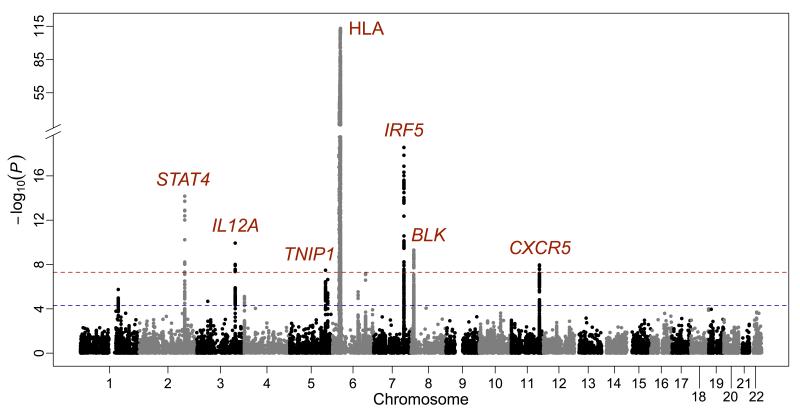
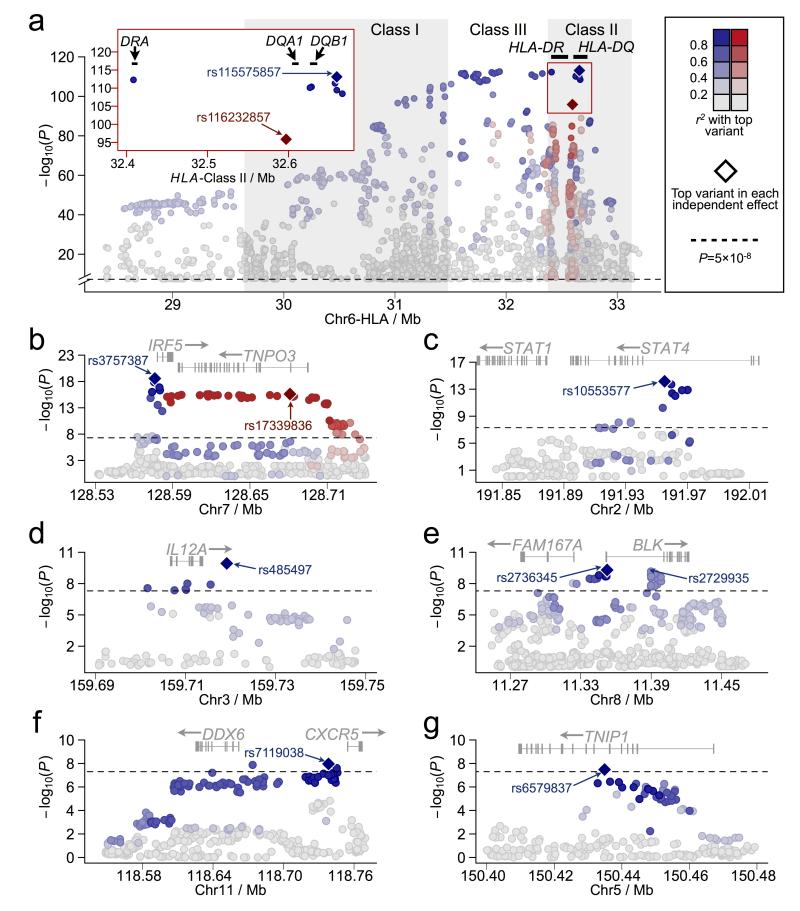
Sjögren's syndrome is a common autoimmune disease (affecting ∼0.7% of European Americans) that typically presents as keratoconjunctivitis sicca and xerostomia. Here we report results of a large-scale association study of Sjögren's syndrome. In addition to strong association within the human leukocyte antigen (HLA) region at 6p21 (Pmeta = 7.65 × 10(-114)), we establish associations with IRF5-TNPO3 (Pmeta = 2.73 × 10(-19)), STAT4 (Pmeta = 6.80 × 10(-15)), IL12A (Pmeta = 1.17 × 10(-10)), FAM167A-BLK (Pmeta = 4.97 × 10(-10)), DDX6-CXCR5 (Pmeta = 1.10 × 10(-8)) and TNIP1 (Pmeta = 3.30 × 10(-8)). We also observed suggestive associations (Pmeta < 5 × 10(-5)) with variants in 29 other regions, including TNFAIP3, PTTG1, PRDM1, DGKQ, FCGR2A, IRAK1BP1, ITSN2 and PHIP, among others. These results highlight the importance of genes that are involved in both innate and adaptive immunity in Sjögren's syndrome.
Figures
References
-
- Helmick CG, et al. Estimates of the prevalence of arthritis and other rheumatic conditions in the United States. Part I. Arthritis Rheum. 2008;58:15–25. - PubMed
-
- Pillemer SR, et al. Incidence of physician-diagnosed primary Sjogren syndrome in residents of Olmsted County, Minnesota. Mayo Clin Proc. 2001;76:593–9. - PubMed
-
- Jonsson R, et al. The complexity of Sjogren’s syndrome: novel aspects on pathogenesis. Immunol Lett. 2011;141:1–9. - PubMed
Publication types
MeSH terms
Substances
Grants and funding
- R01 DE015223/DE/NIDCR NIH HHS/United States
- 7S10 RR027190-02/RR/NCRR NIH HHS/United States
- U01 AI101934/AI/NIAID NIH HHS/United States
- 5P30 GM103510/GM/NIGMS NIH HHS/United States
- 5RC2 AR058959/AR/NIAMS NIH HHS/United States
- 8P20 GM103456/GM/NIGMS NIH HHS/United States
- 5P01 AR049084-10/AR/NIAMS NIH HHS/United States
- MR/J002720/1/MRC_/Medical Research Council/United Kingdom
- P20 GM103636/GM/NIGMS NIH HHS/United States
- P01 AR049084/AR/NIAMS NIH HHS/United States
- R01 DE018209/DE/NIDCR NIH HHS/United States
- 5P01 AI083194-03/AI/NIAID NIH HHS/United States
- 5R01 DE015223/DE/NIDCR NIH HHS/United States
- U19 AI082714/AI/NIAID NIH HHS/United States
- P30 GM103510/GM/NIGMS NIH HHS/United States
- P20 GM103456/GM/NIGMS NIH HHS/United States
- P50 AR0608040/AR/NIAMS NIH HHS/United States
- RC1 AR058554/AR/NIAMS NIH HHS/United States
- P30 AR053483/AR/NIAMS NIH HHS/United States
- 1U01 AI101934/AI/NIAID NIH HHS/United States
- P50 AR060804/AR/NIAMS NIH HHS/United States
- 5R01 DE018209/DE/NIDCR NIH HHS/United States
- 1R01 DE018209-02/DE/NIDCR NIH HHS/United States
- 5U19 AI082714/AI/NIAID NIH HHS/United States
- R37 AI024717/AI/NIAID NIH HHS/United States
- S10 RR027190/RR/NCRR NIH HHS/United States
- ImNIH/Intramural NIH HHS/United States
- UK G0800629/MRC_/Medical Research Council/United Kingdom
- 5P30 AR053483/AR/NIAMS NIH HHS/United States
- G0800629/MRC_/Medical Research Council/United Kingdom
- I01 BX001834/BX/BLRD VA/United States
- RC2 AR058959/AR/NIAMS NIH HHS/United States
- P01 AI083194/AI/NIAID NIH HHS/United States
- 5R37 AI024717-25/AI/NIAID NIH HHS/United States
- 1RC1 AR058554/AR/NIAMS NIH HHS/United States
LinkOut - more resources
Full Text Sources
Other Literature Sources
Medical
Molecular Biology Databases
Research Materials
Miscellaneous
