


The role of conspiracist ideation and worldviews in predicting rejection of science
- PMID: 24098391
- PMCID: PMC3788812
- DOI: 10.1371/journal.pone.0075637
The role of conspiracist ideation and worldviews in predicting rejection of science
Erratum in
-
Correction: The Role of Conspiracist Ideation and Worldviews in Predicting Rejection of Science.PLoS One. 2015 Aug 13;10(8):e0134773. doi: 10.1371/journal.pone.0134773. eCollection 2015. PLoS One. 2015. PMID: 26270483 Free PMC article. No abstract available.
Abstract
Background: Among American Conservatives, but not Liberals, trust in science has been declining since the 1970's. Climate science has become particularly polarized, with Conservatives being more likely than Liberals to reject the notion that greenhouse gas emissions are warming the globe. Conversely, opposition to genetically-modified (GM) foods and vaccinations is often ascribed to the political Left although reliable data are lacking. There are also growing indications that rejection of science is suffused by conspiracist ideation, that is the general tendency to endorse conspiracy theories including the specific beliefs that inconvenient scientific findings constitute a "hoax."
Methodology/principal findings: We conducted a propensity weighted internet-panel survey of the U.S. population and show that conservatism and free-market worldview strongly predict rejection of climate science, in contrast to their weaker and opposing effects on acceptance of vaccinations. The two worldview variables do not predict opposition to GM. Conspiracist ideation, by contrast, predicts rejection of all three scientific propositions, albeit to greatly varying extents. Greater endorsement of a diverse set of conspiracy theories predicts opposition to GM foods, vaccinations, and climate science.
Conclusions: Free-market worldviews are an important predictor of the rejection of scientific findings that have potential regulatory implications, such as climate science, but not necessarily of other scientific issues. Conspiracist ideation, by contrast, is associated with the rejection of all scientific propositions tested. We highlight the manifold cognitive reasons why conspiracist ideation would stand in opposition to the scientific method. The involvement of conspiracist ideation in the rejection of science has implications for science communicators.
Conflict of interest statement
Figures
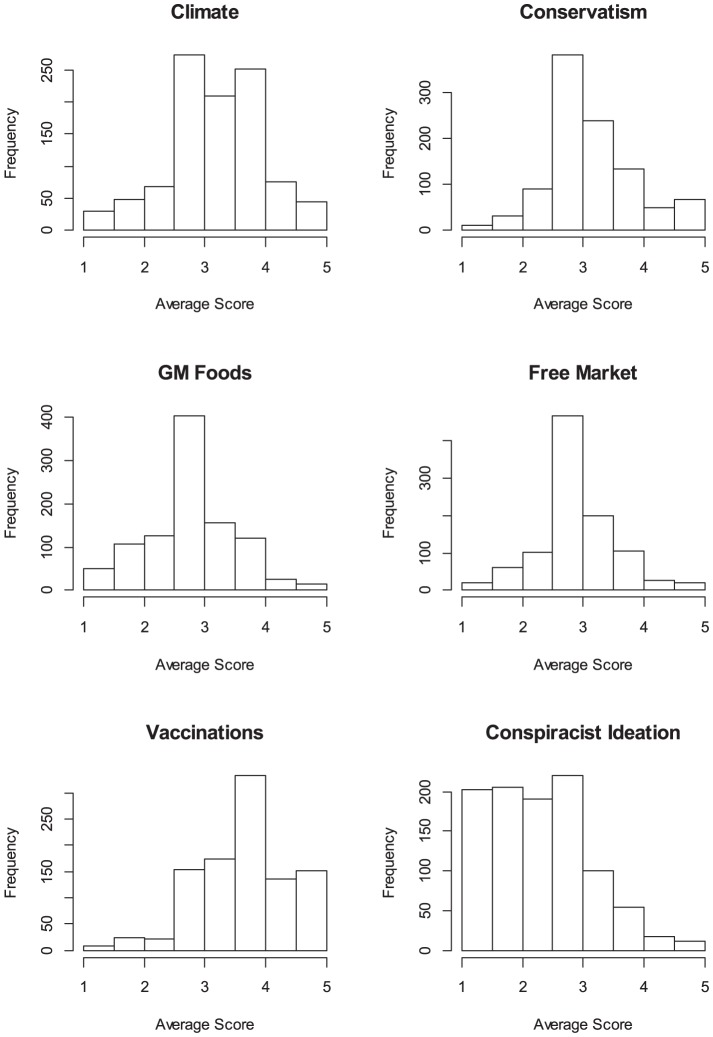
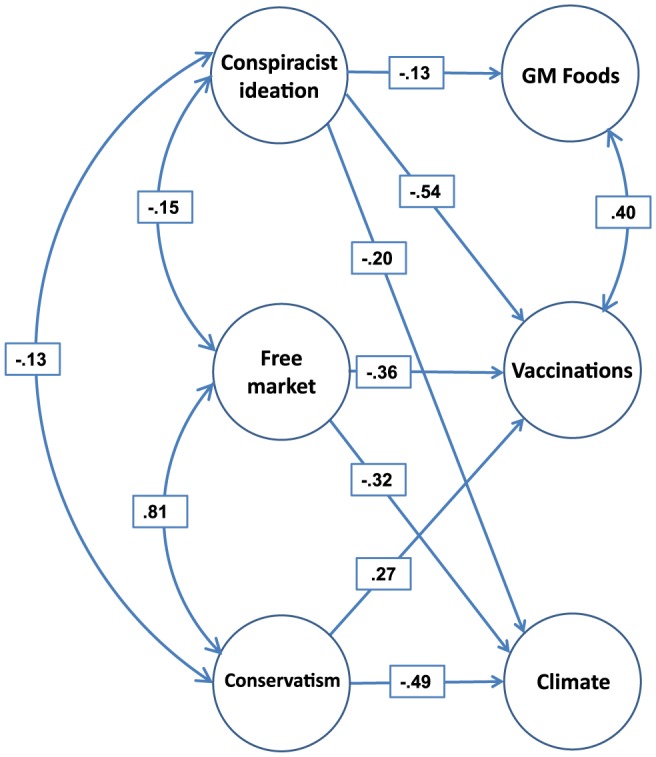
 except the link between Conservatism and Vaccinations;
  ,
,  . Manifest variables and their loadings, and disturbances on endogenous factors, are not shown. Links between latent variables that are not shown are constrained to zero. Loadings and variances of single-indicator manifest variables are not shown and are reported in Table 2.
References
-
- Gauchat G (2012) Politicization of science in the public sphere: A study of public trust in the United States, 1974 to 2010. American Sociological Review 77: 167–187.
-
- Dunlap RE, McCright AM (2008) A widening gap: Republican and Democratic views on climate change. Environment: Science and Policy for Sustainable Development 50: 26–35.
-
- Hamilton LC (2011) Education, politics and opinions about climate change evidence for interaction effects. Climatic Change 104: 231–242.
-
- Heath Y, Gifford R (2006) Free-market ideology and environmental degradation: The case of belief in global climate change. Environment and Behavior 38: 48–71.
-
- Kahan DM (2010) Fixing the communications failure. Nature 463: 296–297. - PubMed
Publication types
MeSH terms
LinkOut - more resources
Full Text Sources
Other Literature Sources
