


Pitavastatin and Atorvastatin double-blind randomized comPArative study among hiGh-risk patients, including thOse with Type 2 diabetes mellitus, in Taiwan (PAPAGO-T Study)
- PMID: 24098467
- PMCID: PMC3788128
- DOI: 10.1371/journal.pone.0076298
Pitavastatin and Atorvastatin double-blind randomized comPArative study among hiGh-risk patients, including thOse with Type 2 diabetes mellitus, in Taiwan (PAPAGO-T Study)
Erratum in
- PLoS One. 2014;9(11):e114175
Abstract
Background: Evidence about the efficacy and safety of statin treatment in high-risk patients with hypercholesterolemia is available for some populations, but not for ethnic Chinese. To test the hypothesis that treatment with pitavastatin (2 mg/day) is not inferior to treatment with atorvastatin (10 mg/day) for reducing low-density lipoprotein cholesterol (LDL-C), a 12-week multicenter collaborative randomized parallel-group comparative study of high-risk ethnic Chinese patients with hypercholesterolemia was conducted in Taiwan. In addition, the effects on other lipid parameters, inflammatory markers, insulin-resistance-associated biomarkers and safety were evaluated.
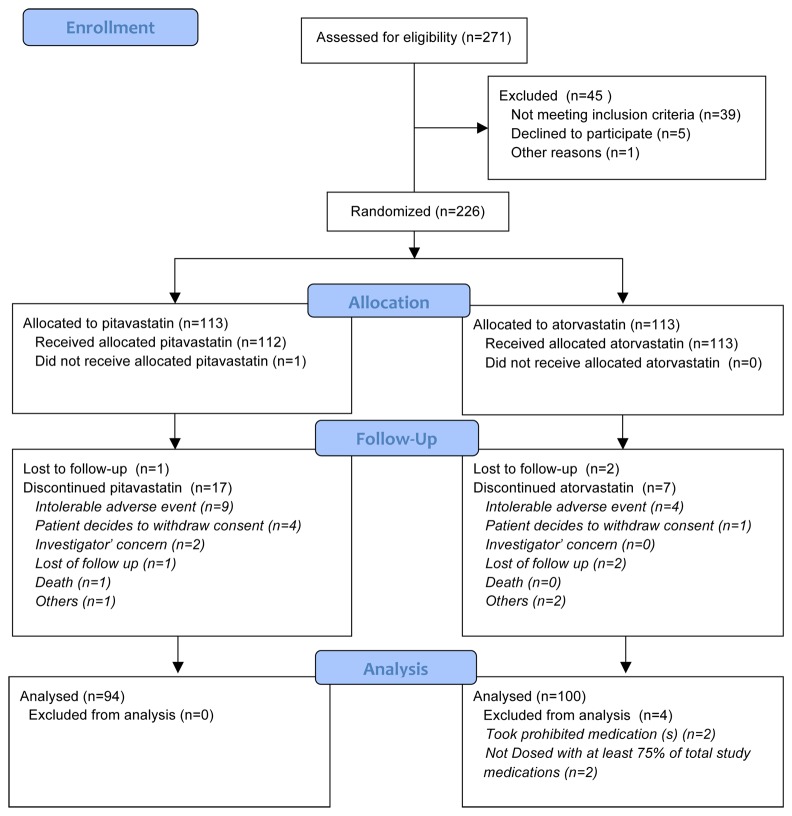
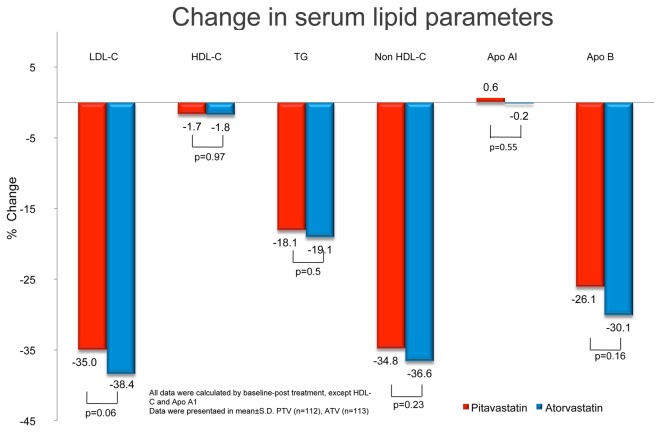
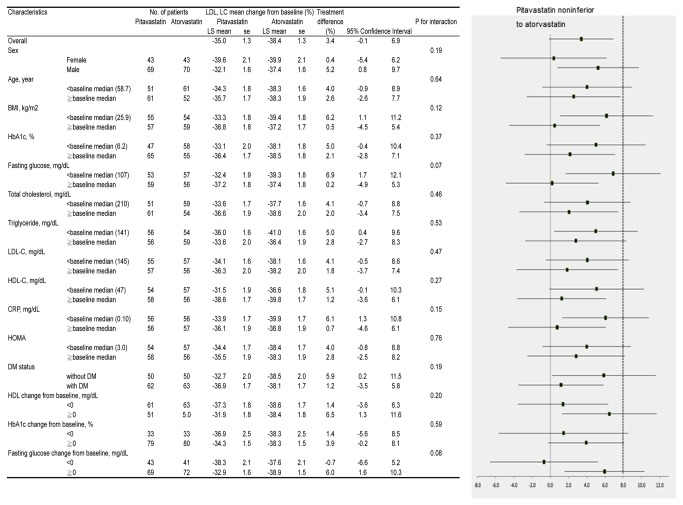
Methods and results: Between July 2011 and April 2012, 251 patients were screened, 225 (mean age: 58.7 ± 8.6; women 38.2% [86/225]) were randomized and treated with pitavastatin (n = 112) or atorvastatin (n = 113) for 12 weeks. Baseline characteristics in both groups were similar, but after 12 weeks of treatment, LDL-C levels were significantly lower: pitavastatin group = -35.0 ± 14.1% and atorvastatin group = -38.4 ± 12.8% (both: p < 0.001). For the subgroup with diabetes mellitus (DM) (n = 125), LDL-C levels (-37.1 ± 12.9% vs. -38.0 ± 13.1%, p = 0.62) were similarly lowered after either pitavastatin (n = 63) or atorvastatin (n = 62) treatment. Triglycerides, non-high density lipoprotein cholesterol, and apoprotein B were similarly and significantly lower in both treatment groups. In non-lipid profiles, HOMA-IR and insulin levels were higher to a similar degree in both statin groups. Hemoglobin A1C was significantly (p = 0.001) higher in the atorvastatin group but not in the pitavastatin group. Both statins were well tolerated, and both groups had a similar low incidence of treatment-emergent adverse events.
Conclusion: Both pitavastatin (2 mg/day) and atorvastatin (10 mg/day) were well tolerated, lowered LDL-C, and improved the lipid profile to a comparable degree in high-risk Taiwanese patients with hypercholesterolemia.
Trial registration: ClinicalTrials.gov NCT01386853 http://clinicaltrials.gov/ct2/show/NCT01386853?term=NCT01386853&rank=1.
Conflict of interest statement
Figures
References
-
- Shepherd J, Cobbe SM, Ford I, Isles CG, Lorimer AR et al. (1995) Prevention of coronary heart disease with pravastatin in men with hypercholesterolemia. N Engl J Med 333: 1301-1307. doi:10.1056/NEJM199511163332001. PubMed: 7566020. - DOI - PubMed
-
- Lu W, Resnick HE, Jablonski KA, Jones KL, Jain AK et al. (2003) Non-HDL cholesterol as a predictor of cardiovascular disease in type 2 diabetes: the strong heart study. Diabetes Care 26: 16-23. doi:10.2337/diacare.26.1.16. PubMed: 12502653. - DOI - PubMed
-
- Panel Expert Detection on, Evaluation, and Treatment of High Blood Cholesterol in Adults (2001) Executive Summary of The Third Report of The National Cholesterol Education Program (NCEP) Expert Panel on Detection, Evaluation, And Treatment of High Blood Cholesterol In Adults (Adult Treatment Panel III). JAMA 285: 2486-2497. doi:10.1001/jama.285.19.2486. PubMed: 11368702. - DOI - PubMed
-
- Colhoun HM, Betteridge DJ, Durrington PN, Hitman GA, Neil HA et al. (2004) Primary prevention of cardiovascular disease with atorvastatin in type 2 diabetes in the Collaborative Atorvastatin Diabetes Study (CARDS): multicentre randomised placebo-controlled trial. Lancet 364: 685-696. doi:10.1016/S0140-6736(04)16895-5. PubMed: 15325833. - DOI - PubMed
Publication types
MeSH terms
Substances
Associated data
LinkOut - more resources
Full Text Sources
Other Literature Sources
Medical
Miscellaneous
