


Prevalence and associated factors of glaucoma in rural central India. The Central India Eye and Medical Study
- PMID: 24098790
- PMCID: PMC3787001
- DOI: 10.1371/journal.pone.0076434
Prevalence and associated factors of glaucoma in rural central India. The Central India Eye and Medical Study
Abstract
Purpose: To assess the prevalence of glaucoma in rural Central India.
Methods: The population-based Central India Eye and Medical Study is a population-based study performed in a rural region of Central India. The study included 4711 subjects (aged 30+ years). A detailed ophthalmic and medical examination was performed. Glaucoma was defined by glaucomatous optic disc morphology, and in a second step, by the criteria of the International Society of Geographical and Epidemiological Ophthalmology (ISGEO).
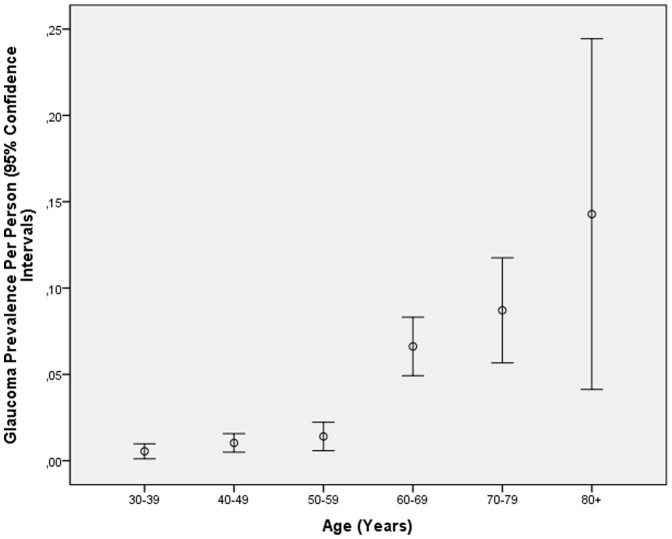
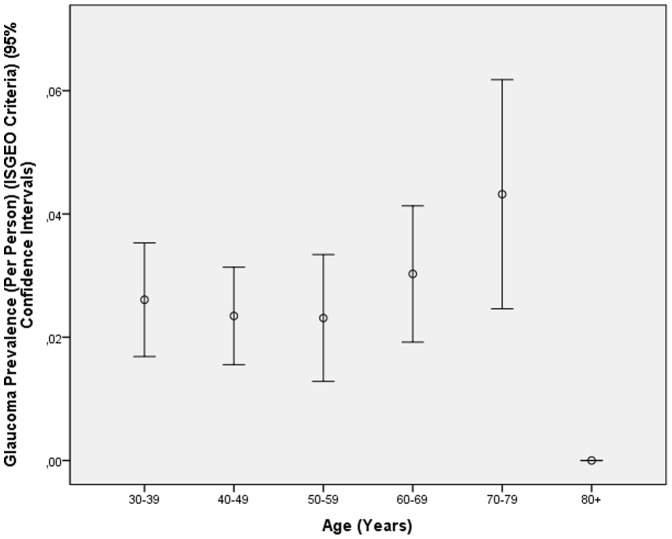
Results: Optic disc photographs were available for 4570 (97.0%) subjects. Glaucoma was detected in 122 subjects (51 unilateral) (2.67% (95%CI: 2.20, 3.14). Glaucoma prevalence for the age groups of 30-39yrs, 40-49yrs, 50-59yrs, 60-69yrs, 70-79yrs, and 80+ years was 0.54% (95%CI: 0.11, 0.98), 1.03% (95%CI: 0.49, 1.57), 1.40% (95%CI: 0.58, 2.23), 6.62% (95%CI: 4.92, 8.31), 8.71% (95%CI: 5.55, 11.75), and 14.3% (95%CI: 4.13, 24.4), respectively. In multivariable analysis, glaucoma was associated with higher age (P<0.001), lower body mass index (P = 0.025), lower blood hemoglobin concentration (P = 0.03), higher intraocular pressure (P<0.001), disc hemorrhages (P<0.001), higher prevalence of myopic retinopathy (P<0.001), lower level of education (P = 0.03), longer axial length (P<0.001), thinner retinal nerve fiber layer (P<0.001), higher vertical cup/disc diameter ratio (P<0.001), and narrow anterior chamber angle (P = 0.02). Ratio of open-angle glaucoma to angle-closure glaucoma was 7.7:1 (1.93% (95%CI: 1.64, 2.22) to 0.24% (95%CI: 0.14, 0.34)). Using the ISGEO criteria, glaucoma prevalence was 2.8% (95%CI: 2.3, 3.3) with a less clear association with older age.
Conclusions: Glaucoma prevalence in remote rural Central India is comparable to other regions. Associated factors were older age, lower body mass index, lower blood concentration of hemoglobin, lower level of education, higher intraocular pressure, disc hemorrhage, myopic retinopathy, and longer axial length. The ratio of open-angle glaucoma to angle-closure glaucoma was about 8:1.
Conflict of interest statement
Figures
References
-
- Leske MC, Connell AM, Wu SY, Hyman LG, Schachat AP (1995) Risk factors for open-angle glaucoma. The Barbados Eye Study. Arch Ophthalmol 113: 918–924. - PubMed
-
- Mitchell P, Hourihan F, Sandbach J, Wang JJ (1999) The relationship between glaucoma and myopia: the Blue Mountains Eye Study. Ophthalmology 106: 2010–2015. - PubMed
-
- Brandt JD, Beiser JA, Kass MA, Gordon MO (2001) Central corneal thickness in the Ocular Hypertension Treatment Study (OHTS). Ophthalmology 108: 1779–1788. - PubMed
-
- Nouri-Mahdavi K, Hoffman D, Coleman AL, Liu G, Li G (2004) Advanced Glaucoma Intervention Study. Predictive factors for glaucomatous visual field progression in the Advanced Glaucoma Intervention Study. Ophthalmology 111: 1627–1635. - PubMed
Publication types
MeSH terms
LinkOut - more resources
Full Text Sources
Other Literature Sources
Medical
