


Impact of telehealth on general practice contacts: findings from the whole systems demonstrator cluster randomised trial
- PMID: 24099334
- PMCID: PMC3852608
- DOI: 10.1186/1472-6963-13-395
Impact of telehealth on general practice contacts: findings from the whole systems demonstrator cluster randomised trial
Abstract
Background: Telehealth is increasingly used in the care of people with long term conditions. Whilst many studies look at the impacts of the technology on hospital use, few look at how it changes contacts with primary care professionals. The aim of this paper was to assess the impacts of home-based telehealth interventions on general practice contacts.
Method: Secondary analysis of data from a Department of Health funded cluster-randomised trial with 179 general practices in three areas of England randomly assigned to offer telehealth or usual care to eligible patients. Telehealth included remote exchange of vitals signs and symptoms data between patients and healthcare professionals as part of the continuing management of patients. Usual care reflected the range of services otherwise available in the sites, excluding telehealth. Anonymised data from GP systems were used to construct person level histories for control and intervention patients. We tested for differences in numbers of general practitioner and practice nurse contacts over twelve months and in the number of clinical readings recorded on general practice systems over twelve months.
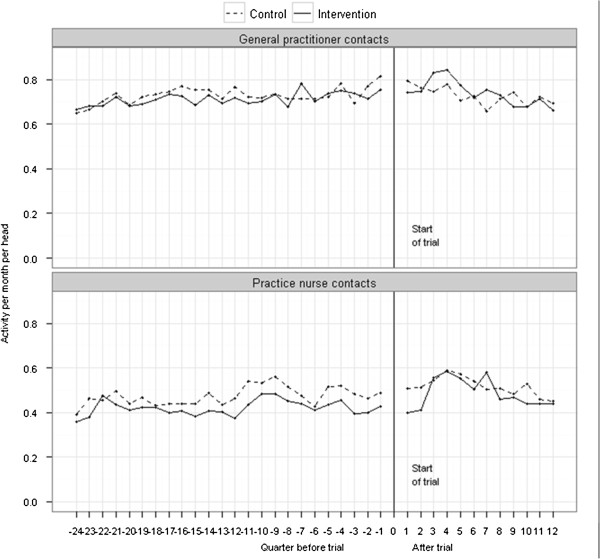
Results: 3,230 people with diabetes, chronic obstructive pulmonary disease or heart failure were recruited in 2008 and 2009. 1219 intervention and 1098 control cases were available for analysis. No statistically significant differences were detected in the numbers of general practitioner or practice nurse contacts between intervention and control groups during the trial, or in the numbers of clinical readings recorded on the general practice systems.
Conclusions: Telehealth did not appear associated with different levels of contact with general practitioners and practice nurses. We note that the way that telehealth impacts on primary care roles may be influenced by a number of other features in the health system. The challenge is to ensure that these systems lead to better integration of care than fragmentation.
Trial registration number: International Standard Randomised Controlled Trial Number Register ISRCTN43002091.
References
-
- Department of Health. Whole system demonstrator programme: headline findings. 2011. Available at: http://www.dh.gov.uk/prod_consum_dh/groups/dh_digitalassets/documents/di... [accessed 2012 07 23]
-
- Henderson C, Knapp M, Fernandez J-L, Beecham J, Hirani SP, Cartwright M, Rixon L. et al. Cost effectiveness of telehealth for patients with long term conditions (whole systems demonstrator telehealth questionnaire study): nested economic evaluation in a pragmatic, cluster randomised controlled trial. BMJ. 2013;346(mar20 4):f1035. doi: 10.1136/bmj.f1035. doi:10.1136/bmj.f1035. - DOI - PubMed
-
- May CR, Finch TL, Cornford J, Exley C, Gately C, Kirk S, Jenkings KN, Osbourne J, Robinson AL, Rogers A, Wilson R, Mair FS. Integrating telecare for chronic disease management in the community: what needs to be done? BMC Health Serv Res. 2011;11:131. doi: 10.1186/1472-6963-11-131. - DOI - PMC - PubMed
Publication types
MeSH terms
Associated data
Grants and funding
LinkOut - more resources
Full Text Sources
Other Literature Sources
Medical
