Offline analysis of context contribution to ERP-based typing BCI performance
- PMID: 24099944
- PMCID: PMC4065780
- DOI: 10.1088/1741-2560/10/6/066003
Offline analysis of context contribution to ERP-based typing BCI performance
Abstract
Objective: We aim to increase the symbol rate of electroencephalography (EEG) based brain-computer interface (BCI) typing systems by utilizing context information.
Approach: Event related potentials (ERP) corresponding to a stimulus in EEG can be used to detect the intended target of a person for BCI. This paradigm is widely utilized to build letter-by-letter BCI typing systems. Nevertheless currently available BCI typing systems still require improvement due to low typing speeds. This is mainly due to the reliance on multiple repetitions before making a decision to achieve higher typing accuracy. Another possible approach to increase the speed of typing while not significantly reducing the accuracy of typing is to use additional context information. In this paper, we study the effect of using a language model (LM) as additional evidence for intent detection. Bayesian fusion of an n-gram symbol model with EEG features is proposed, and a specifically regularized discriminant analysis ERP discriminant is used to obtain EEG-based features. The target detection accuracies are rigorously evaluated for varying LM orders, as well as the number of ERP-inducing repetitions.
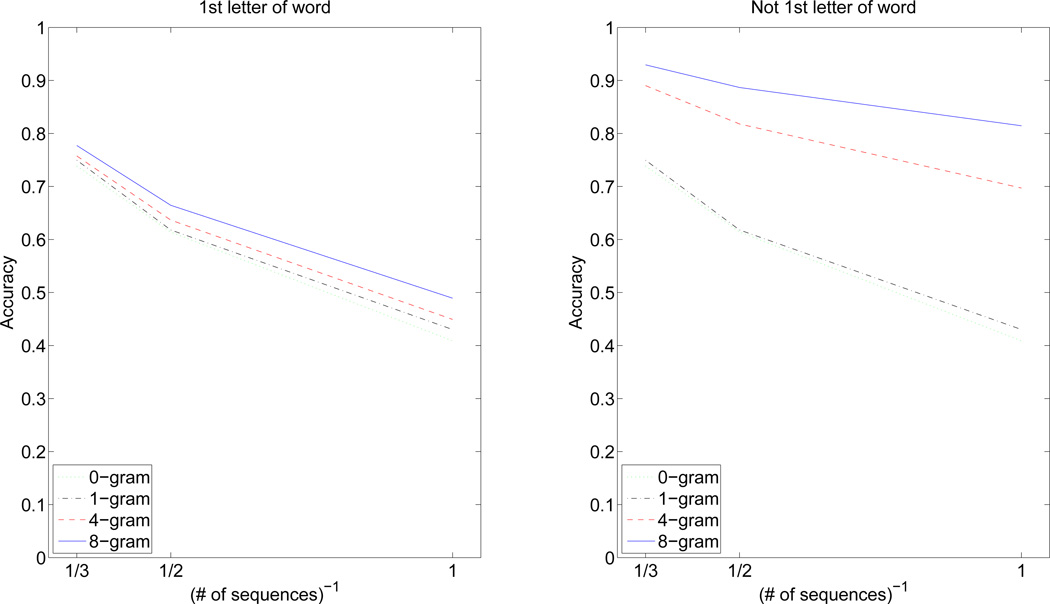
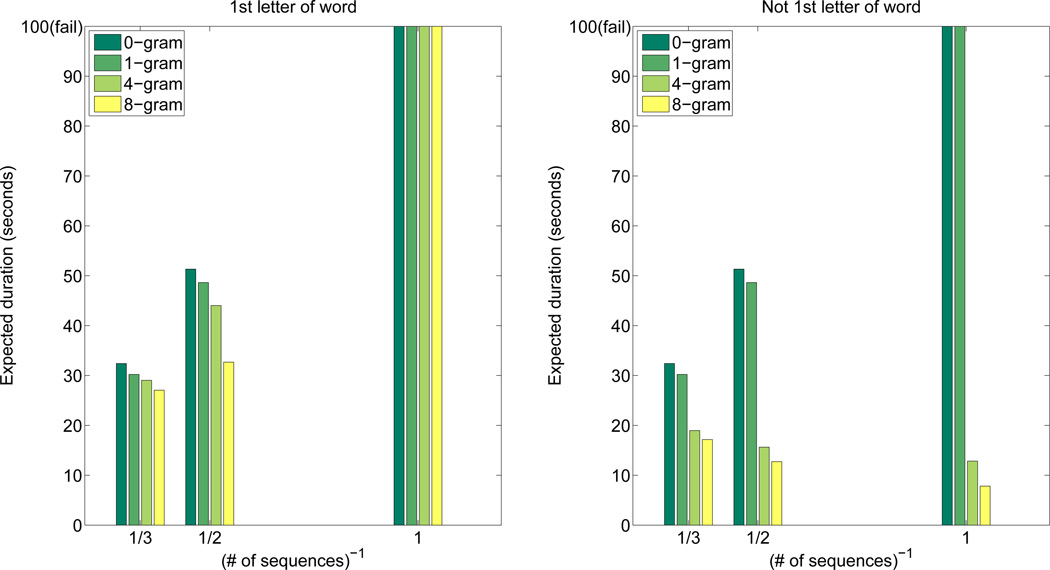
Main results: The results demonstrate that the LMs contribute significantly to letter classification accuracy. For instance, we find that a single-trial ERP detection supported by a 4-gram LM may achieve the same performance as using 3-trial ERP classification for the non-initial letters of words.
Significance: Overall, the fusion of evidence from EEG and LMs yields a significant opportunity to increase the symbol rate of a BCI typing system.
Figures

References
-
- Aloise F, Schettini F, Aricó P, Salinari S, Babiloni F, Cincotti F. A comparison of classification techniques for a gaze-independent p300-based brain–computer interface. Journal of Neural Engineering. 2012;9(4):045012. - PubMed
-
- Brunner P, Bianchi L, Guger C, Cincotti F, Schalk G. Current trends in hardware and software for brain–computer interfaces (BCIs) Journal of Neural Engineering. 2011;8:025001. - PubMed
-
- Cincotti F, Bianchi L, Birch G, Guger C, Mellinger J, Scherer R, Schmidt R, Suarez O, Schalk G. Bci meeting 2005-workshop on technology: hardware and software. Neural Systems and Rehabilitation Engineering, IEEE Transactions on. 2006;14(2):128–131. - PubMed
-
- Dal Seno B, Matteucci M, Mainardi LT. The utility metric: a novel method to assess the overall performance of discrete brain–computer interfaces. Neural Systems and Rehabilitation Engineering, IEEE Transactions on. 2010;18(1):20–28. - PubMed
Publication types
MeSH terms
Grants and funding
LinkOut - more resources
Full Text Sources
Other Literature Sources