


Unveiling the longitudinal association between short sleep duration and the incidence of obesity: the Penn State Cohort
- PMID: 24100421
- PMCID: PMC3954466
- DOI: 10.1038/ijo.2013.172
Unveiling the longitudinal association between short sleep duration and the incidence of obesity: the Penn State Cohort
Abstract
Objective: Several epidemiologic, longitudinal studies have reported that short sleep duration is a risk factor for the incidence of obesity. However, the vast majority of these studies used self-reported measures of sleep duration and did not examine the role of objective short sleep duration, subjective sleep disturbances and emotional stress.
Design: Longitudinal, population-based study.
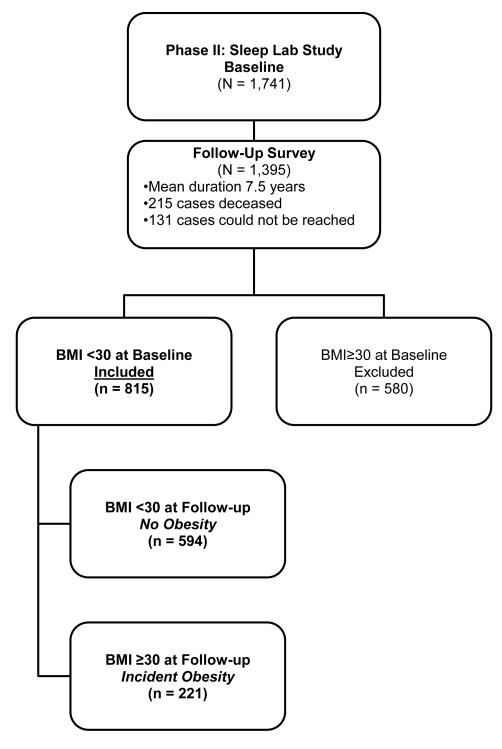
Subjects: We studied a random sample of 815 non-obese adults from the Penn State Cohort in the sleep laboratory for one night using polysomnography (PSG) and followed them up for a mean of 7.5 years. Subjective and objective measures of sleep as well as emotional stress were obtained at baseline. Obesity was defined as a body mass index (BMI) ≥30 kg/ m(-2).
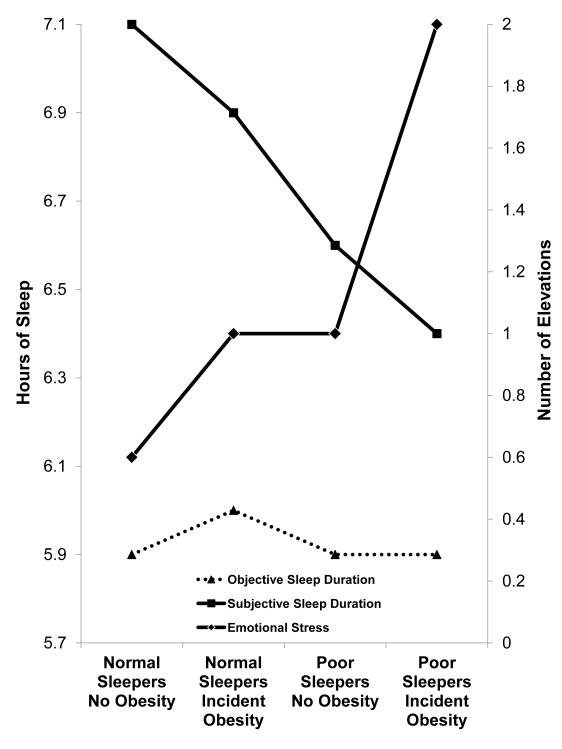
Results: The incidence of obesity was 15% and it was significantly higher in women and in individuals who reported sleep disturbances, shorter sleep duration and higher emotional stress. Significant mediating effects showed that individuals with subjective sleep disturbances who developed obesity reported the shortest sleep duration and the highest emotional stress, and that subjective sleep disturbances and emotional stress were independent predictors of incident obesity. Further analyses revealed that the association between short sleep duration, subjective sleep disturbances and emotional stress with incident obesity was stronger in young and middle-age adults. Objective short sleep duration was not associated with a significantly increased risk of incident obesity.
Conclusion: Self-reported short sleep duration in non-obese individuals at risk of developing obesity is a surrogate marker of emotional stress and subjective sleep disturbances. Objective short sleep duration is not associated with a significant increased risk of incident obesity. The detection and treatment of sleep disturbances and emotional stress should become a target of our preventive strategies against obesity.
Figures
References
-
- Ogden CL, Carroll MD, Kit BK, Flegal KM. Prevalence of Obesity in the United States, data from the National Health and Nutrition Examination Survey, 2009–2010. United States Department of Health and Human Services. Centers for Disease Control and Prevention. National Center for Health Statistics. NCHS Data Brief. 2012;82:1–8.
-
- Zalesin KC, Franklin BA, Miller WM, Peterson ED, McCullough PA. Impact of obesity on cardiovascular disease. Med Clin North Am. 2011;95:919–937. - PubMed
-
- Nielsen LS, Danielsen KV, Sørensen TI. Short sleep duration as a possible cause of obesity: critical analysis of the epidemiological evidence. Obes Rev. 2011;12:78–92. - PubMed
Publication types
MeSH terms
Substances
Grants and funding
LinkOut - more resources
Full Text Sources
Other Literature Sources
Medical
