Efficacy of tecovirimat (ST-246) in nonhuman primates infected with variola virus (Smallpox)
- PMID: 24100494
- PMCID: PMC3837858
- DOI: 10.1128/AAC.00977-13
Efficacy of tecovirimat (ST-246) in nonhuman primates infected with variola virus (Smallpox)
Abstract
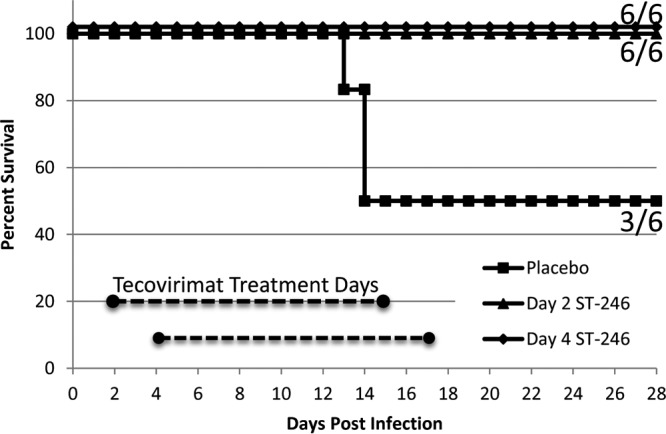
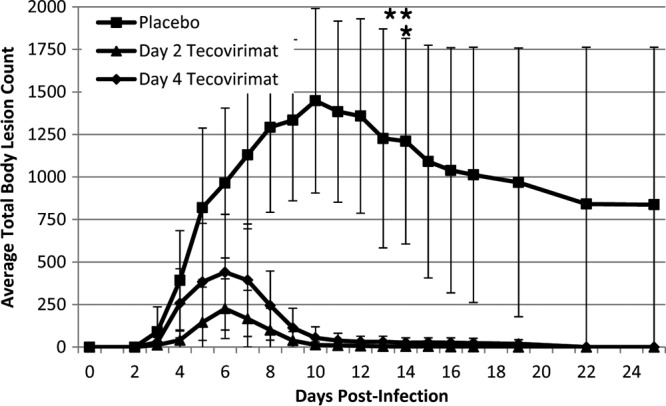
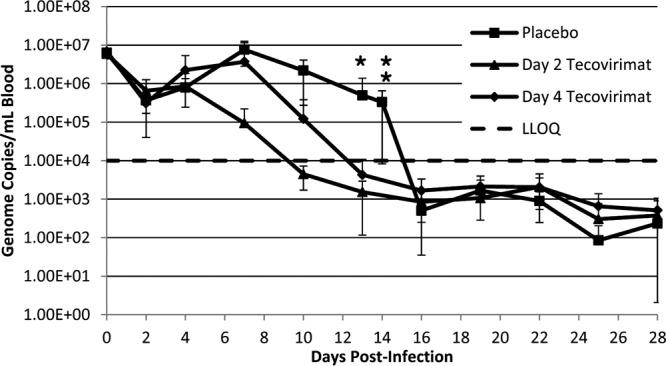
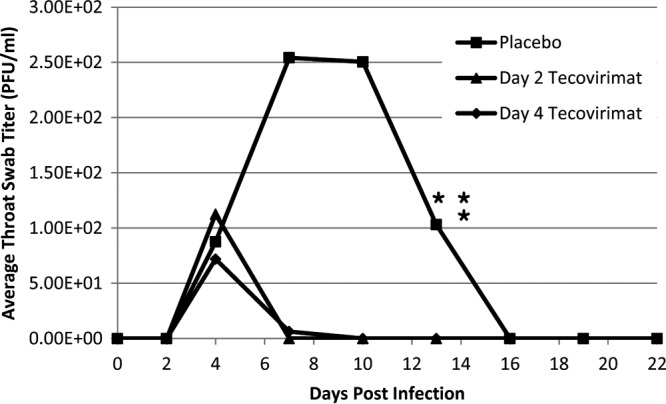
Naturally occurring smallpox has been eradicated but remains a considerable threat as a biowarfare/bioterrorist weapon (F. Fleck, Bull. World Health Organ. 81:917-918, 2003). While effective, the smallpox vaccine is currently not recommended for routine use in the general public due to safety concerns (http://www.bt.cdc.gov/agent/smallpox/vaccination). Safe and effective countermeasures, particularly those effective after exposure to smallpox, are needed. Currently, SIGA Technologies is developing the small-molecule oral drug, tecovirimat (previously known as ST-246), as a postexposure therapeutic treatment of orthopoxvirus disease, including smallpox. Tecovirimat has been shown to be efficacious in preventing lethal orthopoxviral disease in numerous animal models (G. Yang, D. C. Pevear, M. H. Davies, M. S. Collett, T. Bailey, et al., J. Virol. 79:13139-13149, 2005; D. C. Quenelle, R. M. Buller, S. Parker, K. A. Keith, D. E. Hruby, et al., Antimicrob. Agents Chemother., 51:689-695, 2007; E. Sbrana, R. Jordan, D. E. Hruby, R. I. Mateo, S. Y. Xiao, et al., Am. J. Trop. Med. Hyg. 76:768-773, 2007). Furthermore, in clinical trials thus far, the drug appears to be safe, with a good pharmacokinetic profile. In this study, the efficacy of tecovirimat was evaluated in both a prelesional and postlesional setting in nonhuman primates challenged intravenously with 1 × 10(8) PFU of Variola virus (VARV; the causative agent of smallpox), a model for smallpox disease in humans. Following challenge, 50% of placebo-treated controls succumbed to infection, while all tecovirimat-treated animals survived regardless of whether treatment was started at 2 or 4 days postinfection. In addition, tecovirimat treatment resulted in dramatic reductions in dermal lesion counts, oropharyngeal virus shedding, and viral DNA circulating in the blood. Although clinical disease was evident in tecovirimat-treated animals, it was generally very mild and appeared to resolve earlier than in placebo-treated controls that survived infection. Tecovirimat appears to be an effective smallpox therapeutic in nonhuman primates, suggesting that it is reasonably likely to provide therapeutic benefit in smallpox-infected humans.
Figures
References
-
- Barquet N, Domingo P. 1997. Smallpox: the triumph over the most terrible of the ministers of death. Ann. Intern. Med. 127:635–642 - PubMed
-
- Fenner F, Henderson DA, Arita I, Jezek Z, Ladnyi ID. 1988. Smallpox and its eradication. WHO, Geneva, Switzerland
-
- Breman JG, Henderson DA. 2002. Diagnosis and management of smallpox. N. Engl. J. Med. 346:1300–1308 - PubMed
-
- Phadke AM, Samant NR, Dewal SD. 1973. Smallpox as an etiologic factor in male infertility. Fertil. Steril. 24:802–804 - PubMed
-
- Fulginiti VA, Papier A, Lane JM, Neff JM, Henderson DA. 2003. Smallpox vaccination: a review, part II. Adverse events. Clin. Infect. Dis. 37:251–271 - PubMed
Publication types
MeSH terms
Substances
LinkOut - more resources
Full Text Sources
Other Literature Sources