. 2014 Jan:54:197-206.
doi: 10.1016/j.jbior.2013.08.006. Epub 2013 Sep 19.

Phosphatidic acid, phospholipase D and tumorigenesis

Affiliations

Phosphatidic acid, phospholipase D and tumorigenesis

Julian Gomez-Cambronero. Adv Biol Regul. 2014 Jan.

Abstract

Phospholipase D (PLD) is a membrane protein with a double role: maintenance of the structural integrity of cellular or intracellular membranes and involvement in cell signaling through the product of the catalytic reaction, PA, and through protein-protein interaction with a variety of partners. Cross-talk during PLD signaling occurs with other cancer regulators (Ras, PDGF, TGF and kinases). Elevation of either PLD1 or PLD2 (the two mammalian isoforms of PLD) is able to transform fibroblasts and contribute to cancer progression. Elevated total PLD activity, as well as overexpression, is present in a wide variety of cancers such as gastric, colorectal, renal, stomach, esophagus, lung and breast. PLD provides survival signals and is involved in migration, adhesion and invasion of cancer cells, and all are increased during PLD upregulation or, conversely, they are decreased during PLD loss of function. Eventhough the end results of PLD action as relates to downstream signaling mechanisms are still currently being elucidated, invasion, a pre-requisite for metastasis, is directly affected by PLD. This review will introduce the classical mammalian PLD's, PLD1 and PLD2, followed by the mechanisms of intracellular regulation and a status of current investigation in the crucial involvement of PLD in cancer, mostly through its role in cell migration, invasion and metastasis, that has grown exponentially in the last few years.


Conflict of interest statement

Conflict of interest statement

There are no conflicts of interest.

Figures
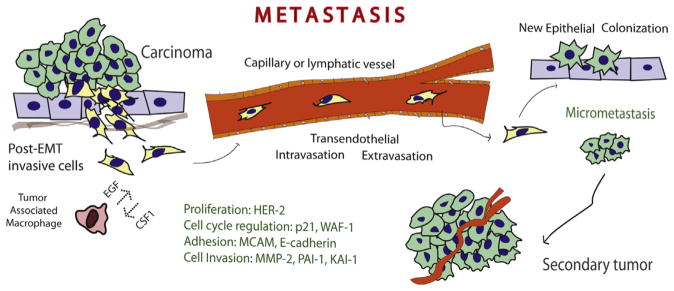
Fig. 1
Fig. 1
The process of metastasis. Post-EMT invasive cells leave the primary tumor and enter the circulatory system via trans-endothelial intravasation where the primary tumor cells migrates to a capillary or the lympatic system and then exits the circulation using transendothelial extravasation. At this point, the migrated epithelial cells colonize new tissue and become micrometastases that eventually develop into full blown tumors.
Fig. 2
Fig. 2
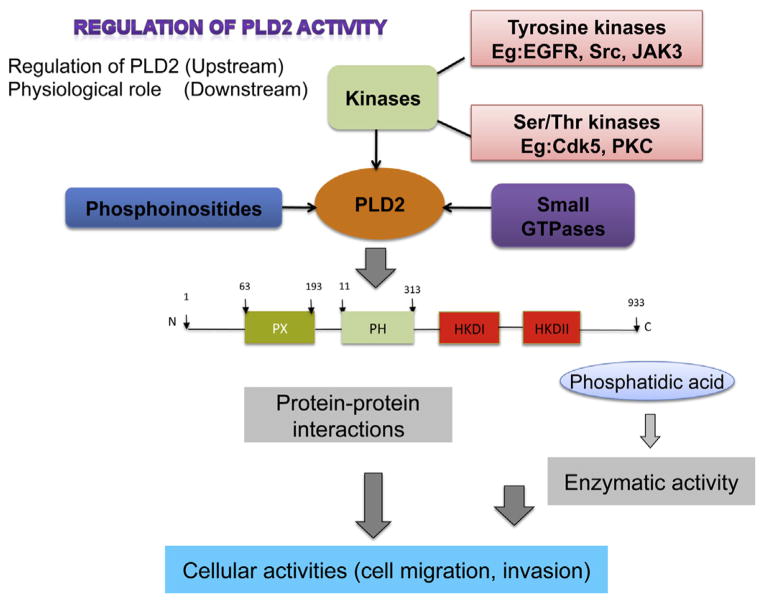
Regulation of PLD2. Tyrosine and/or serine threonine kinases act upstream of PLD and activate it by phosphorylation of certain targeted residues. Phosphoinositides and small GTPases also act on PLD2 signaling pathways. All of these upstream actions ultimately control PLD2’s ability to interact with other protein partners via protein–protein interactions and also modulate its lipase and GEF activities, which effect the downstream targets such as chemotaxis and cell invasion.
Fig. 3
Fig. 3
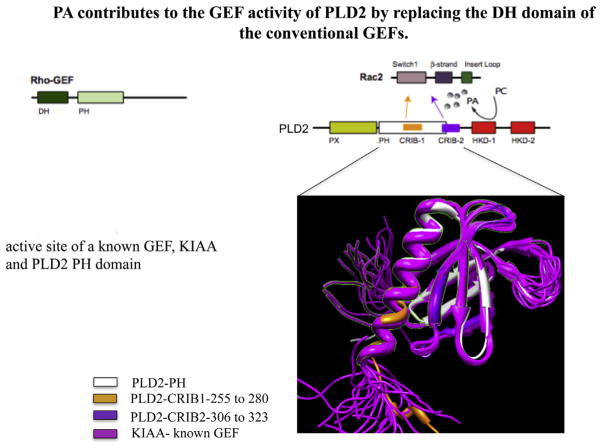
PLD2 as a GEF. We modeled PLD2 structural domains and found that its PH domain aligns with the PH domain of the Rac-GEF, KIAA/SWAP70, including portions where PLD2 can bind to Rac2 through its CRIB domains.

References

    1. Ahn MJ, Park SY, Kim WK, Cho JH, Chang BJ, Kim DJ, et al. A single nucleotide polymorphism in the phospholipase D1 gene is associated with risk of non-small cell lung cancer. Int J Biomed Sci. 2012;8(2):121–8. - PMC - PubMed
    1. Buchanan FG, Mcreynolds M, Couvillon A, Kam Y, Holla VR, Dubois RN, et al. Requirement of phospholipase D1 activity in H-RasV12-induced transformation. Proc Natl Acad Sci USA. 2005;102(5):1638–42. - PMC - PubMed
    1. Chen Q, Hongu T, Sato T, Zhang Y, Ali W, Cavallo JA, et al. Key roles for the lipid signaling enzyme phospholipase d1 in the tumor microenvironment during tumor angiogenesis and metastasis. Sci Signal. 2012;5(249):ra79. - PMC - PubMed
    1. Chen Y, Rodrik V, Foster DA. Alternative phospholipase D/mTOR survival signal in human breast cancer cells. Oncogene. 2005;24(4):672–9. - PubMed
    1. Chen Y, Zheng Y, Foster DA. Phospholipase D confers rapamycin resistance in human breast cancer cells. Oncogene. 2003;22(25):3937–42. - PubMed

Publication types

LinkOut - more resources