Clinical Trial
. 2013 Dec;183(6):1853-1861.
doi: 10.1016/j.ajpath.2013.08.023. Epub 2013 Oct 6.

Decidual natural killer cell interactions with trophoblasts are impaired in pregnancies at increased risk of preeclampsia

Affiliations
Clinical Trial

Decidual natural killer cell interactions with trophoblasts are impaired in pregnancies at increased risk of preeclampsia

Alison E Wallace et al. Am J Pathol. 2013 Dec.

Abstract

Transformation of the uterine spiral arteries (SAs) during pregnancy is critical to support the developing fetus, and is impaired in some pregnancy disorders, including preeclampsia. Decidual natural killer (dNK) cells play a role in SA remodeling, although their interactions with fetal trophoblast remain unclear. A uterine artery Doppler resistance index (RI) in the first trimester of pregnancy can be used as a proxy measure of the extent of SA remodeling; we have used this technique to characterize dNK cells from pregnancies with normal (normal RI) and impaired (high RI) SA remodeling, which display least and highest risk of developing preeclampsia, respectively. We examined the impact of dNK cell secreted factors on trophoblast motility, chemoattraction, and signaling pathways to determine the contribution of dNK cells to SA transformation. We demonstrated that the chemoattraction of the trophoblast by dNK cells is impaired in pregnancies with high RI, as is the ability to induce trophoblast outgrowth from placental villous explants. These processes are dependent on activation of the extracellular signal-regulated kinase 1/2 and phosphatidylinositol 3-kinase-Akt signaling pathways, which were altered in trophoblasts incubated with secreted factors from dNK cells from high RI pregnancies. Therefore, by characterizing pregnancies using uterine artery Doppler RI before dNK cell isolation, we have identified that impaired dNK-trophoblast interactions may lead to poor placentation. These findings have implications for pregnancy pathological conditions, such as preeclampsia.


Figures

Figure 1
Figure 1
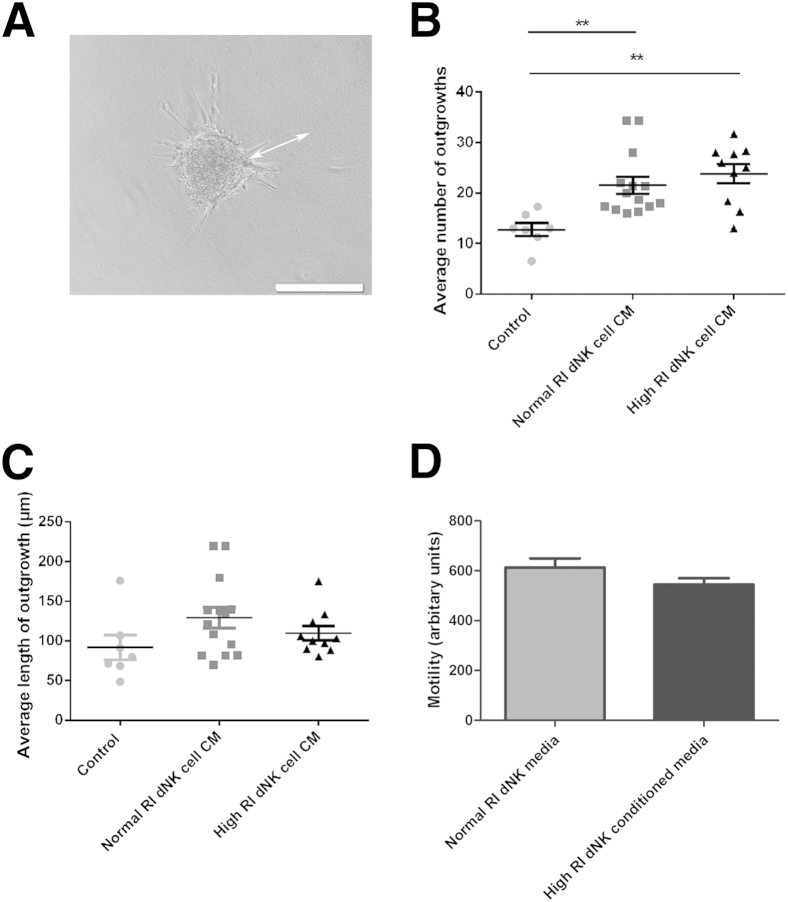
Trophoblast invasion induced by decidual natural killer (dNK) cell conditioned media (CM) does not differ between normal and high RI pregnancies. A: SGHPL-4 cells were cultured to form spheroids as shown and embedded in fibrin gels. The length and number of invasive processes were measured (arrow). B: The average number of invasive process outgrowths of SGHPL-4 cell spheroids increased in response to normal and high resistance index (RI) dNK cell conditioned media from individual patients compared with control culture media. ∗∗P < 0.01. C: The average length of invasive process outgrowths of SGHPL-4 cell spheroids does not differ in response to normal and high RI dNK cell CM from individual patients compared with control culture media. Invasion assay data shown are means ± SEM. Mean gestational ages are as follows: normal, 74.90 ± 2.46 days; high, 74.92 ± 3.31 days. D: Motility of SGHPL-4 cells incubated with normal RI dNK cell CM or high RI dNK cell CM (arbitrary units, as assessed by time-lapse microscopy). Motility assay data shown are means ± SEM. Mean gestational ages are as follows: normal, 73.63 ± 3.7 days; high, 72.1 ± 2.8 days.
Figure 2
Figure 2
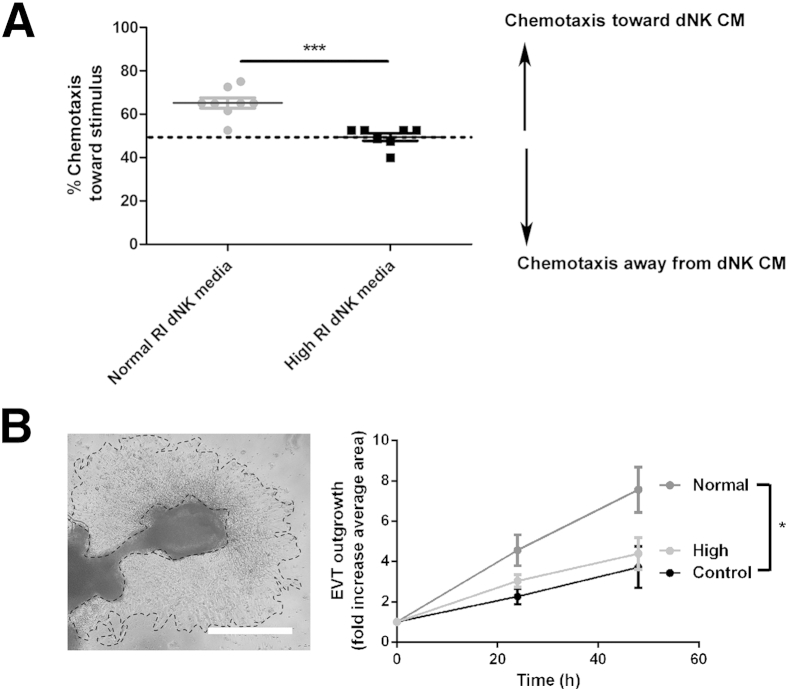
High resistance index (RI) decidual natural killer (dNK) cell secreted factors do not chemoattract trophoblasts or induce significant extravillous trophoblast (EVT) outgrowth from placental villous tissue. A: SGHPL-4 cells were cultured in chemotaxis chambers to analyze chemotactic capacity of normal RI dNK cell conditioned media (CM) and high RI dNK cell CM. Nondirected movement gives expected chemotaxis of 50% of cells. Normal RI dNK CM is significantly more chemotactic to SGHPL-4 cells than high RI dNK CM. Data shown are means ± SEM. Mean gestational ages are as follows: normal RI dNK cell CM, 73.63 ± 3.7 days; high RI dNK cell CM, 72.1 ± 2.8 days. B: EVT explant outgrowth from villous tissue was incubated with control media, normal RI dNK cell CM, and high RI dNK cell conditioned media, and outgrowth area measured by manual tracing as shown. Normal RI dNK cell CM induced significantly increased EVT outgrowth at 24 and 48 hours compared with control and dNK cell CM. High RI dNK cell CM did not significantly induce explant outgrowth. Scale bar = 500 μm. Data shown are means ± SEM. Mean gestational ages are as follows: normal RI dNK cell CM, 75.42 ± 2.7 days; high RI dNK cell CM, 74.07 ± 2.0 days. P < 0.05; ∗∗∗P < 0.01.
Figure 3
Figure 3
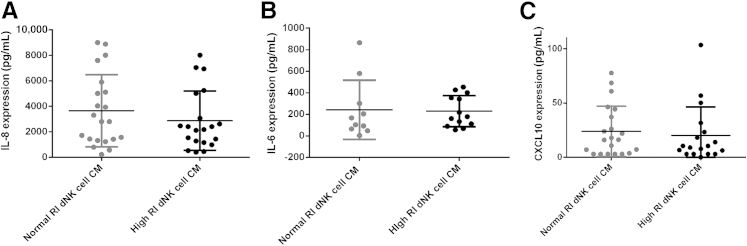
Expression of IL-8, IL-6, and CXCL10 is not significantly altered between normal resistance index (RI) and high RI decidual natural killer (dNK) cell conditioned media (CM). Expression of IL-8 (A), IL-6 (B), and CXCL10 (C) was examined by ELISA in normal and high RI dNK cell CM. Expression levels were not found to be significantly different between high and normal RI dNK cell CM. Data shown are means ± SEM. Mean gestational ages are as follows: IL-8 and CXCL10: normal RI dNK cell CM, 75 ± 2.4 days; high RI dNK cell CM, 73.72 ± 1.6 days; IL-6: normal RI dNK cell CM, 79.7 ± 3.8 days; high RI dNK cell CM, 74.2 ± 1.8 days.
Figure 4
Figure 4
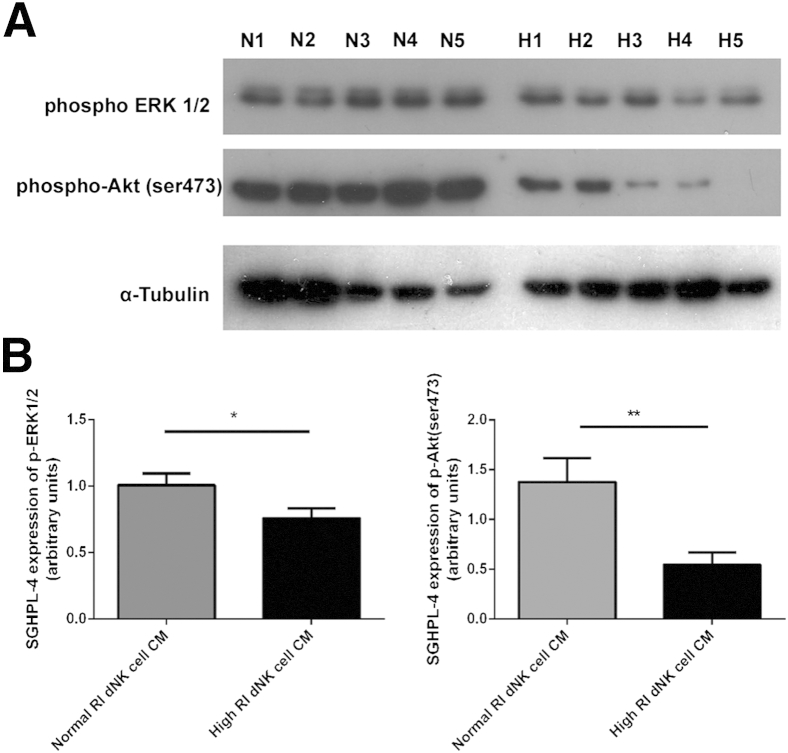
SGHPL-4 cell incubation with normal resistance index (RI) decidual natural killer (dNK) cell conditioned media (CM). differentially phosphorylates ERK1/2 and AKTser473 compared with high RI dNK cell CM. A: SGHPL-4 cells were incubated with normal RI dNK cell CM (N1 to N5) and high RI dNK cell CM (H1 to H5) for 4 hours before total protein was subjected to Western blot analysis for the phosphorylation of ERK1/2 and Akt (n = 8). B: Densitometry of Western blot analysis of phospho-ERK1/2 and phospho-Aktser473 in SGHPL-4 cells incubated with normal RI dNK cell CM and high RI dNK cell CM for 4 hours. Data shown are means ± SEM. P < 0.05, ∗∗P < 0.01.
Figure 5
Figure 5
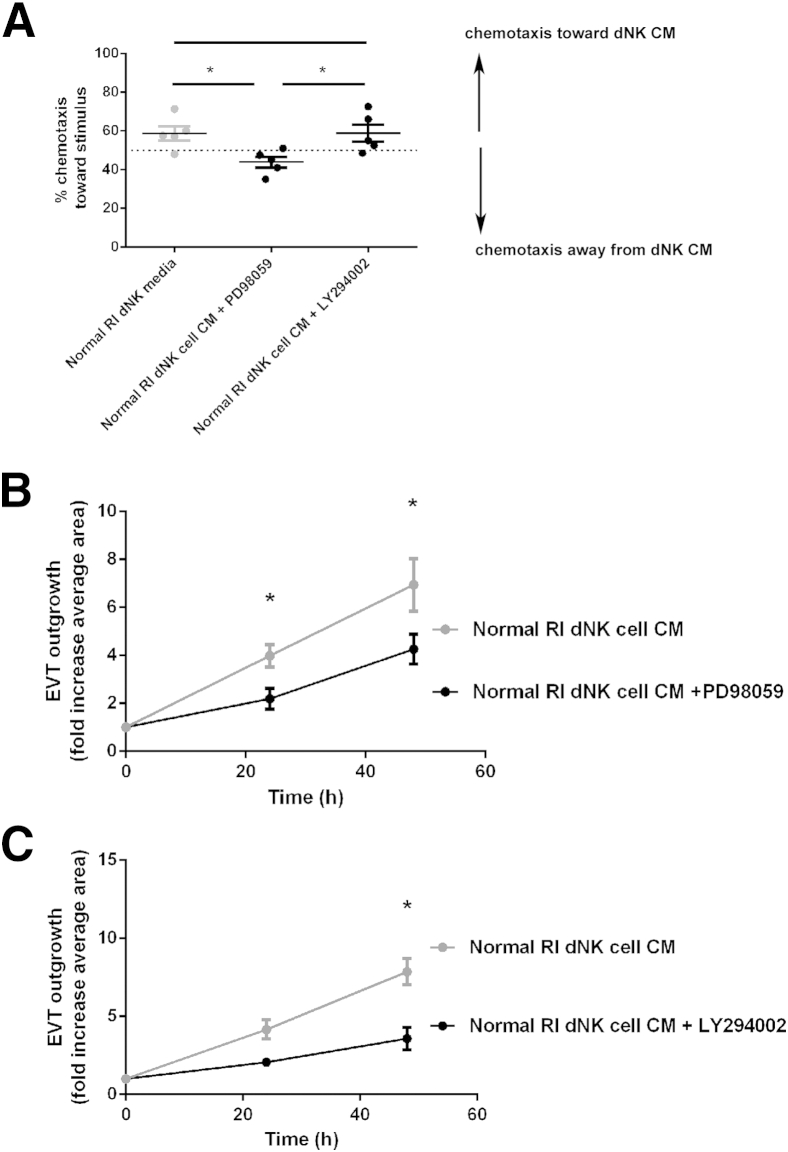
The effect of inhibition of the ERK1/2 and PI3K-Akt signaling pathways on trophoblast chemotaxis and extravillous trophoblast (EVT) outgrowth in the presence of normal resistance index (RI) decidual natural killer (dNK) cell conditioned media (CM). A: SGHPL-4 cells were cultured in chemotaxis chambers to analyze chemotactic capacity of normal RI dNK cell CM in the presence of the ERK1/2 inhibitor, PD98059, and the PI3K inhibitor, LY294002. Nondirected movement gives expected chemotaxis of 50% of cells. The ERK1/2 inhibitor, PD98059, significantly decreased chemotaxis compared with normal RI dNK CM with vehicle control or the PI3K inhibitor, LY294002. Data shown are means ± SEM. The mean gestational age of dNK cell CM is 76 ± 3.8 days. B: EVT explant outgrowth from villous tissue incubated with normal RI dNK cell CM in the presence of vehicle control or the ERK1/2 inhibitor, PD98059. EVT outgrowth induced by normal RI dNK cell CM is significantly inhibited in the presence of PD98059 at 24 and 48 hours compared with normal RI dNK cell CM in the presence of vehicle control. C: EVT explant outgrowth from villous tissue incubated with normal RI dNK cell CM in the presence of vehicle control or the PI3K inhibitor, LY294002. EVT outgrowth induced by normal RI dNK cell CM is significantly inhibited in the presence of LY294002 at 48 hours compared with normal RI dNK cell CM in the presence of vehicle control. Data shown are means ± SEM. The mean gestational ages are as follows: normal RI dNK cell CM, 75.42 ± 2.7 days; high RI dNK cell CM, 74.07 ± 2.0 days. P < 0.05.

References

    1. Pijnenborg R., Vercruysse L., Brosens I. Deep placentation. Best Pract Res Clin Obstet Gynaecol. 2011;25:273–285. - PubMed
    1. Ashton S.V., Whitley G.S., Dash P.R., Wareing M., Crocker I.P., Baker P.N., Cartwright J.E. Uterine spiral artery remodeling involves endothelial apoptosis induced by extravillous trophoblasts through Fas/FasL interactions. Arterioscler Thromb Vasc Biol. 2005;25:102–108. - PMC - PubMed
    1. Keogh R.J., Harris L.K., Freeman A., Baker P.N., Aplin J.D., Whitley G.S., Cartwright J.E. Fetal-derived trophoblast use the apoptotic cytokine tumor necrosis factor-alpha-related apoptosis-inducing ligand to induce smooth muscle cell death. Circ Res. 2007;100:834–841. - PubMed
    1. Bulmer J.N., Innes B.A., Levey J., Robson S.C., Lash G.E. The role of vascular smooth muscle cell apoptosis and migration during uterine spiral artery remodeling in normal human pregnancy. FASEB J. 2012;26:2975–2985. - PubMed
    1. Wallace A.E., Cartwright J.E., Begum R., Laing K., Thilaganathan B., Whitley G.S. Trophoblast-induced changes in C-x-C motif chemokine 10 expression contribute to vascular smooth muscle cell dedifferentiation during spiral artery remodeling. Arterioscler Thromb Vasc Biol. 2013;33:e93–e101. - PubMed

Publication types

MeSH terms

Substances