Clinical review: The role of the parent compound vitamin D with respect to metabolism and function: Why clinical dose intervals can affect clinical outcomes
- PMID: 24106283
- PMCID: PMC3849670
- DOI: 10.1210/jc.2013-2653
Clinical review: The role of the parent compound vitamin D with respect to metabolism and function: Why clinical dose intervals can affect clinical outcomes
Abstract
Context: There is no doubt that vitamin D must be activated to the hormonal form 1,25-dihydroxyvitamin D to achieve full biological activity or that many tissues participate in this activation process-be it endocrine or autocrine. We believe that not only is 25-hydroxyvitamin D important to tissue delivery for this activation process, but also that intact vitamin D has a pivotal role in this process.
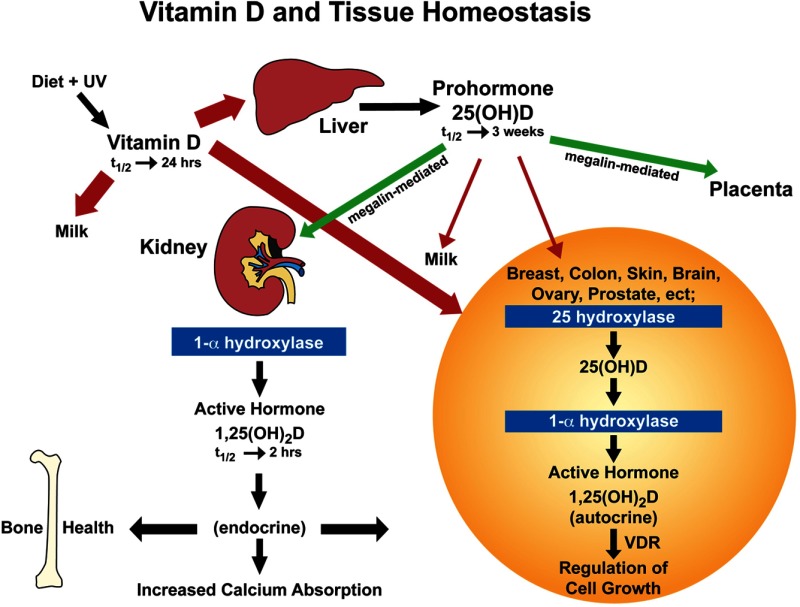
Objective: In this review, evidence on the vitamin D endocrine/autocrine system is presented and discussed in relation to vitamin D-binding protein affinity, circulating half-lives, and enzymatic transformations of vitamin D metabolites, and how these affect biological action in any given tissue.
Conclusions: Circulating vitamin D, the parent compound, likely plays an important physiological role with respect to the vitamin D endocrine/autocrine system, as a substrate in many tissues, not originally thought to be important. Based on emerging data from the laboratory, clinical trials, and data on circulating 25-hydroxyvitamin D amassed during many decades, it is likely that for the optimal functioning of these systems, significant vitamin D should be available on a daily basis to ensure stable circulating concentrations, implying that variation in vitamin D dosing schedules could have profound effects on the outcomes of clinical trials because of the short circulating half-life of intact vitamin D.
Figures
References
-
- Wolf G. The discovery of vitamin D: the contribution of Adolf Windaus. J Nutr. 2004;134:1299–1302 - PubMed
-
- Fraser DR, Kodicek E. Unique biosynthesis by kidney of a biological active vitamin D metabolite. Nature. 1970;228:764–766 - PubMed
-
- Lawson DE, Fraser DR, Kodicek E, Morris HR, Williams DH. Identification of 1,25-dihydroxycholecalciferol, a new kidney hormone controlling calcium metabolism. Nature. 1971;230:228–230 - PubMed
Publication types
MeSH terms
Substances
Grants and funding
LinkOut - more resources
Full Text Sources
Other Literature Sources
Medical