. 2013 Oct 3:7:133.
doi: 10.3389/fncom.2013.00133. eCollection 2013.

A large-scale neural network model of the influence of neuromodulatory levels on working memory and behavior

Affiliations

A large-scale neural network model of the influence of neuromodulatory levels on working memory and behavior

Michael C Avery et al. Front Comput Neurosci. .

Abstract

The dorsolateral prefrontal cortex (dlPFC), which is regarded as the primary site for visuospatial working memory in the brain, is significantly modulated by dopamine (DA) and norepinephrine (NE). DA and NE originate in the ventral tegmental area (VTA) and locus coeruleus (LC), respectively, and have been shown to have an "inverted-U" dose-response profile in dlPFC, where the level of arousal and decision-making performance is a function of DA and NE concentrations. Moreover, there appears to be a sweet spot, in terms of the level of DA and NE activation, which allows for optimal working memory and behavioral performance. When either DA or NE is too high, input to the PFC is essentially blocked. When either DA or NE is too low, PFC network dynamics become noisy and activity levels diminish. Mechanisms for how this is occurring have been suggested, however, they have not been tested in a large-scale model with neurobiologically plausible network dynamics. Also, DA and NE levels have not been simultaneously manipulated experimentally, which is not realistic in vivo due to strong bi-directional connections between the VTA and LC. To address these issues, we built a spiking neural network model that includes D1, α2A, and α1 receptors. The model was able to match the inverted-U profiles that have been shown experimentally for differing levels of DA and NE. Furthermore, we were able to make predictions about what working memory and behavioral deficits may occur during simultaneous manipulation of DA and NE outside of their optimal levels. Specifically, when DA levels were low and NE levels were high, cues could not be held in working memory due to increased noise. On the other hand, when DA levels were high and NE levels were low, incorrect decisions were made due to weak overall network activity. We also show that lateral inhibition in working memory may play a more important role in increasing signal-to-noise ratio than increasing recurrent excitatory input.

Keywords: dopamine; neuromodulation; noradrenaline; spiking neural networks; working memory.


Figures
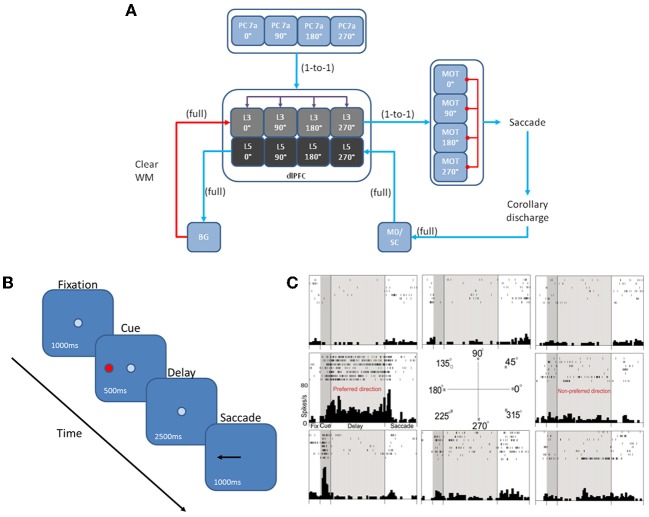
Figure 1
Figure 1
Network architecture, experiment, and neural responses. (A) The model contained 4 input areas (PC 7a) that projected topographically to layer 3 of four cortical columns (that is, PC neurons coding for 180° projected to layer 3 neurons coding for 180°). The layer 3 neurons also outputted topographically to motor output areas in order to bias motor responses. Layer 5 neurons in each cortical layer received input from the MD/SC in a non-topographic manner. These neurons, in turn, projected to a basal ganglia layer in order to clear working memory after a behavioral response was made. (B) We modeled our experiment after the oculomotor delayed response (ODR) behavioral paradigm. This task is broken down into four stages: fixation, cue, delay, and response. The subject must fixate on a visual screen until a cue is briefly presented. After the cue is flashed there is a delay period (2.5 s in our model) during which the subject must remember where the cue was. Lastly, the subject must saccade to the place on the screen where the subject thought the cue was presented. (C) Typical response of a recorded neuron in the ODR task. As you can see, the neuron in this case shows persistent activity when a cue is presented at 180°. This is considered the neurons “preferred direction.” This neuron is non-responsive to cues at other spatial locations (non-preferred directions) [adapted from Wang et al. (2007)].
Figure 2
Figure 2
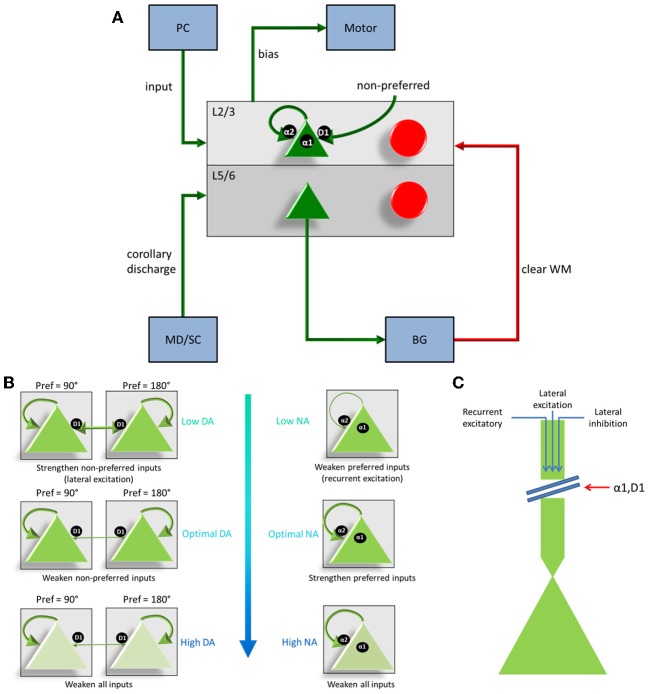
Individual column architecture and neuromodulatory effects. (A) Within a column in the PFC, neuromodulators were modeled by changing the strength of recurrent excitatory inputs (α2A receptors), inputs from non-preferred directions (D1 receptors), and the overall inputs to the neurons (D1 and α1 receptors) depending on concentrations of dopamine and norepinephrine. As in Figure 1, this architecture also shows how layer 5 neurons in each column received input from the MD/SC and output to the basal ganglia in order to clear working memory. (B) On the left and right we show the affects that dopamine and norepinephrine levels have on layer 3 neurons in the columns of our model. When DA is low (top left), connections between columns (non-preferred excitatory inputs) are enhanced, which leads to degradation in spatial tuning. When NE is low (top, right) recurrent excitatory connections are weakened leading to weak firing rates. At optimal levels of DA and NE, non-preferred inputs are blocked from other columns and recurrent excitatory inputs within a column are enhanced. This enhances spatial tuning with the working memory circuits. When DA or NE are high, D1 receptors or α1, respectively weaken all inputs to neurons in layer 3 of the cortical columns. (C) Figure demonstrating, in detail, how activation of α1 or overactivation of D1 receptors can block all inputs to layer 3 neurons, including recurrent excitatory inputs within a column, lateral excitatory inputs from other columns, and lateral inhibitory inputs from other columns.
Figure 3
Figure 3
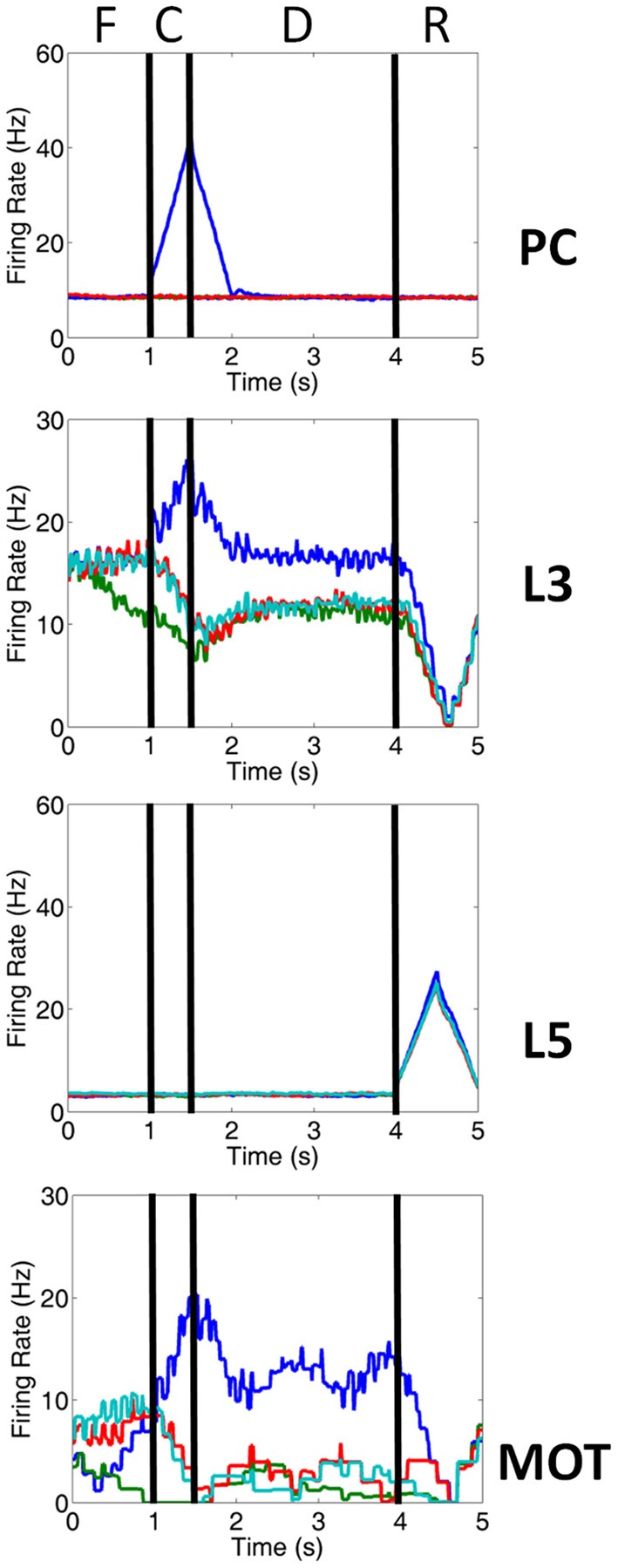
Firing rate activity of neurons in the PC, PFC, and MOT for a single trial. Typical firing rate activity of PC, layer 3, layer 5 and MOT neurons during a single working memory trial when DA and NE levels were optimal. PC neurons encoding the preferred direction (blue) are briefly activated when the cue is presented. Layer 3 neurons then hold onto this direction in working memory and drive neurons in the motor response layer, MOT. Layer 5 neurons, on the other hand, fire during the response phase of the task due to a corollary discharge mediated by the MD/SC and clear working memory in layer 3. Fixation (F), cue (C), delay (D) and response (R) periods are indicated at the top. Firing rates were smoothed using a simple moving average.
Figure 4
Figure 4
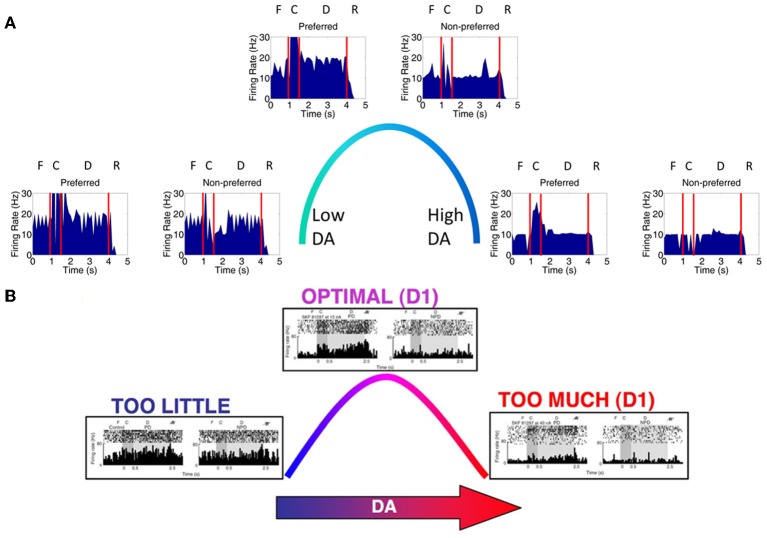
Inverted-U dose-response with changing DA levels. (A) Plot showing average firing rate summed over all neurons in layer 3 in a single trial. When DA levels were varied from low to high, we saw changes in the firing rate of working memory neurons that were consistent with those found experimentally. When DA levels were low, D1 receptors were only weakly activated causing an increase in the strength between columns (i.e., between non-preferred inputs). This lead to a degradation of spatial tuning as can be seen by both preferred (column encoding 0° in the model) and non-preferred (column encoding 90° in the model) columns showing high firing rates (left). The firing rates of preferred direction neurons vs. non-preferred direction neurons during the delay period were not significantly different (p > 0.1; t-test). When DA levels were high (right), all inputs to neurons in the PFC network were partially blocked due to D1 receptor over-stimulation, leading to a decrease firing rate to both preferred and non-preferred neurons (p > 0.1; t-test). When DA levels were optimal, preferred neuron firing rates were higher than non-preferred neurons as is characteristic in successful working memory traces (p < 10−8; t-test). (B) Experimental results obtained from Vijayraghavan et al. (2007); Arnsten (2011) showing a similar inverted-U with varying DA levels.
Figure 5
Figure 5
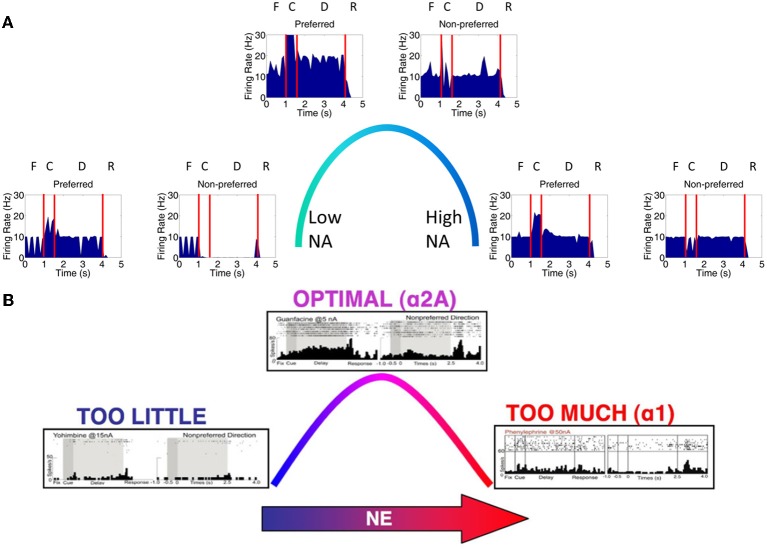
Inverted-U dose-response with changing NE levels. (A) When NE levels were varied from low to high, we saw changes in the firing rate of working memory neurons that were consistent with those found experimentally. When NE levels were low (left), α2A receptors were only weakly activated causing a decrease in the strength of recurrent connections within a column and, ultimately, a degradation of working memory as can be seen by the low firing rates in both preferred (column 1) and non-preferred (column 2) neurons. The firing rates of preferred direction neurons vs. non-preferred direction neurons during the delay period were significantly different since non-preferred direction neurons showed no response at all (p < 10−8; t-test). When NE levels were high (right), all inputs to neurons in the PFC network were partially blocked due to α1 receptor stimulation, leading to a decrease firing rate to both preferred and non-preferred neurons (p > 0.05; t-test). When NE levels were optimal, preferred neuron firing rates were higher than non-preferred neurons as is characteristic in successful working memory traces (p < 10−8; t-test). Note that the optimal and high NE conditions are the same as in Figure 4A due to the fact that identical neuromodulatory changes in the network are imposed in each of these states. (B) Experimental results from Birnbaum et al. (2004); Wang et al. (2007); Arnsten (2011) showing a similar inverted-U response with varying NE levels.
Figure 6
Figure 6
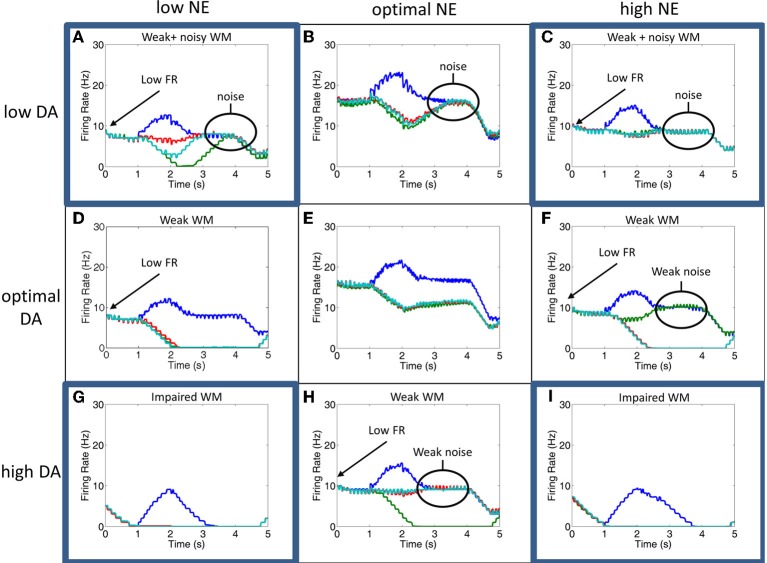
Simultaneous alteration of NE and DA levels. Figure shows firing rates for the all neurons of the four columns for low, optimal, and high concentrations of DA and NE. The column encoding the 0° saccade direction is shown in blue, 90° saccade direction in green, 180° in red and 270° in teal. Panels (B,E,H) and (D–F) are averages of the results seen in Figures 5, 6, respectively. The four corner conditions include: low DA + low NE (A), low DA + high NE (C), high DA + low NE (G), and high NE + high DA (I). To our knowledge, these four conditions have not been experimentally tested. Firing rates were smoothed using a simple moving average.
Figure 7
Figure 7
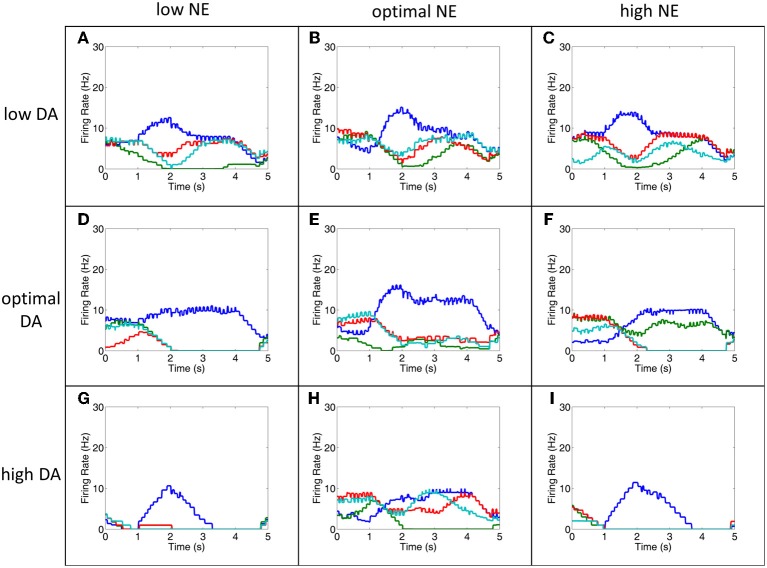
The MOT filters out noise to improve behavioral performance. This figure shows the firing rates of all MOT neurons for a single trial. During low DA (A–C), optimal DA + high NE (F) and optimal NE + high DA (H) conditions, working memory in the PFC is extremely noisy and it is difficult to differentiate which of the columns would correctly drive the motor response (D,E,G,I do not show significant noise). As can be seen in this figure, however, some of this noise is filtered out in the MOT with lateral inhibition. Lateral inhibition allows the initially strong response from the preferred direction (blue, in these cases) to dominate and win out over other directions. This suggests that lateral inhibition may be a means for the MOT to improve behavioral performance even noise in the PFC is high. Firing rates were smoothed using a simple moving average.

References

    1. Arnsten A. F. (2009). Stress signalling pathways that impair prefrontal cortex structure and function. Nat. Rev. Neurosci. 10, 410–422 10.1038/nrn2648 - DOI - PMC - PubMed
    1. Arnsten A. F. (2011). Catecholamine influences on dorsolateral prefrontal cortical networks. Biol. Psychiatry 69, e89–e99 10.1016/j.biopsych.2011.01.027 - DOI - PMC - PubMed
    1. Arnsten A. F., Paspalas C. D., Gamo N. J., Yang Y., Wang M. (2010). Dynamic network connectivity: a new form of neuroplasticity. Trends Cogn. Sci. 14, 365–375 10.1016/j.tics.2010.05.003 - DOI - PMC - PubMed
    1. Arnsten A. F., Wang M. J., Paspalas C. D. (2012). Neuromodulation of thought: flexibilities and vulnerabilities in prefrontal cortical network synapses. Neuron 76, 223–239 10.1016/j.neuron.2012.08.038 - DOI - PMC - PubMed
    1. Avery M. C., Nitz D. A., Chiba A. A., Krichmar J. L. (2012). Simulation of cholinergic and noradrenergic modulation of behavior in uncertain environments. Front. Comput. Neurosci. 6:5 10.3389/fncom.2012.00005 - DOI - PMC - PubMed