Meta-Analysis
. 2013 Oct 10:14:217.
doi: 10.1186/1471-2369-14-217.

An update on the impact of pre-transplant transfusions and allosensitization on time to renal transplant and on allograft survival

Affiliations
Meta-Analysis

An update on the impact of pre-transplant transfusions and allosensitization on time to renal transplant and on allograft survival

Juan C Scornik et al. BMC Nephrol. .

Abstract

Background: Blood transfusions have the potential to improve graft survival, induce sensitization, and transmit infections. Current clinical practice is to minimize transfusions in renal transplantation candidates, but it is unclear if the evidence continues to support pre-transplant transfusion avoidance. Changes in the Medicare prospective payment system may increase transfusion rates. Thus there is a need to re-evaluate the literature to improve the management options for renal transplant candidates.

Methods: A review applying a systematic approach and conducted using MEDLINE(®), Embase(®), and the Cochrane Library for English-language publications (timeframe: 01/1984-03/2011) captured 180 studies and data from publically available registries and assessed the impact of transfusions on allosensitization and graft survival, and the impact of allosensitization on graft survival and wait time.

Results: Blood transfusions continued to be a major cause of allosensitization, with allosensitization associated with increased rejection and graft loss, and longer wait times to transplantation. Although older studies showed a beneficial effect of transfusion on graft survival, this benefit has largely disappeared in the post-cyclosporine era due to improved graft outcomes with current practice. Recent data suggested that it may be the donor-specific antibody component of allosensitization that carried the risk to graft outcomes.

Conclusions: Results of this review indicated that avoiding transfusions whenever possible is a sound management option that could prevent detrimental effects in patients awaiting kidney transplantation.


Figures
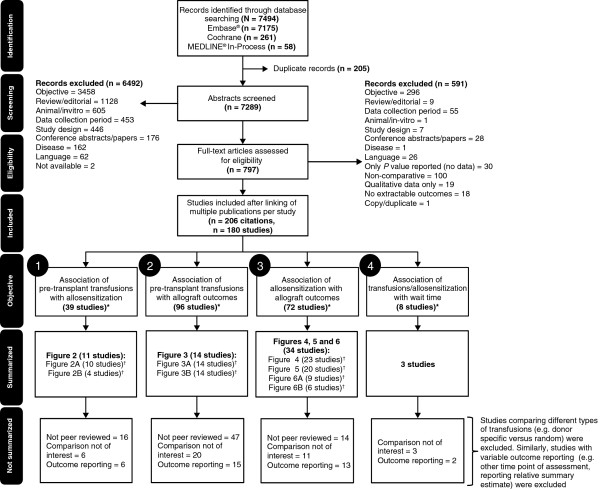
Figure 1
Figure 1
PRISMA diagram depicting study flow through the review. *The number of studies does not sum to 180 across all objectives since a study may answer more than one objective. The number of studies for each figure does not sum to the number of studies summarized since a study may be presented in different figures or multiple parts of a single figure. Not peer-reviewed: studies published in non-peer-reviewed journals (specifically Clinical Transplants and Transplantation Proceedings). Comparison not of interest: includes comparing various types or volume of transfusion (e.g. donor specific versus random); Outcome reporting: data for the outcome have not been reported in a format suitable for graphical representation (e.g. outcomes reported for one patient group only, outcome was drawn from a general conclusion in the text, time points were different from those selected for extraction [3, 6, 12, 24, 36, 60, 120, and 360 months], or outcomes were impacted by the different antibody detection techniques used in the study).
Figure 2
Figure 2
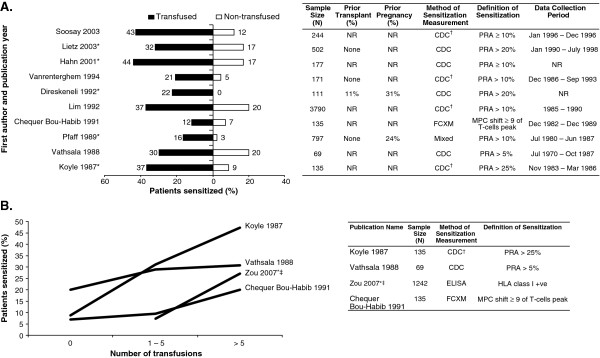
Impact of pre-transplant transfusion on allosensitization. (A) Proportion of patients sensitized stratified by pre-transplant transfusion status. (B) Risk of allosensitization by number of pre-transplant transfusions. *Significant difference as reported in the original publication; represents sensitization measurement not explicit, but identified according to the text; data reported for 0–5 transfusion vs. > 5 transfusions; values have been rounded to the nearest integer. NOTE: Additional calculation has been performed to allow for comparison between the populations of interest. Therefore, the numbers presented differ from those presented in the primary source publications with the exception of Lim 1992, Direskeneli 1992, and Lietz 2003. CDC: complement-dependent cytotoxicity; ELISA: enzyme-linked immunosorbant assay; FXCM: flow cytometry cross-match; HLA: human leukocyte antigen; Mixed: probable CDC + flow cytometry; MPC: mean peak channel; NR: not reported; PRA: panel reactive antibodies; +ve: positive.
Figure 3
Figure 3
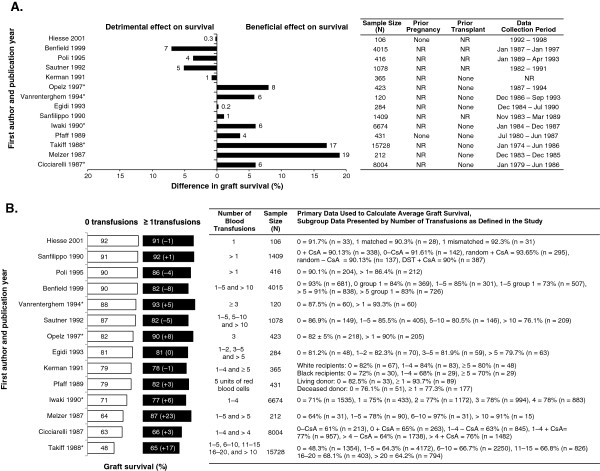
Graft survival at 12 months. (A) Difference between transfused and non-transfused patients. (B) Number of pre-transfusions. *Significant difference as reported in the original publication; values have been rounded to the nearest integer, unless < 1. NOTE: Additional calculation has been performed to allow for comparison between the populations of interest. Therefore, the numbers presented differ from those presented in the primary source publications with the exception of Poli 1995 and Opelz 1997. NR: not reported; n = sample size with reported outcome; CsA: cyclosporin A; DST: donor-specific transfusion.
Figure 4
Figure 4
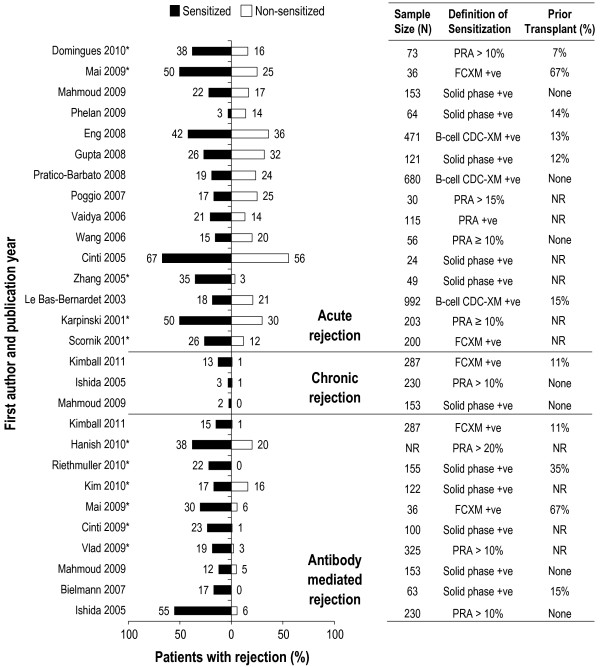
Impact of allosensitization on graft rejection following kidney transplantation measured by acute rejection, chronic rejection, and antibody-mediated rejection. *Significant difference as reported in the original publication; values have been rounded to the nearest integer. NOTE: Additional calculation has been performed to allow comparison of populations of interest. Therefore, the numbers differ from the primary publications with the exception of Mai 2009, Eng 2008, Pratico-Barbato 2008, Wang 2006, Le Bas-Bernardet 2003, Karpinski 2001, Scornik 2001, Hanish 2010, Riethmuller 2010, Cinti 2009, and Vlad 2009. CDC: complement-dependent cytotoxicity; CDC-XM: complement-dependent cytotoxicity cross-match; FCXM: flow cytometry cross-match; NR: not reported; PRA: panel reactive antibodies; +ve: positive.
Figure 5
Figure 5
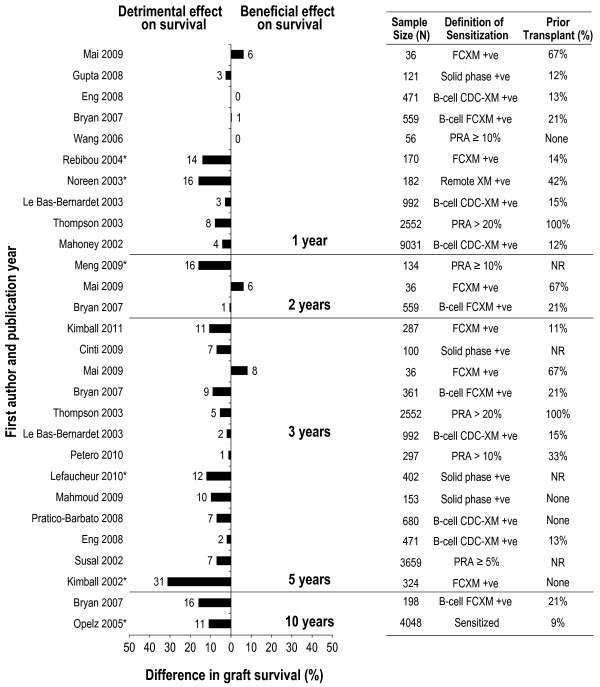
Relationship between allosensitization and graft survival at 1 year, 2 years, 3 years, 5 years, and 10 years. *Significant difference as reported in the original publication; values have been rounded to the nearest integer. NOTE: Additional calculation has been performed to allow for comparison between the populations of interest. Therefore, the numbers presented differ from those presented in the primary source publications for Gupta 2008, Bryan 2007, Thompson 2003, Kimball 2011, Petero 2010, Lefaucheur 2010, Susal 2002, Kimball 2002, and Opelz 2005. CDC: complement-dependent cytotoxicity; CDC-XM: complement-dependent cytotoxicity cross-match; FCXM: flow cytometry cross-match; NR: not reported; PRA: panel reactive antibodies; +ve: positive.
Figure 6
Figure 6
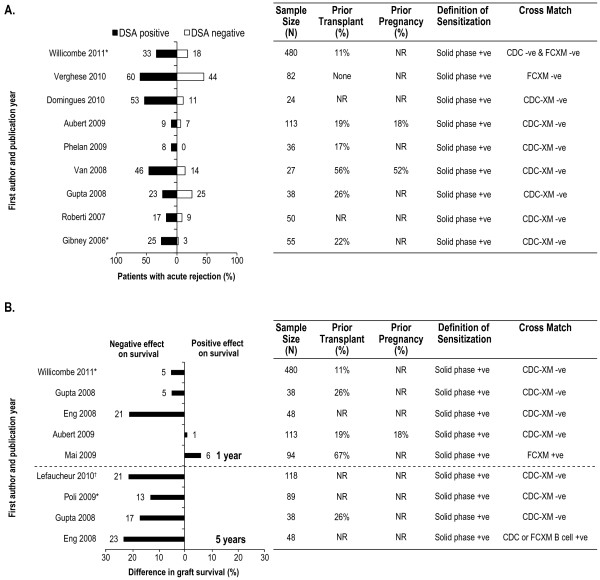
Impact of donor specific antibodies on graft rejection and survival. (A) Graft rejection. (B) Graft survival. *Significant difference as reported in the original publication; death censored graft survival reported; values have been rounded to the nearest integer. NOTE: Additional calculation has been performed to allow for comparison between the populations of interest. Therefore, the numbers presented differ from those presented in the primary source publications for Domingues 2010, Van 2008, Gupta 2008, and Lefaucheur 2010. CDC: complement-dependent cytotoxicity; CDC-XM: complement-dependent cytotoxicity cross-match; FCXM: flow cytometry cross-match; NR: not reported; -ve: negative; +ve: positive.

References

    1. Pfaff WW, Howard RJ, Scornik JC, Day C, Renderer J, Scott J, Fennel RS, Peterson JC, Salomon DR, Patton PR. Incidental and purposeful random donor blood transfusion. Sensitization and transplantation. Transplantation. 1989;14(1):130–133. doi: 10.1097/00007890-198901000-00029. - DOI - PubMed
    1. Sautner T, Gnant M, Banhegyi C, Wamser P, Gotzinger P, Steininger R, Muhlbacher F. Risk factors for development of panel reactive antibodies and their impact on kidney transplantation outcome. Transpl Int. 1992;14(SUPPL. 1):S116–S120. - PubMed
    1. Macdougall IC. Novel erythropoiesis-stimulating agents: a new era in anemia management. Clin J Am Soc Nephrol. 2008;14(1):200–207. doi: 10.2215/CJN.03840907. - DOI - PubMed
    1. Centers for Medicare & Medicaid Services. End-Stage Renal Disease Prospective Payment System. Regulation Number 1418-F. Available at http://www.cms.gov/Medicare/Medicare-Fee-for-Service-Payment/ESRDpayment....
    1. Centers for Medicare & Medicaid Services. Final CY 2013 End-Stage Renal Disease Prospective Payment System. Regulation Number 1352-F. Available at http://www.cms.gov/Medicare/Medicare-Fee-for-Service-Payment/ESRDpayment....

Publication types

MeSH terms