OnabotulinumtoxinA for chronic migraine: efficacy, safety, and tolerability in patients who received all five treatment cycles in the PREEMPT clinical program
- PMID: 24107267
- PMCID: PMC4033567
- DOI: 10.1111/ane.12171
OnabotulinumtoxinA for chronic migraine: efficacy, safety, and tolerability in patients who received all five treatment cycles in the PREEMPT clinical program
Abstract
Objective: Chronic migraine (CM) is a prevalent and disabling neurological disorder. Phase III REsearch Evaluating Migraine Prophylaxis Therapy (PREEMPT) clinical program assessed efficacy and safety of onabotulinumtoxinA (BOTOX(®)) for prophylaxis of headaches in adults with CM. This secondary analysis assessed patients who received all five treatment cycles and completed the study.
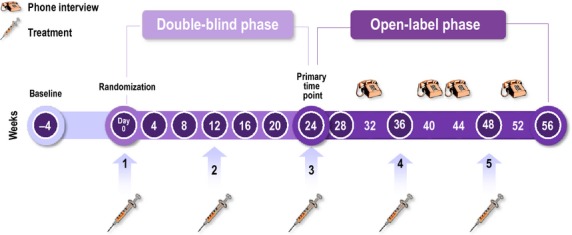
Materials and methods: PREEMPT (two phase III studies: 24-week double-blind, placebo-controlled [DBPC], parallel-group phase, followed by 32-week open-label [OL] phase) evaluated the efficacy and safety of onabotulinumtoxinA in CM (≥15 days/month with headache lasting ≥4 h a day). Patients were randomized (1:1) to onabotulinumtoxinA or placebo every 12 weeks for two cycles, followed by onabotulinumtoxinA for three cycles. Multiple headache symptom measures were evaluated. Results for the completer (five cycles) subgroup of patients are reported.
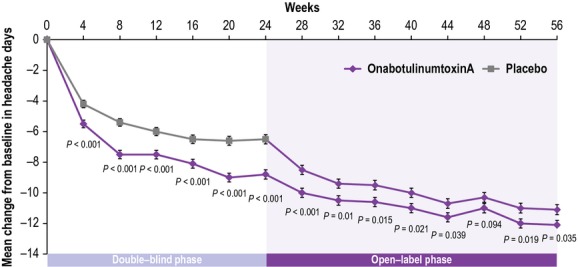
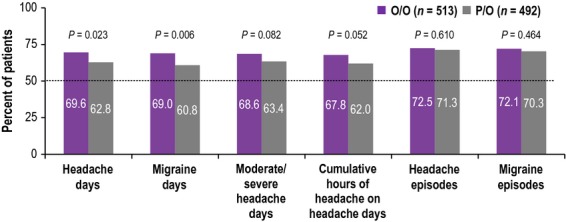
Results: Of 1384 total PREEMPT patients, 1005 received all five treatment cycles (513 received onabotulinumtoxinA only [onabotulinumtoxinA/onabotulinumtoxinA (O/O)] and 492 received two cycles of placebo then three cycles of onabotulinumtoxinA [placebo/onabotulinumtoxinA (P/O)]). Demographics were similar between treatment groups. At Week 56, after all patients were treated with onabotulinumtoxinA, there continued to be significant between-group differences favoring the O/O vs P/O group for the following headache symptom measures: LS mean change from baseline in frequencies of headache days (-12.0 O/O, -11.1 P/O; P = 0.035), migraine days (-11.6 O/O, -10.7 P/O; P = 0.038), and moderate/severe headache days (-11.0 O/O, -10.1 P/O; P = 0.042). For other measures (cumulative hours of headache on headache days, frequency of headache episodes, and percentage with severe Headache Impact Test (HIT)-6 score, and total HIT-6 and Migraine-Specific Quality of Life Questionnaire scores), there were also large mean improvements from baseline. The percent of patients with a ≥50% reduction from baseline in frequency of headache days was significantly greater for the onabotulinumtoxinA-only group at Week 56 (69.6% O/O, 62.8% P/O; P = 0.023). The treatment-related adverse event rate was 28.5% for onabotulinumtoxinA vs 12.4% for placebo in the DBPC phase and 34.8% for patients treated with onabotulinumtoxinA for all five cycles throughout the 56-week trials.
Conclusions: This subgroup analysis demonstrated improvements with onabotulinumtoxinA treatment (five cycles) vs placebo (two cycles)/onabotulinumtoxinA (three cycles) for multiple headache symptom measures and suggests that at Week 56, patients treated earlier with onabotulinumtoxinA had better outcomes. These findings demonstrate the continued need and cumulative benefit over time with continued prophylaxis, an important and clinically pragmatic observation for clinicians and patients.
Keywords: PREEMPT; chronic migraine; headache; long term; onabotulinumtoxinA; prophylaxis.
© 2013 The Authors. Acta Neurologica Scandinavica published by John Wiley & Sons A/S. Published by John Wiley & Sons Ltd.
Figures
References
-
- Natoli J, Manack A, Dean B, et al. Global prevalence of chronic migraine: a systematic review. Cephalalgia. 2010;30:599–609. - PubMed
-
- Bigal ME, Serrano D, Reed M, Lipton RB. Chronic migraine in the population: burden, diagnosis, and satisfaction with treatment. Neurology. 2008;71:559–66. - PubMed
-
- Olesen J, Bousser MG, Diener HC, et al. New appendix criteria open for a broader concept of chronic migraine. Cephalalgia. 2006;26:742–6. - PubMed
-
- Headache Classification Subcommittee of the International Headache Society. The International Classification Of Headache Disorders. Cephalalgia. 2004;24(Suppl. 1):9–160. 2nd edn. - PubMed
-
- Manack AN, Buse DC, Lipton RB. Chronic migraine: epidemiology and disease burden. Curr Pain Headache Rep. 2010;15:70–8. - PubMed
Publication types
MeSH terms
Substances
Grants and funding
LinkOut - more resources
Full Text Sources
Other Literature Sources
Medical