


Conceptual learning by miniature brains
- PMID: 24107530
- PMCID: PMC3813328
- DOI: 10.1098/rspb.2013.1907
Conceptual learning by miniature brains
Abstract
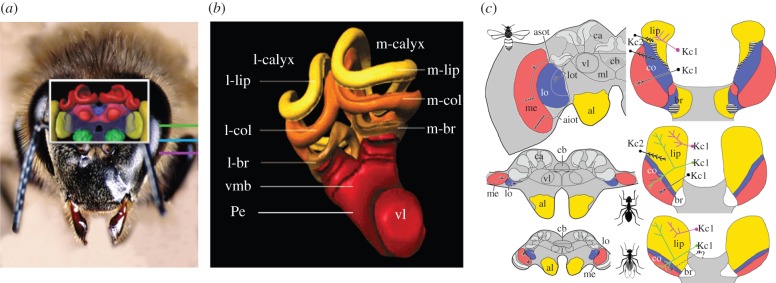
Concepts act as a cornerstone of human cognition. Humans and non-human primates learn conceptual relationships such as 'same', 'different', 'larger than', 'better than', among others. In all cases, the relationships have to be encoded by the brain independently of the physical nature of objects linked by the relation. Consequently, concepts are associated with high levels of cognitive sophistication and are not expected in an insect brain. Yet, various works have shown that the miniature brain of honeybees rapidly learns conceptual relationships involving visual stimuli. Concepts such as 'same', 'different', 'above/below of' or 'left/right are well mastered by bees. We review here evidence about concept learning in honeybees and discuss both its potential adaptive advantage and its possible neural substrates. The results reviewed here challenge the traditional view attributing supremacy to larger brains when it comes to the elaboration of concepts and have wide implications for understanding how brains can form conceptual relations.
Keywords: Apis mellifera; concept learning; honeybee; insect cognition; visual cognition.
Figures
References
-
- Murphy GL. 2002. The big book of concepts. Cambridge, MA: MIT Press
-
- Halford GS, Wilson WH, Phillips S. 2010. Relational knowledge: the foundation of higher cognition. Trends Cogn. Sci. 14, 497–505 (doi:10.1016/j.tics.2010.08.005) - DOI - PubMed
-
- Doumas LAA, Hummel JE, Sandhofer CM. 2008. A theory of the discovery and predication of relational concepts. Psychol. Rev. 115, 1–43 (doi:10.1037/0033-295X.115.1.1) - DOI - PubMed
-
- Lamberts K, Shanks D. 1997. Knowledge, concepts, and categories. Cambridge, MA: Psychology Press
-
- Zentall TR, Galizio M, Critchfied TS. 2002. Categorization, concept learning, and behavior analysis: an introduction. J. Exp. Anal. Behav. 78, 237–248 (doi:10.1901/jeab.2002.78-237) - DOI - PMC - PubMed
Publication types
MeSH terms
LinkOut - more resources
Full Text Sources
Other Literature Sources
