


Ureidoglycolate hydrolase, amidohydrolase, lyase: how errors in biological databases are incorporated in scientific papers and vice versa
- PMID: 24107613
- PMCID: PMC3793230
- DOI: 10.1093/database/bat071
Ureidoglycolate hydrolase, amidohydrolase, lyase: how errors in biological databases are incorporated in scientific papers and vice versa
Abstract
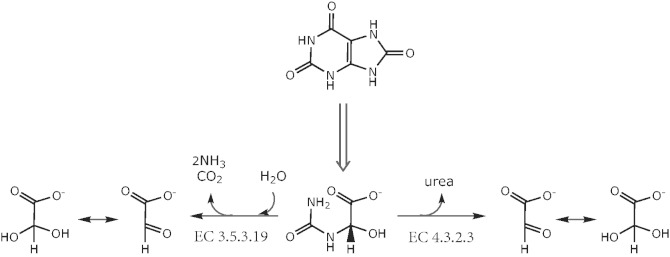
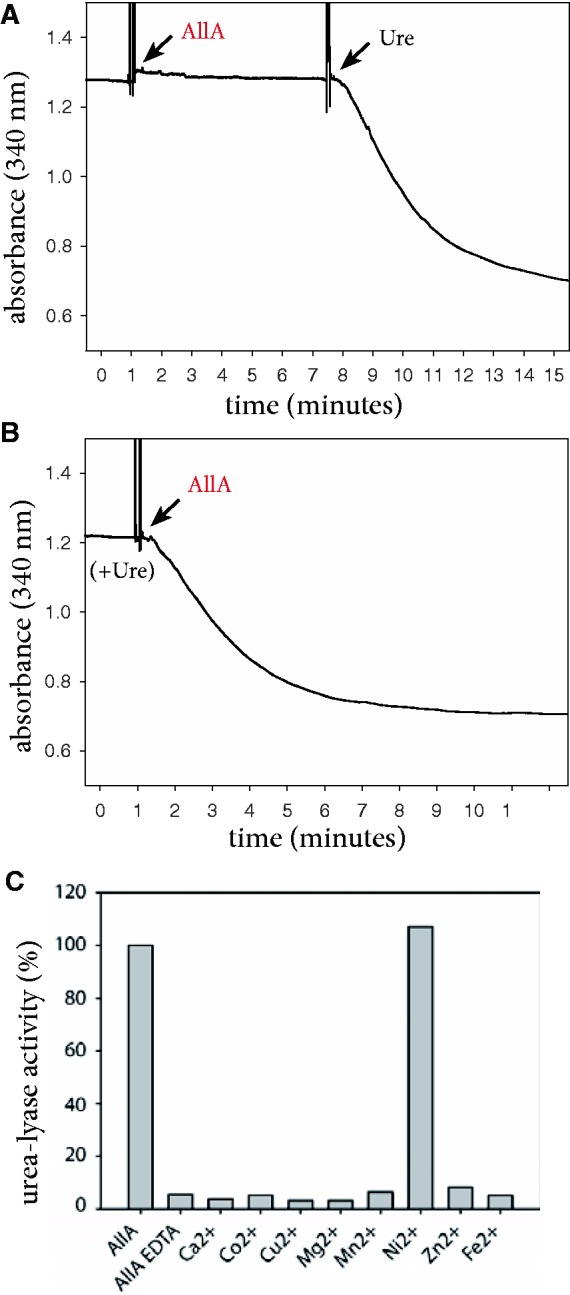
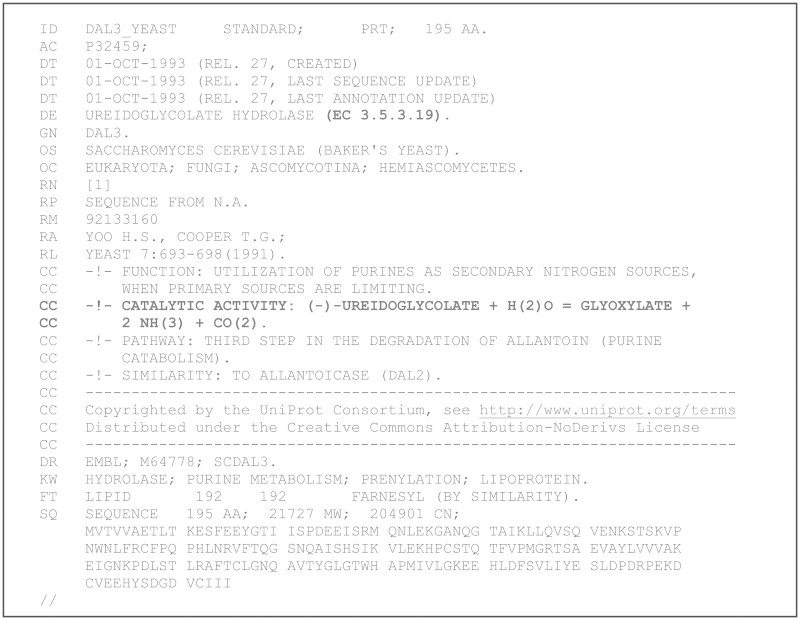
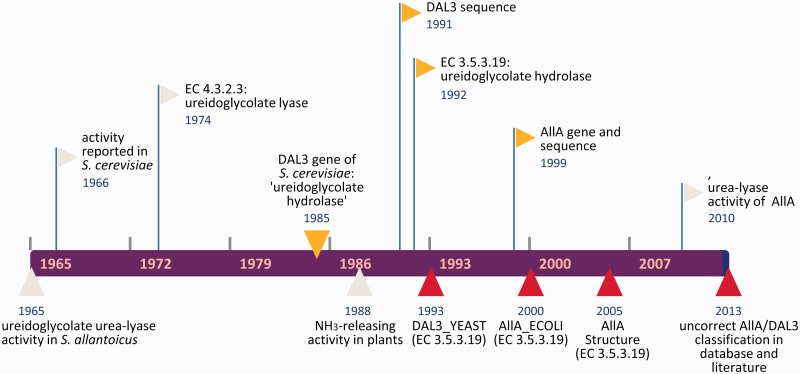
An opaque biochemical definition, an insufficient functional characterization, an interpolated database description, and a beautiful 3D structure with a wrong reaction. All these are elements of an exemplar case of misannotation in biological databases and confusion in the scientific literature concerning genes and enzymes acting on ureidoglycolate, an intermediate of purine catabolism. Here we show biochemical evidence for the relocation of genes assigned to EC 3.5.3.19 (ureidoglycolate hydrolase, releasing ammonia), such as allA of Escherichia coli or DAL3 of Saccharomyces cerevisiae, to EC 4.3.2.3 (ureidoglycolate lyase, releasing urea). The EC 3.5.3.19 should be more appropriately named ureidoglycolate amidohydrolase and include genes equivalent to UAH of Arabidopsis thaliana. The distinction between ammonia- or urea-releasing activities from ureidoglycolate is relevant for the understanding of nitrogen metabolism in various organisms and of virulence factors in certain pathogens rather than a nomenclature problem. We trace the original fault in database annotation and provide a rationale for its incorporation and persistence in the scientific literature. Notwithstanding the technological distance, yet not surprising for the constancy of human nature, error categories and mechanisms established in the study of the work of amanuensis monks still apply to the modern curation of biological databases.
Figures
References
-
- West ML. Textual Criticism and Editorial Technique applicable to Greek and Latin Texts. Stuttgart: Teubner; 1973.
-
- Quentin H. Essais de critique textuelle (Ecdotique) Paris: Picard A.; 1926.
-
- Bork P, Bairoch A. Go hunting in sequence databases but watch out for the traps. Trends Genet. 1996;12:425–427. - PubMed
Publication types
MeSH terms
Substances
LinkOut - more resources
Full Text Sources
Other Literature Sources
Molecular Biology Databases
Research Materials
