Autoimmune, neurological, and venous thromboembolic adverse events after immunisation of adolescent girls with quadrivalent human papillomavirus vaccine in Denmark and Sweden: cohort study
- PMID: 24108159
- PMCID: PMC3805482
- DOI: 10.1136/bmj.f5906
Autoimmune, neurological, and venous thromboembolic adverse events after immunisation of adolescent girls with quadrivalent human papillomavirus vaccine in Denmark and Sweden: cohort study
Abstract
Objective: To assess the risk of serious adverse events after vaccination of adolescent girls with quadrivalent human papillomavirus (qHPV) vaccine.
Design: Register based cohort study.
Setting: Denmark and Sweden, October 2006 to December 2010.
Participants: 997,585 girls aged 10-17, among whom 296,826 received a total of 696,420 qHPV vaccine doses.
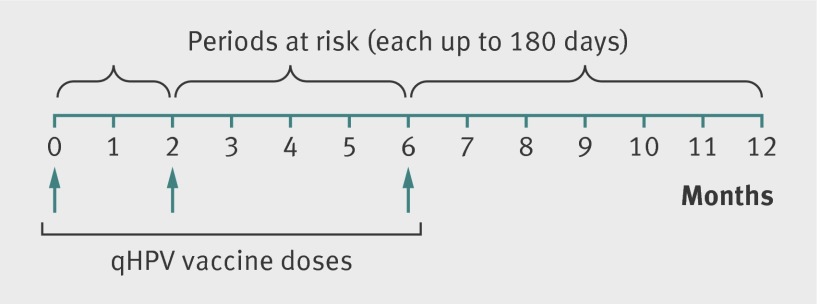
Main outcome measures: Incident hospital diagnosed autoimmune, neurological, and venous thromboembolic events (53 different outcomes) up to 180 days after each qHPV vaccine dose. Only events with at least five vaccine exposed cases were considered for further assessment. Rate ratios adjusted for age, country, calendar year, and parental country of birth, education, and socioeconomic status were estimated, comparing vaccinated and unvaccinated person time. For outcomes where the rate ratio was significantly increased, we regarded three criteria as signal strengthening: analysis based on 20 or more vaccine exposed cases (reliability), rate ratio 3.0 or more (strength), and significantly increased rate ratio in country specific analyses (consistency). We additionally assessed clustering of events in time and estimated rate ratios for a risk period that started on day 181.
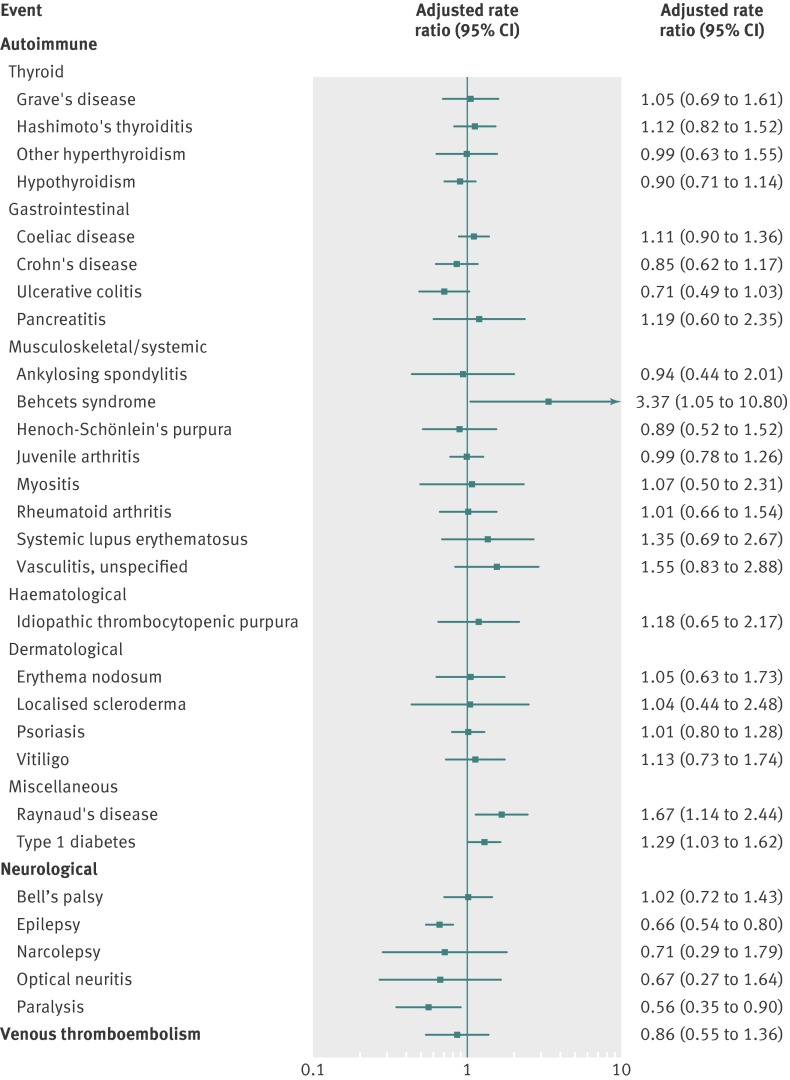
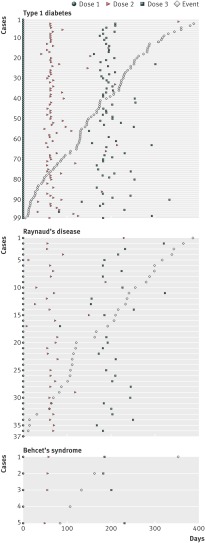
Results: Among the 53 outcomes, at least five vaccine exposed cases occurred in 29 and these were analysed further. Whereas the rate ratios for 20 of 23 autoimmune events were not significantly increased, exposure to qHPV vaccine was significantly associated with Behcet's syndrome, Raynaud's disease, and type 1 diabetes. Each of these three outcomes fulfilled only one of three predefined signal strengthening criteria. Furthermore, the pattern of distribution in time after vaccination was random for all three and the rate ratios for these outcomes in the period from day 181 after vaccination were similar to the rate ratios in the primary risk period. The rate ratios for five neurological events were not significantly increased and there were inverse associations with epilepsy (rate ratio 0.66, 95% confidence interval 0.54 to 0.80) and paralysis (0.56, 0.35 to 0.90). There was no association between exposure to qHPV vaccine and venous thromboembolism (0.86, 0.55 to 1.36).
Conclusions: This large cohort study found no evidence supporting associations between exposure to qHPV vaccine and autoimmune, neurological, and venous thromboembolic adverse events. Although associations for three autoimmune events were initially observed, on further assessment these were weak and not temporally related to vaccine exposure. Furthermore, the findings need to be interpreted considering the multiple outcomes assessed.
Conflict of interest statement
Competing interests: All authors have completed the ICMJE uniform disclosure form at
Figures
Comment in
-
Safety of the quadrivalent human papillomavirus vaccine.BMJ. 2013 Oct 9;347:f5631. doi: 10.1136/bmj.f5631. BMJ. 2013. PMID: 24108153 No abstract available.
-
No association of HPV vaccination with serious adverse events.J Pediatr. 2014 May;164(5):1240. doi: 10.1016/j.jpeds.2014.02.043. J Pediatr. 2014. PMID: 24742654 No abstract available.
References
-
- Medical Products Agency. Vaccination against human papillomavirus (HPV) vaccine Gardasil and Cervarix. 2012. [In Swedish.] www.lakemedelsverket.se/OVRIGA-SIDOR/HPV-vaccinering/.
-
- Wraith DC, Goldman M, Lambert PH. Vaccination and autoimmune disease: what is the evidence? Lancet 2003;362:1659-66. - PubMed
Publication types
MeSH terms
Substances
LinkOut - more resources
Full Text Sources
Other Literature Sources
Medical