


A lesson in business: cost-effectiveness analysis of a novel financial incentive intervention for increasing physical activity in the workplace
- PMID: 24112295
- PMCID: PMC3852549
- DOI: 10.1186/1471-2458-13-953
A lesson in business: cost-effectiveness analysis of a novel financial incentive intervention for increasing physical activity in the workplace
Abstract
Background: Recently both the UK and US governments have advocated the use of financial incentives to encourage healthier lifestyle choices but evidence for the cost-effectiveness of such interventions is lacking. Our aim was to perform a cost-effectiveness analysis (CEA) of a quasi-experimental trial, exploring the use of financial incentives to increase employee physical activity levels, from a healthcare and employer's perspective.
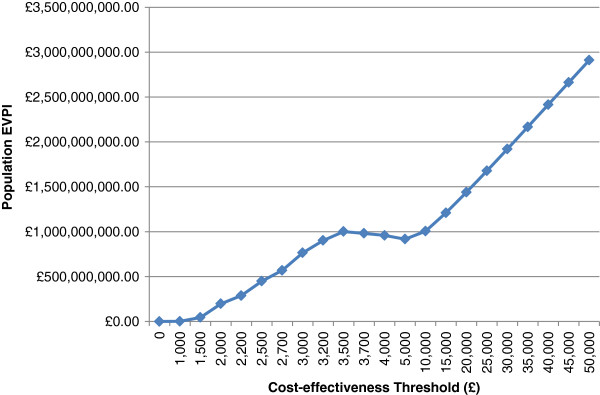
Methods: Employees used a 'loyalty card' to objectively monitor their physical activity at work over 12 weeks. The Incentive Group (n=199) collected points and received rewards for minutes of physical activity completed. The No Incentive Group (n=207) self-monitored their physical activity only. Quality of life (QOL) and absenteeism were assessed at baseline and 6 months follow-up. QOL scores were also converted into productivity estimates using a validated algorithm. The additional costs of the Incentive Group were divided by the additional quality adjusted life years (QALYs) or productivity gained to calculate incremental cost effectiveness ratios (ICERs). Cost-effectiveness acceptability curves (CEACs) and population expected value of perfect information (EVPI) was used to characterize and value the uncertainty in our estimates.
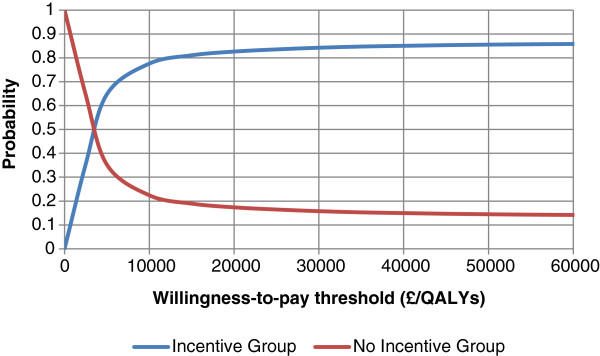
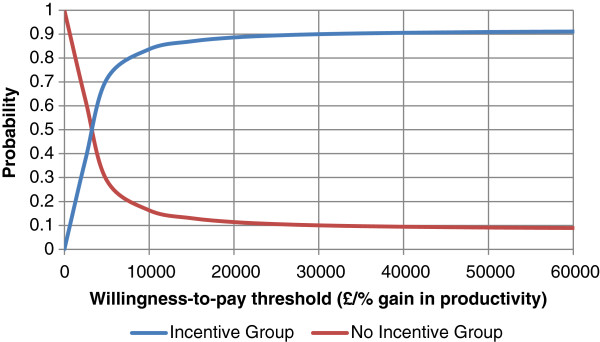
Results: The Incentive Group performed more physical activity over 12 weeks and by 6 months had achieved greater gains in QOL and productivity, although these mean differences were not statistically significant. The ICERs were £2,900/QALY and £2,700 per percentage increase in overall employee productivity. Whilst the confidence intervals surrounding these ICERs were wide, CEACs showed a high chance of the intervention being cost-effective at low willingness-to-pay (WTP) thresholds.
Conclusions: The Physical Activity Loyalty card (PAL) scheme is potentially cost-effective from both a healthcare and employer's perspective but further research is warranted to reduce uncertainty in our results. It is based on a sustainable "business model" which should become more cost-effective as it is delivered to more participants and can be adapted to suit other health behaviors and settings. This comes at a time when both UK and US governments are encouraging business involvement in tackling public health challenges.
Figures
References
-
- Chenoweth D, Leutzinger J. The economic cost of physical inactivity and excess weight in American adults. J Phys Act Heal. 2003;3:148–163. - PubMed
-
- Department of Health. Healthy lives, healthy people. Our strategy for public health in England. http://www.dh.gov.uk/en/Publicationsandstatistics/Publications/Publicati....
-
- Kaiser Family Foundation. Summary of new health reform law. http://www.kff.org/healthreform/8061.cfm.
Publication types
MeSH terms
Grants and funding
LinkOut - more resources
Full Text Sources
Other Literature Sources
