. 2013 Oct 11;9(1):39.
doi: 10.1186/1746-4811-9-39.

Plant genome editing made easy: targeted mutagenesis in model and crop plants using the CRISPR/Cas system

Affiliations

Plant genome editing made easy: targeted mutagenesis in model and crop plants using the CRISPR/Cas system

Khaoula Belhaj et al. Plant Methods. .

Abstract

Targeted genome engineering (also known as genome editing) has emerged as an alternative to classical plant breeding and transgenic (GMO) methods to improve crop plants. Until recently, available tools for introducing site-specific double strand DNA breaks were restricted to zinc finger nucleases (ZFNs) and TAL effector nucleases (TALENs). However, these technologies have not been widely adopted by the plant research community due to complicated design and laborious assembly of specific DNA binding proteins for each target gene. Recently, an easier method has emerged based on the bacterial type II CRISPR (clustered regularly interspaced short palindromic repeats)/Cas (CRISPR-associated) immune system. The CRISPR/Cas system allows targeted cleavage of genomic DNA guided by a customizable small noncoding RNA, resulting in gene modifications by both non-homologous end joining (NHEJ) and homology-directed repair (HDR) mechanisms. In this review we summarize and discuss recent applications of the CRISPR/Cas technology in plants.


Figures
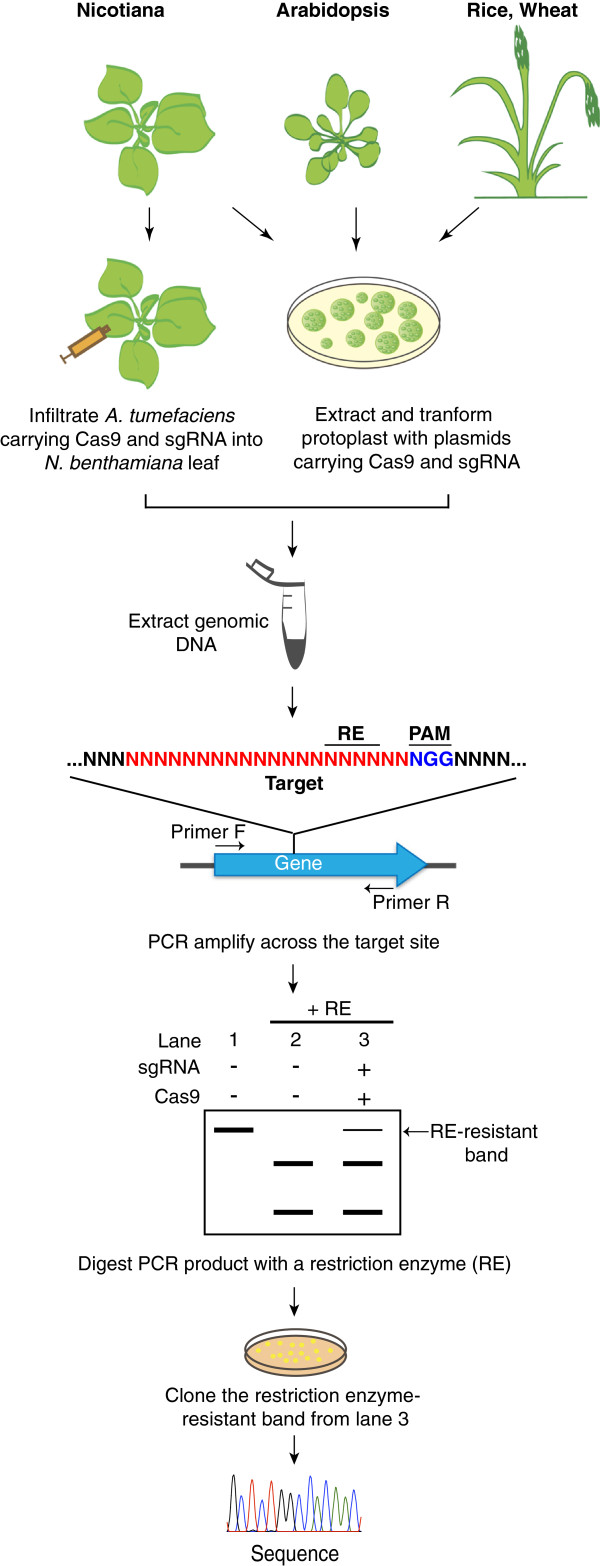
Figure 1
Figure 1
Schematic drawing illustrating examples of genome editing assays in plants. The CRISPR/Cas9 technology was successfully applied in model plants (Nicotiana benthamiana, Arabidopsis thaliana) and crops (rice, wheat). The Cas9 nuclease and the sgRNA matching the gene of interest are co-expressed using Agrobacterium tumefaciens as a vector in N. benthamiana leaves or transfected into protoplasts from Arabidopsis, wheat or rice. Then, the genomic DNA is extracted from the leaf tissues or protoplasts and subject to PCR-amplification with primers flanking the target site. The presence of Cas9/sgRNA-induced mutations can be easily detected using the restriction enzyme (RE) site loss method. The RE-resistant band (lane 3) can be cloned. The exact nature of the mutations is then revealed by sequencing individual clones.
Figure 2
Figure 2
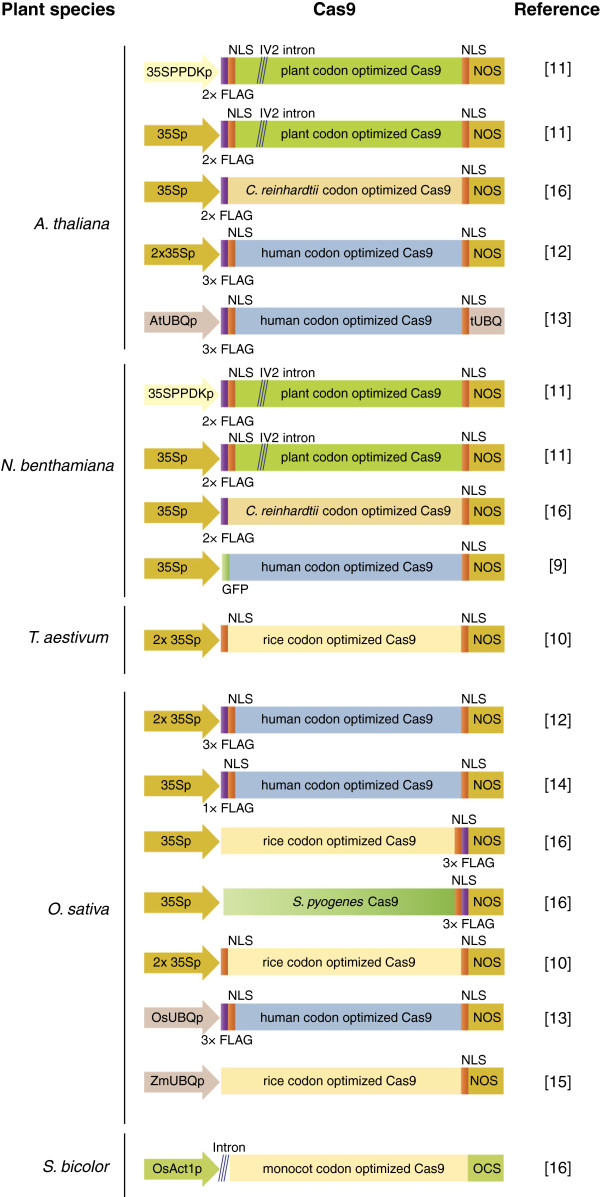
Cas9 variants used for genome editing in plants. The Cas9 nuclease was expressed as a fusion protein with a tag (FLAG or GFP as indicated) under various constitutive promoters. Diagonal lines indicate an intron inserted into the Cas9 gene. NLS, nuclear localization signal.
Figure 3
Figure 3
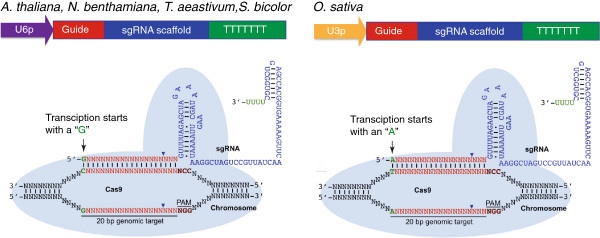
Scheme illustrating the sgRNA structure and mechanism of the target recognition. sgRNA is expressed under the U6 promoter in A. thaliana, N. benthamiana, O. sativa, T. aestivum and S. bicolor, and under the U3 promoter in O. sativa. The transcript initiation nucleotide in the case of U6p and U3p is “G” and “A”, respectively.
Figure 4
Figure 4
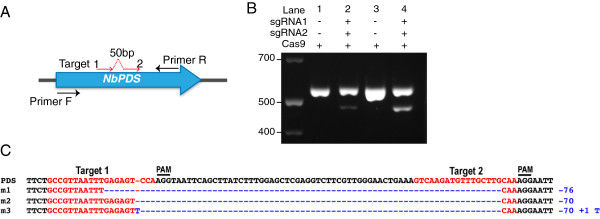
Generation of a chromosomal deletion by targeting two adjacent sequences within the PDS locus of Nicotiana benthamiana. A. Cartoon explaining setup of the experiment. B. Detection of deletion mutations using the AFLP analysis. Agarose gel shows PCR bands amplified across targets 1 and 2 using genomic DNA extracted from respective leaf samples. Cas9, sgRNA1 and 2 were expressed in N. benthamiana leaf tissue using the standard agroinfiltration protocol. In lane 2, Cas9/sgRNA1/sgRNA2 were expressed from three separate plasmids, while in lane 4 they were expressed from a single plasmid. C. Types of deletion mutations identified. Bottom PCR bands from lanes 2 and 4 were cloned into a high copy vector and 15 individual clones were sequenced. All clones contained deletions that can be grouped in three different types (m1-3).

References

    1. Sorek R, Lawrence CM, Wiedenheft B. CRISPR-mediated adaptive immune systems in bacteria and archaea. Annu Rev Biochem. 2013;82:237–266. doi: 10.1146/annurev-biochem-072911-172315. - DOI - PubMed
    1. Jinek M, Chylinski K, Fonfara I, Hauer M, Doudna JA, Charpentier E. A programmable dual-RNA-guided DNA endonuclease in adaptive bacterial immunity. Science. 2012;337:816–821. doi: 10.1126/science.1225829. - DOI - PMC - PubMed
    1. Jinek M, East A, Cheng A, Lin S, Ma E, Doudna J. RNA-programmed genome editing in human cells. Elife. 2013;2:e00471. doi: 10.7554/eLife.00471. - DOI - PMC - PubMed
    1. Mali P, Yang L, Esvelt KM, Aach J, Guell M, DiCarlo JE, Norville JE, Church GM. RNA-guided human genome engineering via Cas9. Science. 2013;339:823–826. doi: 10.1126/science.1232033. - DOI - PMC - PubMed
    1. Cong L, Ran FA, Cox D, Lin S, Barretto R, Habib N, Hsu PD, Wu X, Jiang W, Marraffini LA, Zhang F. Multiplex genome engineering using CRISPR/Cas systems. Science. 2013;339:819–823. doi: 10.1126/science.1231143. - DOI - PMC - PubMed