


Developing complex interventions: lessons learned from a pilot study examining strategy training in acute stroke rehabilitation
- PMID: 24113727
- PMCID: PMC3949124
- DOI: 10.1177/0269215513502799
Developing complex interventions: lessons learned from a pilot study examining strategy training in acute stroke rehabilitation
Abstract
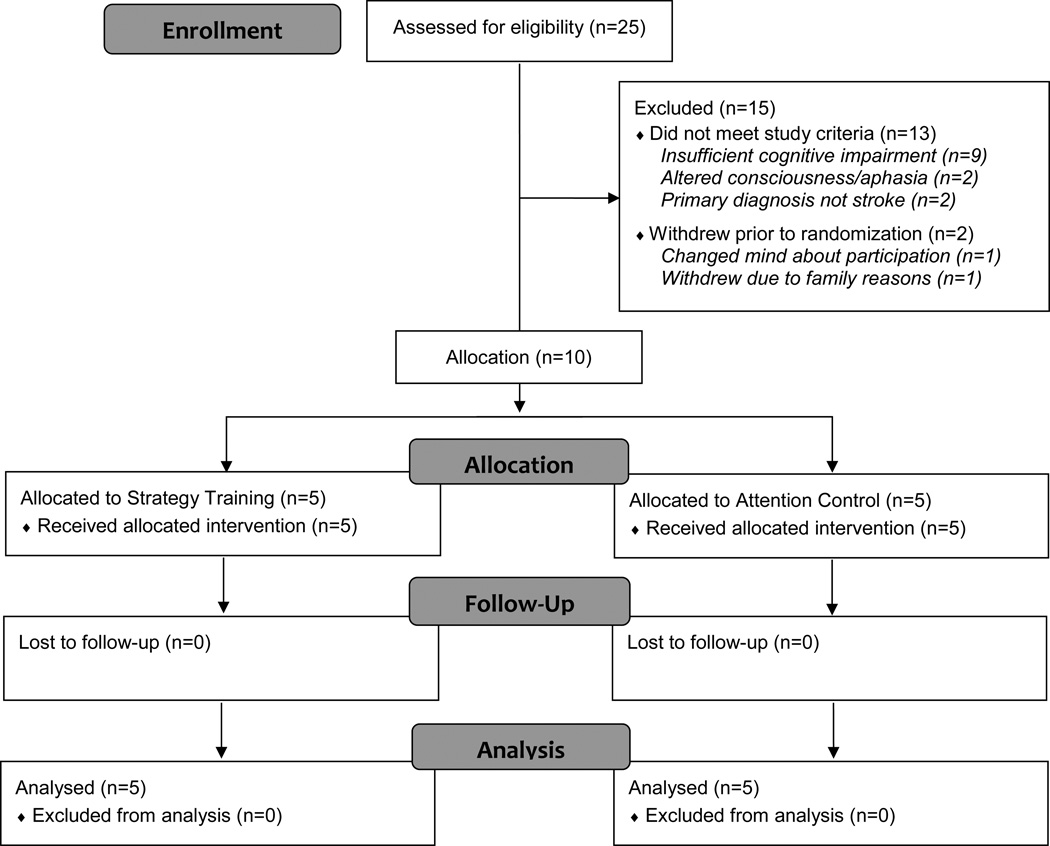
Objective: To examine the feasibility of a strategy training clinical trial in a small group of adults with stroke-related cognitive impairments in inpatient rehabilitation, and to explore the impact of strategy training on disability.
Design: Non-randomized two-group intervention pilot study.
Setting: Two inpatient rehabilitation units within an academic health centre.
Participants: Individuals with a primary diagnosis of acute stroke, who were admitted to inpatient rehabilitation and demonstrated cognitive impairments were included. Individuals with severe aphasia; dementia; major depressive disorder, bipolar, or psychotic disorder; recent drug or alcohol abuse; and anticipated length of stay less than five days were excluded.
Intervention: Participants received strategy training or an attention control session in addition to usual rehabilitation care. Sessions in both groups were 30-40 minutes daily, five days per week, for the duration of inpatient rehabilitation.
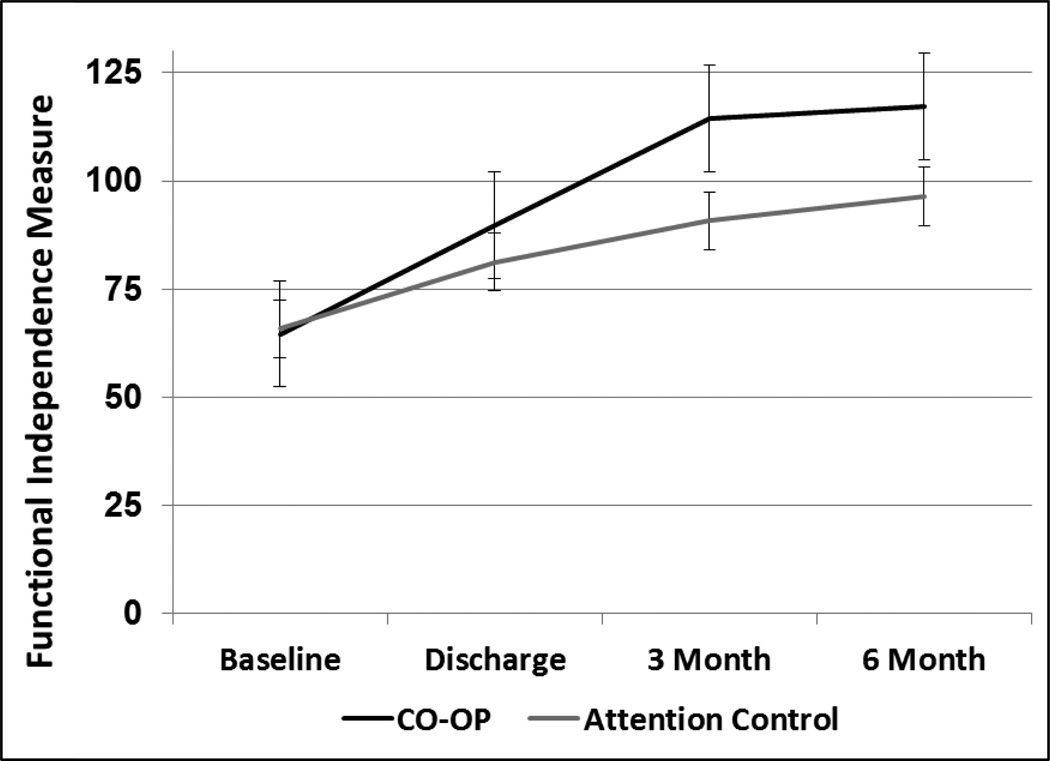
Main outcome measures: We assessed feasibility through participants' recruitment and retention; research intervention session number and duration; participants' comprehension and engagement; intervention fidelity; and participants' satisfaction. We assessed disability at study admission, inpatient rehabilitation discharge, 3 and 6 months using the Functional Independence Measure.
Results: Participants in both groups (5 per group) received the assigned intervention (>92% planned sessions; >94% fidelity) and completed follow-up testing. Strategy training participants in this small sample demonstrated significantly less disability at six months (M (SE) = 117 (3)) than attention control participants (M(SE) = 96 (14); t 8 = 7.87, P = 0.02).
Conclusions: It is feasible and acceptable to administer both intervention protocols as an adjunct to acute inpatient rehabilitation, and strategy training shows promise for reducing disability.
Keywords: Rehabilitation interventions; cognitive impairment; strategy training; stroke.
Conflict of interest statement
There are no conflicts of interest to disclose.
Figures
References
-
- Craig P, Dieppe P, Macintyre S, et al. Developing and evaluating complex interventions: new guidance. London: Medical Research Council; 2008. Available at: www.mrc.ac.uk/complexinterventionsguidance. - PMC - PubMed
-
- Holm MB. The 200 Eleanor Clarke Slagle Lecture. Our mandate for the new millennium: evidence based practice. Am J Occup Ther. 2000;54:575–585. - PubMed
-
- Whyte J. Rehabilitation effectiveness: the state of the science and a hope for the future. Am J Phys Med Rehabil. 2007;86:835–837. - PubMed
-
- Whyte J, Gordon W, Nash J, et al. A phased developmental approach to neurorehabilitation research: the science of knowledge building. Arch Phys Med Rehabil. 2009;90:S3–S10. - PubMed
-
- Hart T, Bagiella E. Design and implementation of clinical trials in rehabilitation research. Arch Phys Med Rehabil. 2012;93:S117–S126. - PubMed
Publication types
MeSH terms
Grants and funding
LinkOut - more resources
Full Text Sources
Other Literature Sources
Medical
