


Effect of patient navigation on time to diagnostic resolution among patients with colorectal cancer-related abnormalities
- PMID: 24113902
- PMCID: PMC3945676
- DOI: 10.1007/s13187-013-0561-2
Effect of patient navigation on time to diagnostic resolution among patients with colorectal cancer-related abnormalities
Abstract
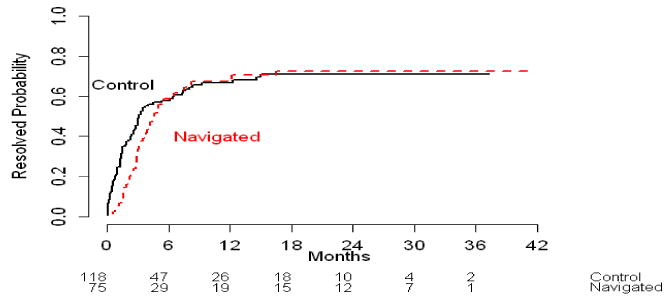
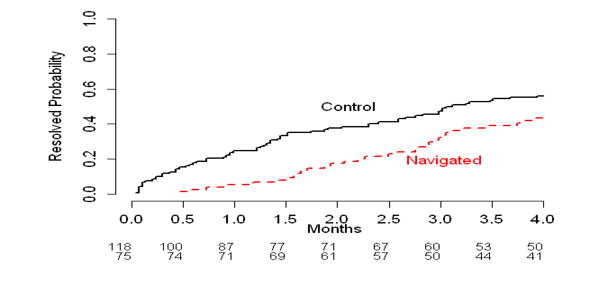
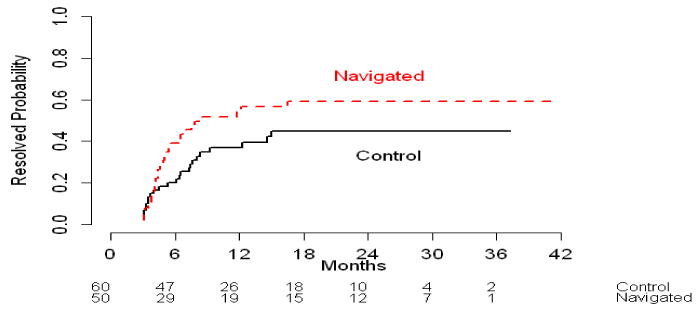
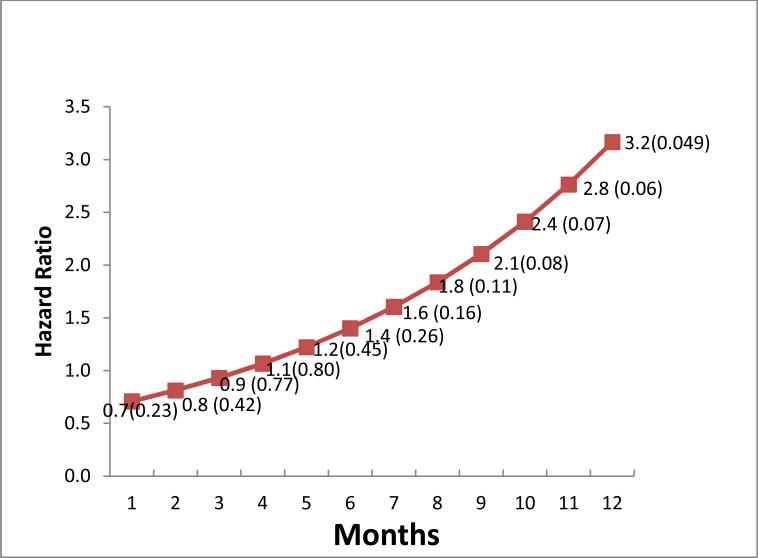
The objective of this study is to evaluate whether a patient navigation (PN) program is effective in reducing delay in diagnostic resolution among medically underserved patients with colorectal cancer (CRC)-related abnormalities in Tampa Bay, Florida. This study involved ten primary care clinics randomized either to receive navigation or to serve as controls (five clinics per arm). Each clinic identified all subjects with CRC-related abnormalities in the year prior to the clinic beginning participation in the Moffitt Patient Navigator Research Program. Patients with CRC-related abnormalities were navigated from the time of a colorectal abnormality to diagnostic resolution. Control patients received usual care, and outcome information was obtained from medical record abstraction. Using a frailty Cox proportional hazard model, we examined the length of time between colorectal abnormality and definitive diagnosis. One hundred ninety-three patients were eligible for the study because of a CRC-related abnormality (75 navigated and 118 controls). Analysis of PN effect by two time periods of resolution (0-4 and >4 months) showed a lagged effect of PN. The adjusted time-varying PN effect on diagnostic resolution compared to the controls was marginally significant (adjusted hazard ratio [aHR] = 1.15, 95% confidence interval = 1.02-1.29) after controlling for insurance status. The predicted aHR at 4 months was 1.2, but showed no significant effect until 12 months. For patients having an abnormal symptom of CRC, PN appeared to have a positive effect over time and sped diagnostic resolution after 4 months. However, the small sample size limits drawing a definitive conclusion regarding the positive PN effect.
Figures
References
-
- Atkin WS, et al. Once-only flexible sigmoidoscopy screening in prevention of colorectal cancer: a multicentre randomised controlled trial. The Lancet. 2010;375(9726):1624–1633. - PubMed
-
- Freeman HP. The Origin, Evolution, and Principles of Patient Navigation. Cancer Epidemiology Biomarkers & Prevention. 2012;21(10):1614–1617. - PubMed
Publication types
MeSH terms
Grants and funding
LinkOut - more resources
Full Text Sources
Other Literature Sources
Medical
