


Aging, empathy, and prosociality
- PMID: 24115776
- PMCID: PMC4415076
- DOI: 10.1093/geronb/gbt091
Aging, empathy, and prosociality
Abstract
Objectives: Although empathy is a well-established motivation in younger adults for helping others, it is not known whether this extends to aging. Prioritization of socioemotional goals with age may increase the salience of helping others (i.e., prosocial behavior), but older adults also experience decreased cognitive empathy. Thus, we investigated age-related differences in relationships among empathy and prosocial behavior.
Method: Participants were 24 younger (M = 19.8 years) and 24 older (M = 77.9 years) healthy adults. Whereas participants believed the study involved playing the dictator game, in reality, state emotional empathy was induced implicitly through a note from an opponent describing their experience with cancer. Prosocial behavior was measured by participants' monetary offers to that opponent.
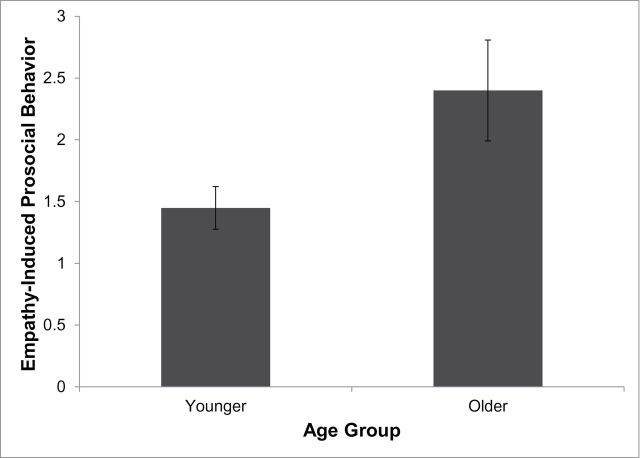
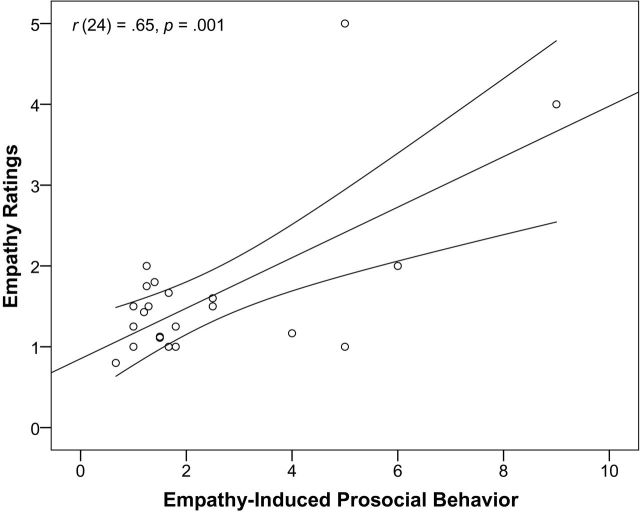
Results: Older adults showed greater prosocial behavior due to the empathy induction than younger adults. There was a positive association between state emotional empathy ratings and prosocial behavior in older, but not in younger adults, and preliminary evidence for higher state emotional empathy levels in older adults with higher trait cognitive empathy.
Discussion: This suggests that in contexts relevant to socioemotional goals, older adults may be more motivated than younger adults to help others and state emotional empathy may be a potential mechanism for greater prosocial behavior in aging.
Keywords: Aging; Economic decision making; Empathy; Prosocial..
© The Author 2013. Published by Oxford University Press on behalf of The Gerontological Society of America. All rights reserved. For permissions, please e-mail: journals.permissions@oup.com.
Figures
References
-
- Bailey P. E., Henry J. D., Von Hippel W. (2008). Empathy and social functioning in late adulthood. Aging & Mental Health, 12, 499–503. 10.1080/13607860802224243 - PubMed
-
- Bailey P. E., Ruffman T., Rendell P. G. (2013). Age-related differences in social economic decision making: The ultimatum game. The Journals of Gerontology, Series B: Psychological Sciences and Social Sciences, 68, 356–363. 10.1093/geronb/gbs073 - PubMed
-
- Baron-Cohen S., Wheelwright S. (2004). The empathy quotient: An investigation of adults with Asperger syndrome or high functioning autism, and normal sex differences. Journal of Autism and Developmental Disorders, 34, 163–175. 10.1023/B: JADD.0000022607.19833.00 - PubMed
-
- Barraza J. A., Zak P. J. (2009). Empathy toward strangers triggers oxytocin release and subsequent generosity. Annals of the New York Academy of Sciences, 1167, 182–189. 10.1111/j.1749-6632. 2009.04504.x - PubMed
-
- Batson C. D. (1987). Prosocial motivation: Is it ever truly altruistic? In L. Berkowitz (Ed.), Advances in experimental social psychology (Vol. 20, pp. 65–122). San Diego, CA: Academic Press. 10.1016/S0065-2601(08)60412-8
Publication types
MeSH terms
Grants and funding
LinkOut - more resources
Full Text Sources
Other Literature Sources
Medical
