. 2013 Oct 8;8(10):e75640.
doi: 10.1371/journal.pone.0075640. eCollection 2013.

Obesity and association with area of residence, gender and socio-economic factors in Algerian and Tunisian adults

Affiliations

Obesity and association with area of residence, gender and socio-economic factors in Algerian and Tunisian adults

Madjid Atek et al. PLoS One. .

Abstract

Introduction: The epidemiological transition has resulted in a major increase in the prevalence of obesity in North Africa. This study investigated differences in obesity and its association with area of residence, gender and socio-economic position among adults in Algeria and Tunisia, two countries with socio-economic and socio-cultural similarities.

Methods: Cross-sectional studies used stratified, three-level, clustered samples of 35-70 year old adults in Algeria, (women n = 2741, men n = 2004) and Tunisia (women n = 2964, men n = 2379). Thinness was defined as Body Mass Index (BMI) = weight/height <18.5 kg/m(2), obesity as BMI ≥30, and abdominal obesity as waist circumference/height ≥0.6. Associations with area of residence, gender, age, education, profession and household welfare were assessed.

Results: Prevalence of thinness was very low except among men in Algeria (7.3% C.I.[5.9-8.7]). Prevalence of obesity among women was high in Algeria (30.1% C.I.[27.8-32.4]) and Tunisia (37.0% C.I.[34.4-39.6]). It was less so among men (9.1% C.I.[7.1-11.0] and 13.3% C.I.[11.2-15.4]).The results were similar for abdominal obesity. In both countries women were much more obesity-prone than men: the women versus men obesity Odds-Ratio was 4.3 C.I.[3.4-5.5] in Algeria and 3.8 C.I.[3.1-4.7] in Tunisia. Obesity was more prevalent in urban versus rural areas in Tunisia, but not in Algeria (e.g. for women, urban versus rural Odds-Ratio was 2.4 C.I.[1.9-3.1] in Tunisia and only 1.2 C.I.[1.0-5.5] in Algeria). Obesity increased with household welfare, but more markedly in Tunisia, especially among women. Nevertheless, in both countries, even in the lowest quintile of welfare, a fifth of the women were obese.

Conclusion: The prevention of obesity, especially in women, is a public health issue in both countries, but there were differences in the patterning of obesity according to area of residence and socio-economic position. These specificities must be taken into account in the management of obesity inequalities.


Conflict of interest statement

Competing Interests: The authors have declared that no competing interests exist.

Figures

Figure 1
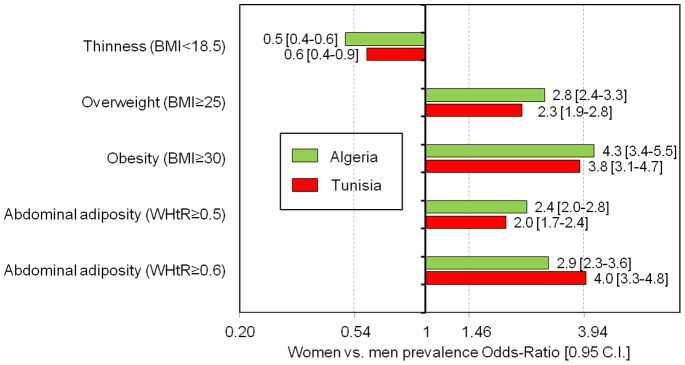
Figure 1. Gender contrasts of overall and abdominal adiposity among Algerian and Tunisian 35–70 year old adults.
Women vs. men prevalence proportion odd-ratios weighted estimates for overall and abdominal adiposity, by country (Algeria women: n = 2742, men: n = 2004; Tunisia women: n = 2964, men: n = 2379). BMI: Body Mass Index in kg/m2, WHtR: Waist (cm) to Height (cm) Ratio. C.I.: 0.95 confidence interval adjusted for sampling design.
Figure 2
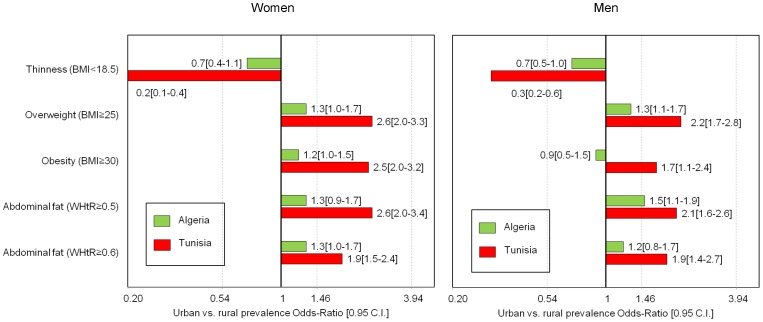
Figure 2. Urban vs. rural contrasts of overall and abdominal adiposity among Algerian and Tunisian 35–70 year old adults, by gender.
Urban vs. rural prevalence proportion odd-ratios weighted estimates for overall and abdominal adiposity, by gender and country (Women Algeria: urban n = 1735, rural: n = 1007; women Tunisia: urban n = 1638, rural: n = 1326; men Algeria: urban n = 1185, rural: n = 819; men Tunisia: urban n = 1423, rural: n = 956). BMI: Body Mass Index in kg/m2, WHtR: Waist (cm) to Height (cm) Ratio. C.I.: 0.95 confidence interval adjusted for sampling design.
Figure 3
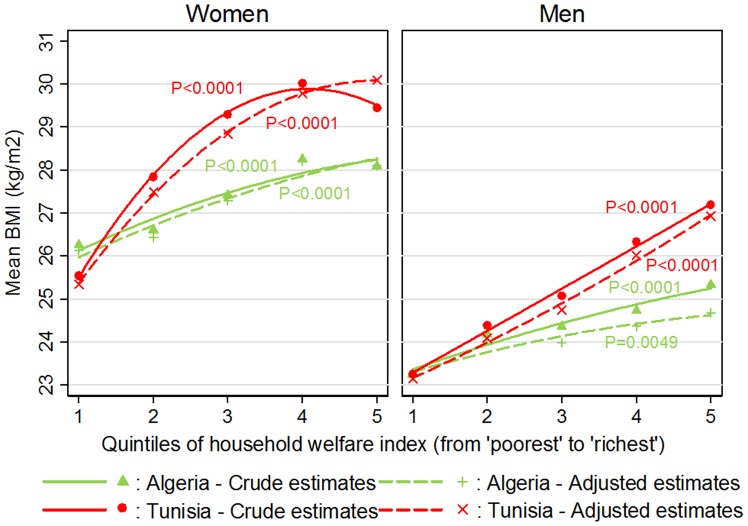
Figure 3. Association between the household welfare index and Body Mass Index among 35–70 year old Algerian and Tunisian adults, by gender.
Association between quintiles of the asset-based household welfare index and Body Mass Index among Algerian and Tunisian adults, by gender. Comparison of unadjusted or adjusted (for age, marital status, education, and profession) BMI means by general linear models taking into account sampling design: P-value for null hypothesis of no difference in unadjusted or adjusted BMI means between quintiles of household welfare. Trends interpolated by quadratic fit. Complete case analysis (Algeria women: n = 2678, men: n = 1944, Tunisia women: n = 2725, men: n = 2238).

References

    1. Popkin BM, Adair LS, Ng SW (2012) Global nutrition transition and the pandemic of obesity in developing countries. Nutr Rev 70: 3–21. - PMC - PubMed
    1. Musaiger AO (2011) Overweight and obesity in eastern mediterranean region: prevalence and possible causes. J Obes 2011: 407237. - PMC - PubMed
    1. Wells JC (2011) The thrifty phenotype: An adaptation in growth or metabolism? Am J Hum Biol 23: 65–75. - PubMed
    1. McLaren L (2007) Socioeconomic status and obesity. Epidemiol Rev 29: 29–48. - PubMed
    1. Subramanian SV, Perkins JM, Ozaltin E, Smith GD (2011) Weight of nations: a socioeconomic analysis of women in low- to middle-income countries. Am J Clin Nutr 93: 413–421. - PMC - PubMed

Publication types