. 2013 Oct 7;8(10):e76749.
doi: 10.1371/journal.pone.0076749. eCollection 2013.

Mutation in the kv3.3 voltage-gated potassium channel causing spinocerebellar ataxia 13 disrupts sound-localization mechanisms

Affiliations

Mutation in the kv3.3 voltage-gated potassium channel causing spinocerebellar ataxia 13 disrupts sound-localization mechanisms

John C Middlebrooks et al. PLoS One. .

Abstract

Normal sound localization requires precise comparisons of sound timing and pressure levels between the two ears. The primary localization cues are interaural time differences, ITD, and interaural level differences, ILD. Voltage-gated potassium channels, including Kv3.3, are highly expressed in the auditory brainstem and are thought to underlie the exquisite temporal precision and rapid spike rates that characterize brainstem binaural pathways. An autosomal dominant mutation in the gene encoding Kv3.3 has been demonstrated in a large Filipino kindred manifesting as spinocerebellar ataxia type 13 (SCA13). This kindred provides a rare opportunity to test in vivo the importance of a specific channel subunit for human hearing. Here, we demonstrate psychophysically that individuals with the mutant allele exhibit profound deficits in both ITD and ILD sensitivity, despite showing no obvious impairment in pure-tone sensitivity with either ear. Surprisingly, several individuals exhibited the auditory deficits even though they were pre-symptomatic for SCA13. We would expect that impairments of binaural processing as great as those observed in this family would result in prominent deficits in localization of sound sources and in loss of the "spatial release from masking" that aids in understanding speech in the presence of competing sounds.


Conflict of interest statement

Competing Interests: The authors have declared that no competing interests exist.

Figures

Figure 1
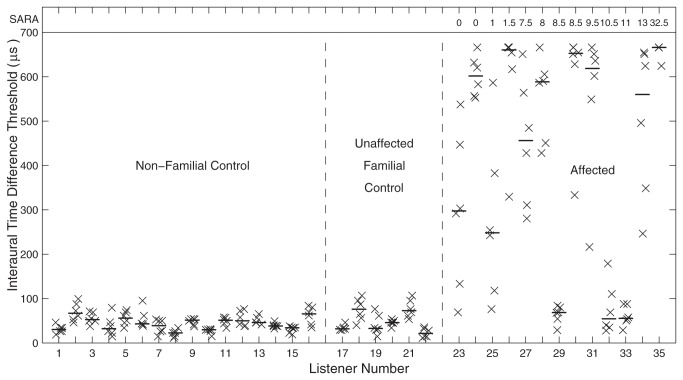
Figure 1. Interaural-time-difference (ITD) thresholds.
Groups of listeners are sorted by non-familial control, unaffected familial control, and affected groups, and the affected listeners are sorted by their SARA scores, which indicate degree of cerebellar ataxia as described in the text. SARA scores for affected listeners are given as the row of numbers at the top of the figure. Each vertical column of X's represents ITD thresholds for one listener measured using a 3-down-1-up adaptive procedure. The horizontal line segment in each column indicates the median value for that listener. Horizontal positions of symbols are jittered to improve readability.
Figure 2
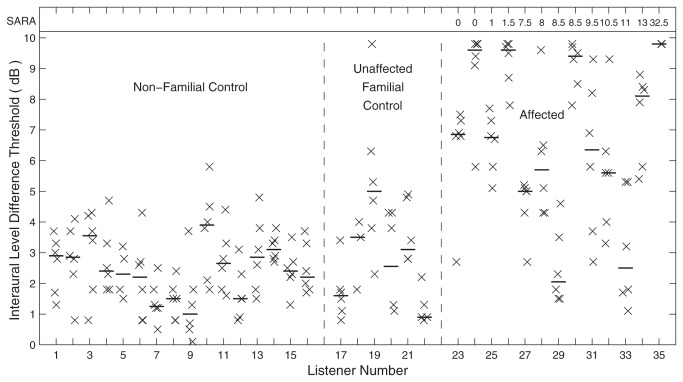
Figure 2. Interaural-level-difference (ILD) thresholds.
Each vertical column of X's represents ILD thresholds for one listener measured using a 3-down-1-up adaptive procedure. The horizontal line segment in each column indicates the median value for that listener. All other conventions are as in Figure 1.
Figure 3
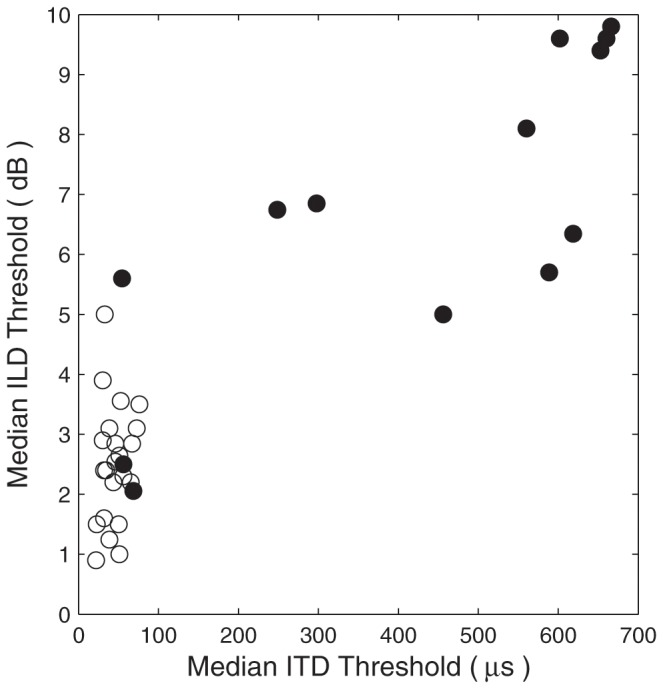
Figure 3. Relationship of ILD and ITD sensitivity.
Each symbol represents data from one listener, with median ILD thresholds and median ITD thresholds plotted in the vertical and horizontal dimensions, respectively. Open circles represent non-familial and unaffected familial control listeners, and filled symbols represent affected listeners.

References

    1. Zwislocki J, Feldman RS (1956) Just noticeable differences in dichotic phase. J Acoust Soc Am 28: 860-864. doi:10.1121/1.1908495. - DOI
    1. Yost WA (1974) Discriminations of interaural phase differences. J Acoust Soc Am 55: 1299-1303. doi:10.1121/1.1914701. PubMed: 4846726. - DOI - PubMed
    1. Mills AW (1960) Lateralization of high-frequency tones. J Acoust Soc Am 32: 132-134. doi:10.1121/1.1907864. - DOI
    1. Grigg JJ, Brew HM, Tempel BL (2000) Differential expression of voltage-gated ptassium channel genes in auditory nuclei of the mouse brainstem. Hear Res 140: 77-90. doi:10.1016/S0378-5955(99)00187-2. PubMed: 10675636. - DOI - PubMed
    1. Li W, Kaczmarek LK, Perney TM (2001) Localization of two high-threshold potassium channel subunits in the rat central auditory system. J Comp Neurol 437: 196-218. doi:10.1002/cne.1279. PubMed: 11494252. - DOI - PubMed

Publication types

MeSH terms

Substances

Supplementary concepts