


Adverse outcomes associated with media exposure to contradictory nutrition messages
- PMID: 24117281
- PMCID: PMC4353569
- DOI: 10.1080/10810730.2013.798384
Adverse outcomes associated with media exposure to contradictory nutrition messages
Abstract
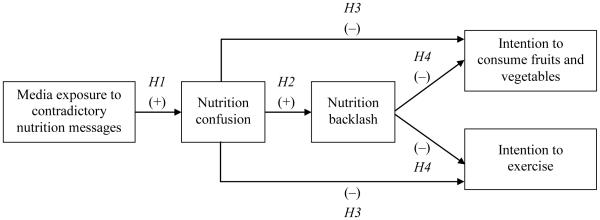
There is increasing concern that the media present conflicting health information on topics including cancer screening and nutrition. Although scholars have speculated that exposure to this information leads to increased public confusion, less trust in health recommendations, and less engagement in health behaviors, there is a lack of empirical research that directly addresses the role of media exposure to conflicting information. Using data from the Annenberg National Health Communication Survey, this study finds that exposure to conflicting information on the health benefits and risks of, for example, wine, fish, and coffee consumption is associated with confusion about what foods are best to eat and the belief that nutrition scientists keep changing their minds. There is evidence that these beliefs, in turn, may lead people to doubt nutrition and health recommendations more generally-including those that are not rife with contradictory information (e.g., fruit/vegetable consumption, exercise). The implications of these findings for healthy eating campaigns and interventions are discussed.
Figures
References
-
- American Dietetic Association Position of the American Dietetic Association: Total diet approach to communicating food and nutrition information. Journal of the American Dietetic Association. 2007;107:1224–1232. - PubMed
-
- Angell M, Kassirer JP. Clinical research: What should the public believe? New England Journal of Medicine. 1994;331:189–190. - PubMed
-
- Annenberg National Health Communication Survey (ANHCS) ANHCS overview. 2007 Retrieved October 18, 2011, from http://anhcs.asc.upenn.edu/ - PubMed
-
- Baron RM, Kenny DA. The moderator-mediator variable distinction in social psychological research: Conceptual, strategic, and statistical considerations. Journal of Personality and Social Psychology. 1986;51:1173–1182. - PubMed
-
- Basu AJ, Hogard E. Fit for public consumption? An exploratory study of the reporting of nutrition research in UK tabloids with regard to its accuracy, and a preliminary investigation of public attitudes towards it. Public Health Nutrition. 2008;11:1124–1131. - PubMed
Publication types
MeSH terms
Grants and funding
LinkOut - more resources
Full Text Sources
Other Literature Sources