


Functional outcomes of child and adolescent oppositional defiant disorder symptoms in young adult men
- PMID: 24117754
- PMCID: PMC3944082
- DOI: 10.1111/jcpp.12150
Functional outcomes of child and adolescent oppositional defiant disorder symptoms in young adult men
Abstract
Background: Oppositional defiant disorder(ODD) is considered to be a disorder of childhood, yet evidence suggests that prevalence rates of the disorder are stable into late adolescence and trajectories of symptoms persist into young adulthood. Functional outcomes associated with ODD through childhood and adolescence include conflict within families, poor peer relationships, peer rejection, and academic difficulties. Little examination of functional outcomes in adulthood associated with ODD has been undertaken.
Method: Data for the present analyses come from a clinic referred sample of 177 boys aged 7-12 followed up annually to age 18 and again at age 24. Annual parental report of psychopathology through adolescence was used to predict self-reported functional outcomes at 24.
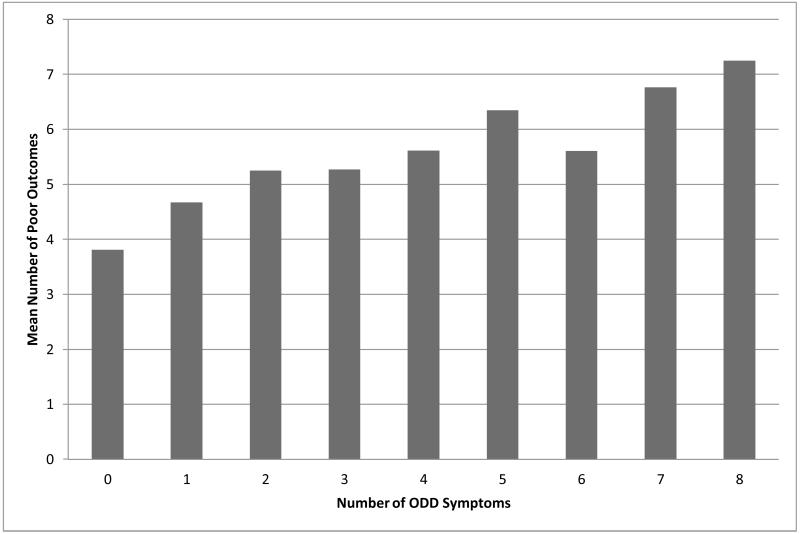
Results: Controlling for parent reported symptoms of attention deficit hyperactivity disorder (ADHD), Conduct disorder (CD), depression and anxiety, ODD symptoms from childhood through adolescence predicted poorer age 24 functioning with peers, poorer romantic relationships, a poorer paternal relationship, and having nobody who would provide a recommendation for a job. CD symptoms predicted workplace problems, poor maternal relationship, lower academic attainment, and violent injuries. Only parent reported ODD symptoms and child reported CD symptoms predicted a composite of poor adult outcomes.
Conclusion: Oppositional defiant disorder is a disorder that significantly interferes with functioning, particularly in social or interpersonal relationships. The persistence of impairment associated with ODD into young adulthood calls for a reconsideration of ODD as a disorder limited to childhood.
Keywords: Oppositional defiant disorder; adulthood; impairment; outcomes.
© 2013 The Authors. Journal of Child Psychology and Psychiatry © 2013 Association for Child and Adolescent Mental Health.
Figures
References
-
- American Psychiatric Association. American Psychiatric Association . Diagnostic and statistical manual of mental disorders: DSM-IV. 4th ed. American Psychiatric Association; Washington, DC: 1994. Task Force on DSM-IV.
-
- Barkley RA, Edwards G, Laneri M, Fletcher K, Metevia L. Executive functioning, temporal discounting, and sense of time in adolescents with attention deficit hyperactivity disorder (ADHD) and oppositional defiant disorder (ODD) Journal of Abnormal Child Psychology. 2001;29(6):541–556. - PubMed
-
- Bolea B, Adamou M, Arif M, Asherson P, Gudjonsson G, Muller U, Young S. ADHD matures: time for practitioners to do the same? Journal of Psychopharmacology. 2012;26(6):766–770. - PubMed
-
- Boylan K, Vaillancourt T, Boyle M, Szatmari P. Comorbidity of internalizing disorders in children with oppositional defiant disorder. European Child & Adolescent Pscyhiatry. 2007;16(8):484–494. - PubMed
-
- Boylan K, Vaillancourt T, Szatmari P. Linking oppositional behaviour trajectories to the development of depressive symptoms in childhood. Child Psychiatry and Human Development. 2012;43:484–497. - PubMed
Publication types
MeSH terms
Grants and funding
LinkOut - more resources
Full Text Sources
Other Literature Sources
Medical
