Review
. 2013 Nov;256(1):282-99.
doi: 10.1111/imr.12114.

Actin cytoskeletal defects in immunodeficiency

Affiliations
Free PMC article
Review

Actin cytoskeletal defects in immunodeficiency

Dale A Moulding et al. Immunol Rev. 2013 Nov.
Free PMC article

Erratum in

  • Corrigendum.
    [No authors listed] [No authors listed] Immunol Rev. 2016 May;271(1):293. doi: 10.1111/imr.12421. Immunol Rev. 2016. PMID: 27088922 Free PMC article. No abstract available.

Abstract

The importance of the cytoskeleton in mounting a successful immune response is evident from the wide range of defects that occur in actin-related primary immunodeficiencies (PIDs). Studies of these PIDs have revealed a pivotal role for the actin cytoskeleton in almost all stages of immune system function, from hematopoiesis and immune cell development, through to recruitment, migration, intercellular and intracellular signaling, and activation of both innate and adaptive immune responses. The major focus of this review is the immune defects that result from mutations in the Wiskott-Aldrich syndrome gene (WAS), which have a broad impact on many different processes and give rise to clinically heterogeneous immunodeficiencies. We also discuss other related genetic defects and the possibility of identifying new genetic causes of cytoskeletal immunodeficiency.

Keywords: WASp neutropenia; actin cytoskeleton; immunodeficiency.


Figures

Figure 1
Figure 1
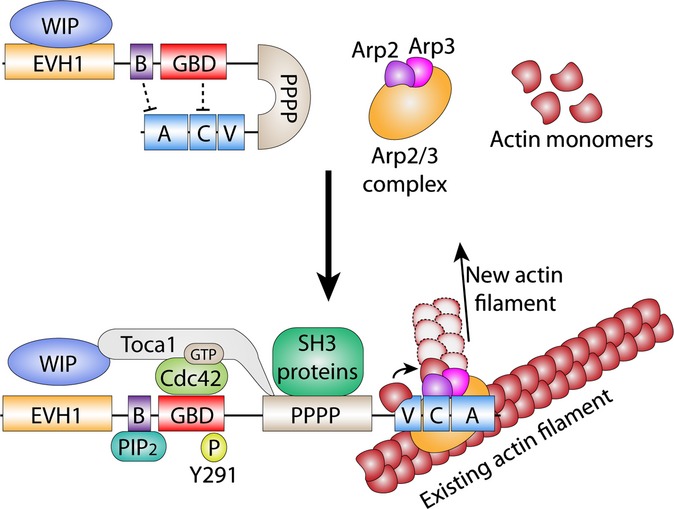
WASp domain structure, interacting proteins, and activation. Cytosolic WASp exists in an auto-inhibited conformation, with the VCA domain tethered to the GBD and basic domains. This inactive state is stabilized by WIP binding to the EVH1 domain. WASp is activated by a variety of signals, including GTP-Cdc42, PIP2, and Y291 phosphorylation by SH3 kinases recruited by the polyproline domain. Toca1 aids WASp activation by displacing WIP, binds GTP-Cdc42, and is required for PIP2 activation of WASp. Activation is restricted to the cell cortex where PIP2 and GTP-Cdc42 are present. Upon activation, the VCA domain is free to bind to and activate Arp2/3. Active Arp2/3 then attaches to an existing actin filament, where Arp2 and Arp3 form the template for a new actin filament branched at a 70° angle from the parent filament.

References

    1. Campellone KG, Welch MD. A nucleator arms race: cellular control of actin assembly. Nat Rev Mol Cell Biol. 2010;11:237–251. - PMC - PubMed
    1. Mullins RD, Heuser JA, Pollard TD. The interaction of Arp2/3 complex with actin: nucleation, high affinity pointed end capping, and formation of branching networks of filaments. Proc Natl Acad Sci USA. 1998;95:6181–6186. - PMC - PubMed
    1. Welch MD, Iwamatsu A, Mitchison TJ. Actin polymerization is induced by Arp2/3 protein complex at the surface of Listeria monocytogenes. Nature. 1997;385:265–269. - PubMed
    1. Goley ED, Welch MD. The ARP2/3 complex: an actin nucleator comes of age. Nat Rev Mol Cell Biol. 2006;7:713–726. - PubMed
    1. Pollard TD, Cooper JA. Actin, a central player in cell shape and movement. Science. 2009;326:1208–1212. - PMC - PubMed

Publication types

MeSH terms

Substances

LinkOut - more resources