


Poor prognosis of rare sarcomeric gene variants in patients with dilated cardiomyopathy
- PMID: 24119082
- PMCID: PMC3865161
- DOI: 10.1111/cts.12116
Poor prognosis of rare sarcomeric gene variants in patients with dilated cardiomyopathy
Abstract
Background: In dilated cardiomyopathy (DCM), the clinical and prognostic implications of rare variants in sarcomeric genes remain poorly understood. To address this question, we analyzed the outcome of rare sarcomeric gene variants in patients enrolled in our Familial Cardiomyopathy Registry.
Methods: DCM families harboring rare sarcomeric variants in MYH6, MYH7, MYBPC3, TNNT2, and TTN were identified. Genotype-phenotype association analysis was performed, and long-term survival-free from death or heart transplant was compared between carriers and noncarriers.
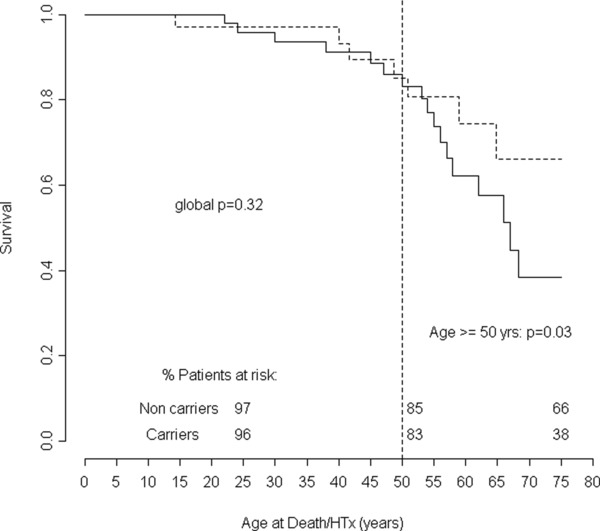
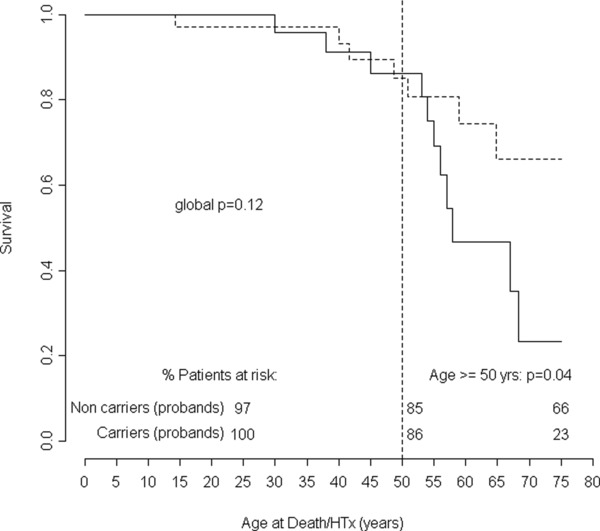
Results: We found 24 rare variants (3 in MYH6, 3 in MYH7, 3 in MYBPC3, 2 in TNNT2, and 13 in TTN) affecting 52 subjects in 25 families. The phenotypes of variant carriers were severe (3 sudden deaths, 6 heart failure deaths, 8 heart transplants, 2 ventricular fibrillations). There was no difference in the overall long-term survival between carriers and the 33 noncarriers (p = 0.322). However after 50 years of age, the combined endpoint of death or transplant was decreased in carriers as compared to noncarriers (p = 0.026).
Conclusions: Patients with DCM carrying rare variants in sarcomeric genes manifest a poorer prognosis as compared to noncarriers after the age of 50 years. These data further support the role of genetic testing in DCM for risk stratification.
Keywords: cardiomyopathy; genes; genetics; molecular genetics; phenotyping; prognosis.
© 2013 Wiley Periodicals, Inc.
Figures
References
-
- Richardson P, McKenna W, Bristow M, Maisch B, Mautner B, O‘Connell J, Olsen E, Thiene G, Goodwin J, Gyarfas I, et al. Report of the 1995 World Health Organization/International Society and Federation of Cardiology Task Force on the Definition and Classification of cardiomyopathies. Circulation 1996; 93: 841–842. - PubMed
-
- Baig MK, Goldman JH, Caforio ALP, Coonar AS, Keeling PJ, McKenna WJ. Familial dilated cardiomyopathy: cardiac abnormalities are common in asymptomatic relatives and may represent early disease. J Am Coll Cardiol. 1998; 31: 195–201. - PubMed
-
- Mestroni L, Rocco C, Gregori D, Sinagra G, Di Lenarda A, Miocic S, Vatta M, Pinamonti B, Muntoni F, Caforio AL, et al. Familial dilated cardiomyopathy: evidence for genetic and phenotypic heterogeneity. J Am Coll Cardiol. 1999; 34: 181–190. - PubMed
-
- Watkins H, Ashrafian H, Redwood C. Inherited cardiomyopathies. N Engl J Med. 2011; 364: 1643–1656. - PubMed
Publication types
MeSH terms
Substances
Supplementary concepts
Grants and funding
LinkOut - more resources
Full Text Sources
Other Literature Sources
Research Materials
Miscellaneous
