. 2013 Oct 21;23(20):2011-5.
doi: 10.1016/j.cub.2013.08.015. Epub 2013 Oct 10.

Rapid innate defensive responses of mice to looming visual stimuli

Affiliations

Rapid innate defensive responses of mice to looming visual stimuli

Melis Yilmaz et al. Curr Biol. .

Abstract

Much of brain science is concerned with understanding the neural circuits that underlie specific behaviors. While the mouse has become a favorite experimental subject, the behaviors of this species are still poorly explored. For example, the mouse retina, like that of other mammals, contains ∼20 different circuits that compute distinct features of the visual scene [1, 2]. By comparison, only a handful of innate visual behaviors are known in this species--the pupil reflex [3], phototaxis [4], the optomotor response [5], and the cliff response [6]--two of which are simple reflexes that require little visual processing. We explored the behavior of mice under a visual display that simulates an approaching object, which causes defensive reactions in some other species [7, 8]. We show that mice respond to this stimulus either by initiating escape within a second or by freezing for an extended period. The probability of these defensive behaviors is strongly dependent on the parameters of the visual stimulus. Directed experiments identify candidate retinal circuits underlying the behavior and lead the way into detailed study of these neural pathways. This response is a new addition to the repertoire of innate defensive behaviors in the mouse that allows the detection and avoidance of aerial predators.


Figures

Figure 1
Figure 1. A dark expanding disc in the upper visual field triggers flight and freezing
(a) Schematic of the experimental setup: a box with a display monitor (M) on the ceiling and an opaque nest (N) in a corner. Multiple cameras monitor the animal’s movements, from which one can measure the distance (D) to the nest. (b) Expansion of the looming stimulus in time from 2 degrees to 20 degrees. (c) An example trajectory of the mouse ~3 seconds before (green) and after (red) stimulus onset. The outline of the box shows the boundaries of the arena. Each tick is 33 ms. (d) Distance of the mouse from the nest before and during the stimulus. Example traces for flight (red) and freezing (purple) behaviors. Gray trace indicates the repetitions of the looming stimulus. See also Supplementary Movies 1 and 2. (e) Detail of the flight trace in (d) to emphasize the onset of the run to the nest in relationship to the disc expansion from 2 to 20 degrees.
Figure 2
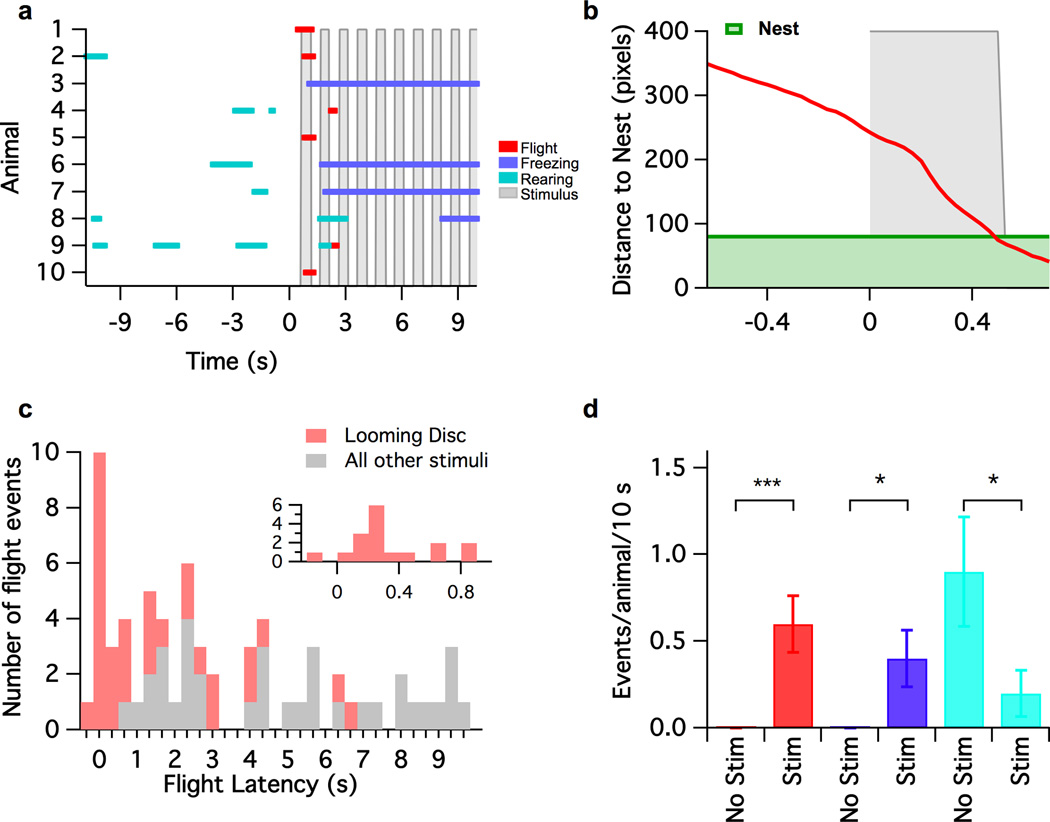
Figure 2. Statistics of reactions to the looming stimulus
(a) Occurrences of flight, freezing, and upward rearing behaviors 10 s before and after stimulus onset. (b) Distance of mouse 1 to the nest before and after the stimulus. The speed increases more than 2-fold at 0.2 s after stimulus onset. (c) Histogram of flight latencies for looming stimuli (red) and all other stimuli tested (gray). The inset shows the distribution of sub-second flight events. (d) Probability of each of the three behaviors before and after stimulus onset. Error bars show standard error of the mean.
Figure 3
Figure 3. The frequency and speed of defensive behaviors depend strongly on stimulus parameters
(a–d) Comparison of four stimulus displays: black looming disc (a), white looming disc (b), white receding disc (c), dimming disc (d). For each condition an ethogram indicates occurrence of three behaviors after stimulus onset at time 0: flight (red), freezing (purple), and upward rearing (cyan). The experimental sequence was b-c-d-a. (e) Frequency of sub-second flight in each of the four disc displays from panels a-d. (f) Frequency of sub-second flight after addition of a patterned background, either static or moving. (g–h) Frequency of upward rearing events under the stimulus conditions of panels e-f. (i–k) Flight latencies observed in 10 animals under the four disc displays (i), as a function of expansion rate of a dark disc (j), and as a function of background pattern (k). Each trace is from a different animal. Error bars show standard error of the mean.

Comment in

References

    1. Masland RH. The neuronal organization of the retina. Neuron. 2012;76:266–280. - PMC - PubMed
    1. Gollisch T, Meister M. Eye smarter than scientists believed: Neural computations in circuits of the retina. Neuron. 2010;65:150–164. - PMC - PubMed
    1. Chen SK, Badea TC, Hattar S. Photoentrainment and pupillary light reflex are mediated by distinct populations of ipRGCs. Nature. 2011;476:92–95. - PMC - PubMed
    1. Bourin M, Hascoet M. The mouse light/dark box test. Eur J Pharmacol. 2003;463:55–65. - PubMed
    1. Prusky GT, Alam NM, Beekman S, Douglas RM. Rapid quantification of adult and developing mouse spatial vision using a virtual optomotor system. Invest Ophthalmol Vis Sci. 2004;45:4611–4616. - PubMed

Publication types