Review
. 2014 Apr;10(4):1542-57.
doi: 10.1016/j.actbio.2013.10.001. Epub 2013 Oct 9.

Designing protein-based biomaterials for medical applications

Affiliations
Review

Designing protein-based biomaterials for medical applications

Jennifer E Gagner et al. Acta Biomater. 2014 Apr.

Abstract

Biomaterials produced by nature have been honed through billions of years, evolving exquisitely precise structure-function relationships that scientists strive to emulate. Advances in genetic engineering have facilitated extensive investigations to determine how changes in even a single peptide within a protein sequence can produce biomaterials with unique thermal, mechanical and biological properties. Elastin, a naturally occurring protein polymer, serves as a model protein to determine the relationship between specific structural elements and desirable material characteristics. The modular, repetitive nature of the protein facilitates the formation of well-defined secondary structures with the ability to self-assemble into complex three-dimensional architectures on a variety of length scales. Furthermore, many opportunities exist to incorporate other protein-based motifs and inorganic materials into recombinant protein-based materials, extending the range and usefulness of these materials in potential biomedical applications. Elastin-like polypeptides (ELPs) can be assembled into 3-D architectures with precise control over payload encapsulation, mechanical and thermal properties, as well as unique functionalization opportunities through both genetic and enzymatic means. An overview of current protein-based materials, their properties and uses in biomedicine will be provided, with a focus on the advantages of ELPs. Applications of these biomaterials as imaging and therapeutic delivery agents will be discussed. Finally, broader implications and future directions of these materials as diagnostic and therapeutic systems will be explored.

Keywords: Biomimetic materials; Elastin-like peptides; Molecular imaging; Nanotherapeutics; Recombinant polypeptides.


Figures

Fig. 1
Fig. 1
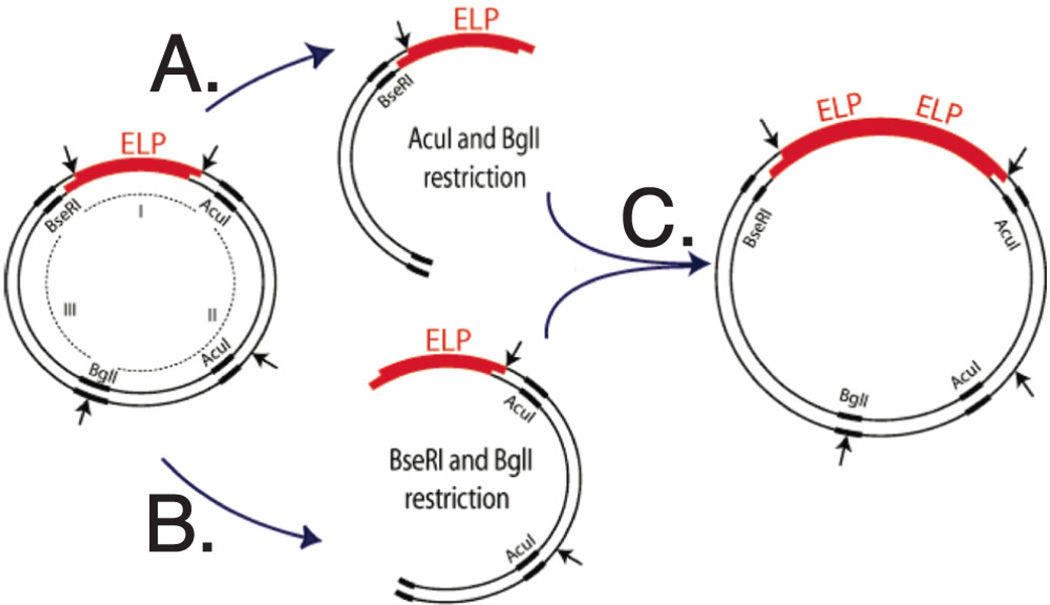
Recursive directional ligation by plasmid reconstruction (Pre-RDL). In order to produce peptide oligomers with no extraneous peptides at the junction, two halves of a parent plasmid are ligated together. (A) The ELP-containing fragment is purified from the parent vector after digestion with AcuI and Bgll. (B) The parent ELP is also digested with BseRI and Bgll. (C) The two compatible halves are then reconstituted into the original vector, doubling the length of the insert. Reprinted with permission from [28]. Copyright (2010) American Chemical Society.
Fig. 2
Fig. 2
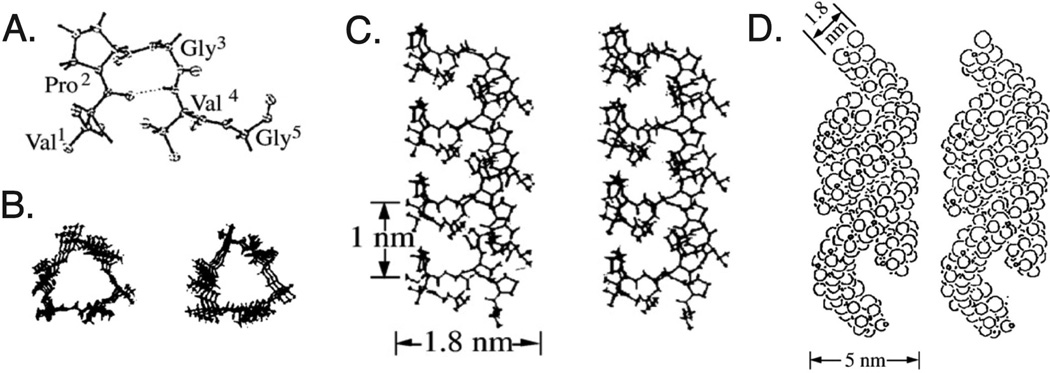
Proposed structure of poly(GVGVP) based on extensive characterization. (A) The pentapeptide sequence Val-Pro-Gly-Val-Gly, with the (B) β-spiral formed though connections between the Val-Gly-Val segments. The side view of the spiral (C) reveals the pitch of the β-turns to be ~ 1 nm. These spirals can then assemble into filaments (D) or other 3D architectures. Adapted with permission from [199]. Copyright (1980) American Chemical Society.
Fig. 3
Fig. 3
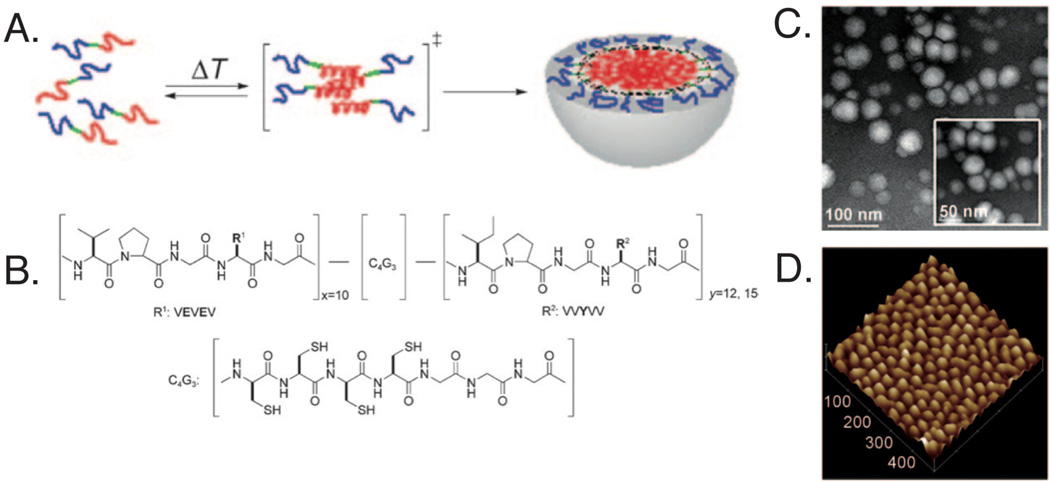
Developed elastin-like peptide for self-assembly into micelles. Upon heating, the (A) hydrophobic blocks (red) assemble into micelles with the hydrophilic blocks (blue) creating an outer shell and the cysteine containing regions (green) at the interface. (B) Chemical structure of synthesized amphiphilic diblock polypeptide, where ADP1 (x10y12) and ADP2 (x10y15). Micelles were characterized using (C) transmission electron microscopy and (D) atomic force microscopy, with ADP1 forming ~ 28 nm spheres with low polydispersity. Reprinted with permission from [70]. Copyright 2010 Wiley-VCH Verlag GmbH & Co. KGaA, Weinheim.
Fig. 4
Fig. 4
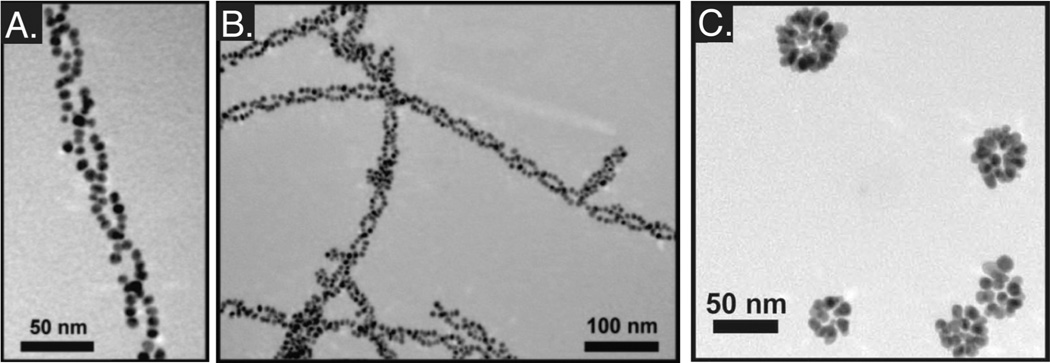
Synthesis and assembly of topographically complex hybrid materials. (A) Highly ordered double helices are formed using an organic molecule, PEPAu with an aliphatic carbon tail on the N-terminus. (B) By adding chloroauric acid (HAuCl4) to the solution, additional structures were formed in a precipitate. This work has been extended to spherical superstructures (C), including hollow spherical gold nanoparticles templated with structurally modified PEPAu. (A, B) Reprinted with permission from [108]. Copyright 2010 Wiley-VCH Verlag GmbH & Co. KGaA, Weinheim. (C) Reprinted with permission from [104]. Copyright (2008) American Chemical Society.
Fig. 5
Fig. 5
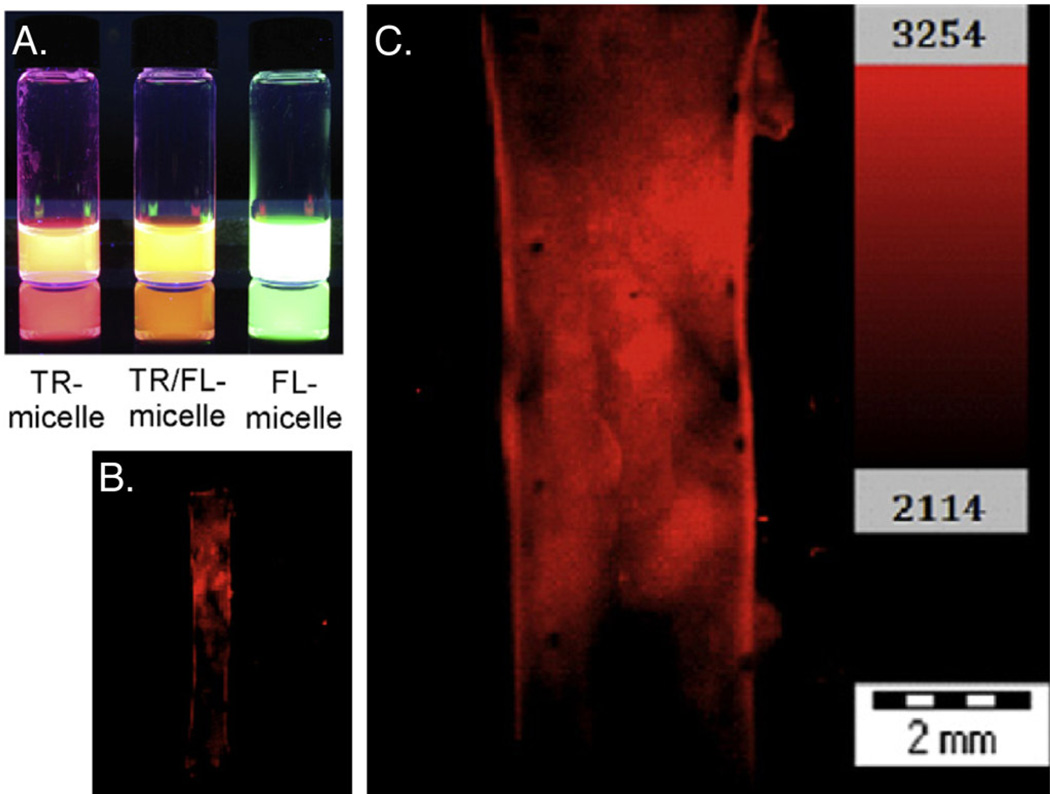
Development of fluorescent-dye labeled micelles for in vivo imaging. (A) UV illumination of aqueous dispersions of Texas Red (TR)-micelle, Texas Red/fluorescein micelle, and a fluorescein-micelle. (B) It was found that in the rat aortic balloon injury model, TR-micelles accumulated only in the injury zone (defined by Evans Blue), with (C) significant penetration correlated to areas of greater injury (6× magnification). Reprinted from [113]. Copyright (2012), with permission from Elsevier.
Fig. 6
Fig. 6
Use of self-assembling chimeric polypeptide-doxorubicin (CP-Dox nanoparticles for tumor therapy. (A) Concentration of free Dox and CP-Dox in the tumor at 2 and 24 hours after systemic injection. (B) Concentration of Dox and CP-Dox in heart tissues at 2 and 24 hours. (C) Tumor volume after administration of Dox and CP-Dox 15 days after implantation. A substantial increase in animal survival was correlated with administration of CP-Dox. Laser scanning confocal microscopy images of C26 cells (blue) showing cellular uptake of CP-Dox (red) at (D) 5 min, (E) 30 min and (F) 24 hours. Scale bar: 20 µM. Reprinted by permission from Macmillan Publishers Ltd: Nature Materials [150], copyright 2009.
Fig. 7
Fig. 7
In vivo investigation of plaque distribution and protease activity in the iliac artery. An activable near infra-red fluorescent (NIRF) imaging agent was utilized to provide contrast for a pull-back scan on a monorail NIRF catheter (A) with areas of intensity shown. (B) An intravascular ultrasound (IVUS) of the same region was overlaid and provided both structural and molecular information for arterial information in atheroma and coronary stent-induced vascular injury. Reprinted from [188], Copyright (2011) with permission from Elsevier.
Fig. 8
Fig. 8
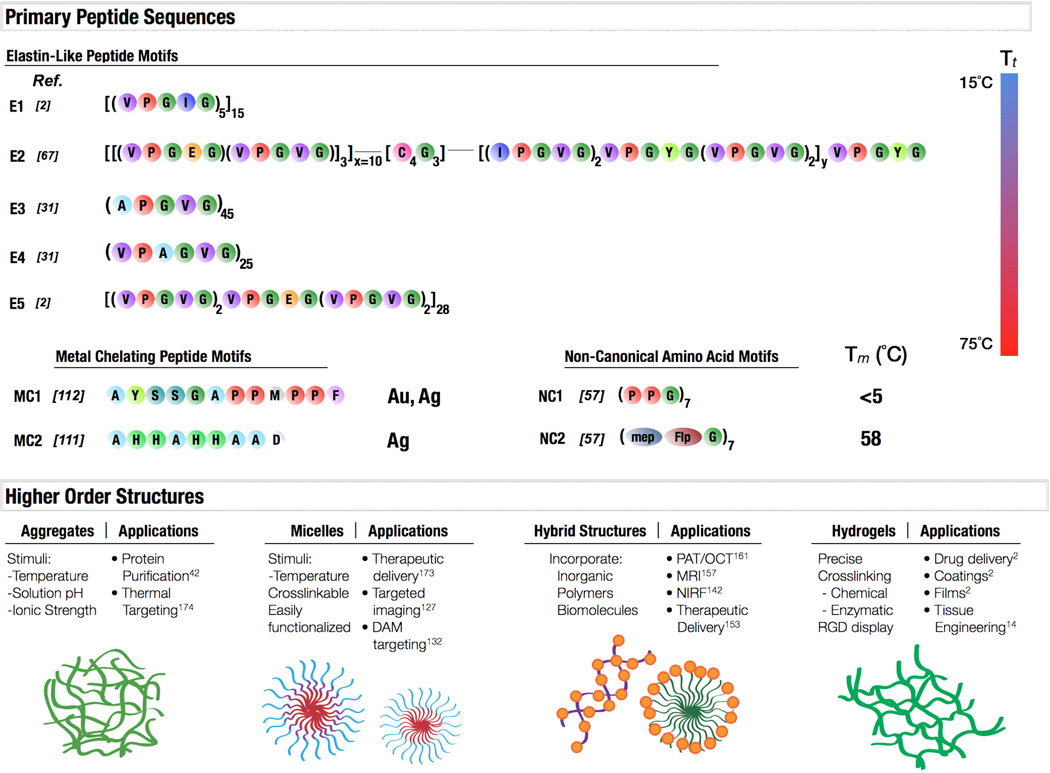
A schematic depicting primary peptide sequences, associated properties, and potential applications. Elastin-like polypeptides E1-E5 exhibit transition temperatures between 15°C and 75°C. E1 and E5 are elastomeric-like. E2 is an amphiphilic diblock copolymer with an intermediate crosslinking domain. E3 and E4 represent potential for hexapeptide elastin-like motifs, shown to have a wide range of temperature and structural variability. Polypeptides have also been identified which chelate metallic ions, such as MC1, which is capable of capturing both gold and silver. MC2 has been shown to efficiently bind silver. Further expansion of the basic collagen motif, NC1, with modified prolines (2S,4R)-4-methylproline (mep) and (2S,4R)-4-fluoroproline (Flp) showed how side chain modification could stabilize the collagen triple helix, concepts that could be applied to many protein motifs. These protein motifs can then organize into higher order structures in response to environmental stimuli or composition, such as protein aggregates, micelles, hybrid organic-inorganic structures, and hydrogels. All of these protein materials can be utilized in a variety of applications.

References

    1. Urry DW, Urry KD, Szaflarski W, Nowicki M. Elastic-contractile model proteins: physical chemistry, protein function and drug design and delivery. Adv Drug Deliv Rev. 2010;62:1404–1455. - PubMed
    1. Kim W, Chaikof EL. Recombinant elastin-mimetic biomaterials: Emerging applications in medicine. Adv Drug Deliv Rev. 2010;62:1468–1478. - PMC - PubMed
    1. Kamaly N, Xiao Z, Valencia PM, Radovic-Moreno AF, Farokhzad OC. Targeted polymeric therapeutic nanoparticles: design, development and clinical translation. Chem Soc Rev. 2012;41:2971. - PMC - PubMed
    1. Chen C-Y, Kim TH, Wu W-C, Huang C-M, Wei H, Mount CW, et al. pH-dependent, thermosensitive polymeric nanocarriers for drug delivery to solid tumors. Biomaterials. 2013;34:4501–4509. - PMC - PubMed
    1. Tatham AS, Shewry PR. Elastomeric proteins: biological roles, structures and mechanisms. Trends Biochem Sci. 2000;25:567–571. - PubMed