. 2013:4:2585.
doi: 10.1038/ncomms3585.

Evidence for distinct human auditory cortex regions for sound location versus identity processing

Affiliations

Evidence for distinct human auditory cortex regions for sound location versus identity processing

Jyrki Ahveninen et al. Nat Commun. 2013.

Abstract

Neurophysiological animal models suggest that anterior auditory cortex (AC) areas process sound identity information, whereas posterior ACs specialize in sound location processing. In humans, inconsistent neuroimaging results and insufficient causal evidence have challenged the existence of such parallel AC organization. Here we transiently inhibit bilateral anterior or posterior AC areas using MRI-guided paired-pulse transcranial magnetic stimulation (TMS) while subjects listen to Reference/Probe sound pairs and perform either sound location or identity discrimination tasks. The targeting of TMS pulses, delivered 55-145 ms after Probes, is confirmed with individual-level cortical electric-field estimates. Our data show that TMS to posterior AC regions delays reaction times (RT) significantly more during sound location than identity discrimination, whereas TMS to anterior AC regions delays RTs significantly more during sound identity than location discrimination. This double dissociation provides direct causal support for parallel processing of sound identity features in anterior AC and sound location in posterior AC.


Conflict of interest statement

The authors declare no competing financial interests.

Figures
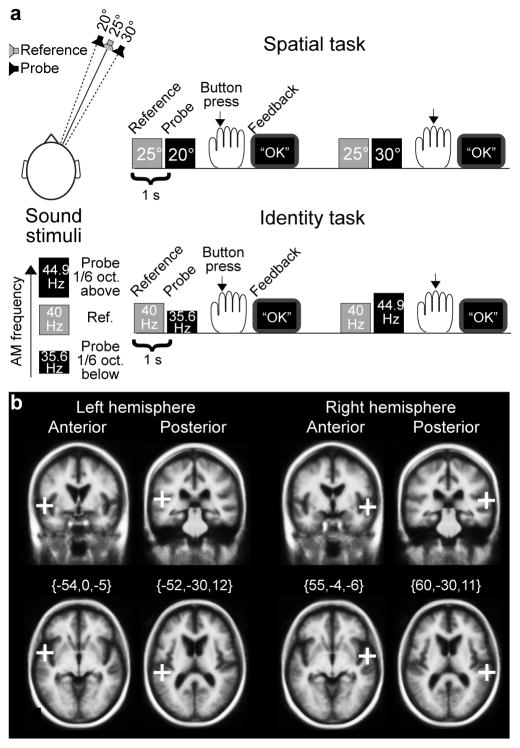
Figure 1
Figure 1
Study design. (a) Stimuli and tasks. In the Spatial task, subjects discriminated whether Probe was simulated from 5° to the left or 5° to the right relative to Reference (25° to the right). In the Identity task, subjects discriminated whether Probe sound had 1/6 octaves lower or higher AM frequency than the AM frequency of Reference (40 Hz). Feedback was presented at a computer screen after each trial in both tasks. (b) Initial TMS target locations. In 50% of the trials, paired TMS pulses were delivered 55–145 ms after Probe sound onsets, bilaterally to either the posterior or anterior target regions of AC, shown here in the Freesurfer standard brain (i.e., Montreal Neurological Institute 305; MNI305) in Talairach coordinates. For each subject, target regions were transformed through the Talairach coordinate systems. Using navigated TMS, the coil was positioned to maximally stimulate the cortical area of interest. After the experiments, TMS-induced E-fields were estimated in each subject’s cortical surface using physical modeling, to localize the maximally stimulated AC subregions (Fig 4).
Figure 2
Figure 2
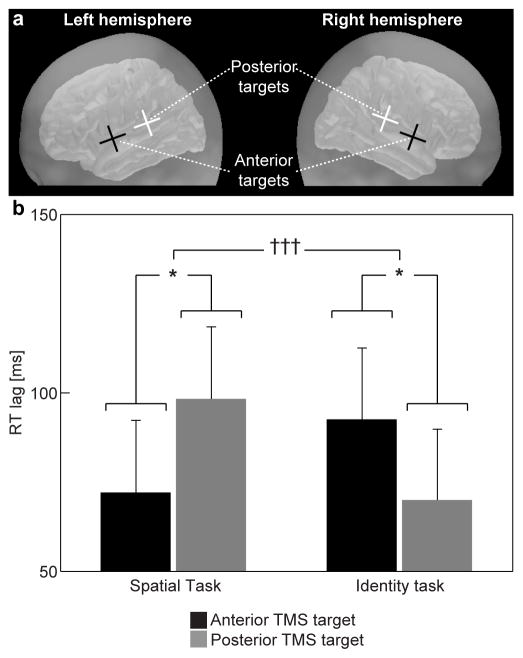
TMS-induced RT lags during Spatial and Identity tasks. (a) Schematic illustration of the approximate TMS coil center locations during bilateral anterior vs. posterior stimulation. (b) Estimated marginal means and standard errors of RT lags derived from the linear mixed model, with the different stimulation latencies pooled together (N=10). These data show a significant interaction between the task and TMS target factors, suggesting brain location-specific performance modulations during auditory Identity vs. Spatial tasks. This result provides causal support for the theory of two distinct AC areas for sound identity and location processing , , which has previously been suggested in humans based on neuroimaging activation studies. ††† PMCMC = 0.001, task by target location interaction of the linear mixed model; * P < 0.05, a priori comparison of task-specific effects across the TMS target loci derived from the linear mixed model.
Figure 3
Figure 3
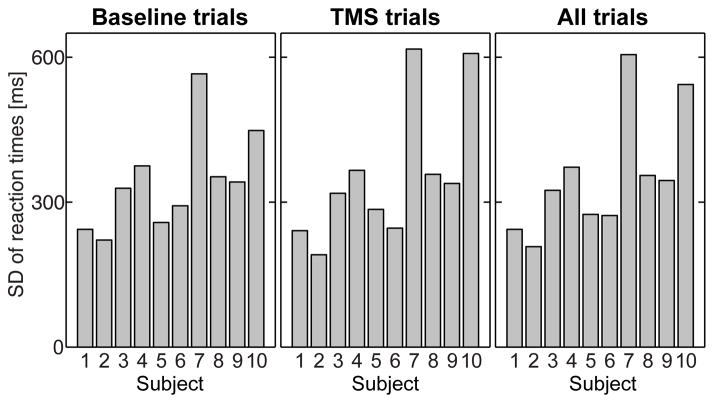
Standard deviation of individual-trial RTs in the population of 10 subjects. SDs of RTs are shown during trials without TMS (left), during TMS (middle), and across all trials (right). The variance of RT performance was relatively homogeneous across subjects, apart from two subjects (7 and 10) that demonstrated a higher level of variance than the other subjects. This potential bias was taken into account in the linear mixed model by using least-squares weighting of the regression coefficients by the inverse variance of each subjects’ behavioral performance.
Figure 4
Figure 4
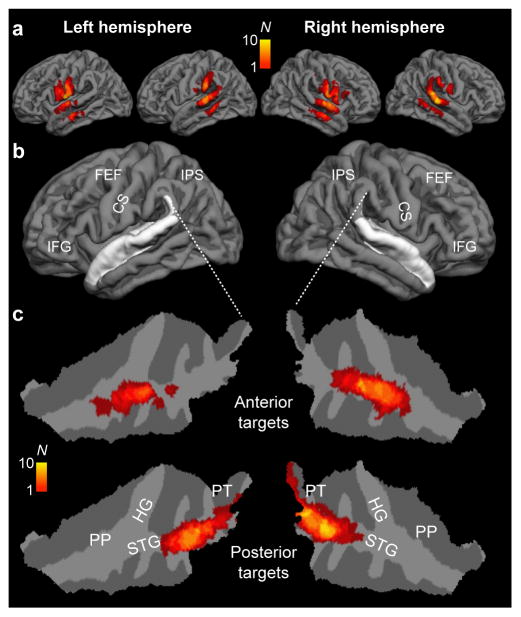
Modeling of TMS-induced E-fields in the cortex. (a) Distribution of TMS effects exceeding 80% motor threshold (MT) strength during TMS in all subjects (N=10), shown on a standard brain cortical reconstruction. (b) Gross anatomical landmarks of interest shown on the standard-brain cortex. The location of superior temporal cortices, which encompass ACs has been shown in white. The loci of central sulcus (CS), and extra-AC areas related to “what” (inferior frontal gyrus, IFG) and “where” (intraparietal sulcus, IPS; frontal eye fields, FEF) processing streams are also shown. (c) TMS-induced electric fields in AC on flattened patches of the superior temporal cortices. Taken together, our modeling results demonstrate that TMS-induced E-fields were successfully delivered at the posterior (posterior STG, PT) vs. anterior AC areas (anterior STG, PP), hypothesized to be associated with sound location vs. identity feature discrimination, respectively. As expected, TMS also induced E-fields in the adjacent cortical gyri. However, the panel a shows that these fields were not close to the frontoparietal areas typically associated with extra-AC “where” (IPS/FEF) and “what” (IFG) processing. The color scale depicts the number of subjects with stimulation reaching the threshold at a given location.

References

    1. Rauschecker JP, Tian B. Mechanisms and streams for processing of “what” and “where” in auditory cortex. Proc Natl Acad Sci U S A. 2000;97:11800–11806. - PMC - PubMed
    1. Tian B, Reser D, Durham A, Kustov A, Rauschecker JP. Functional specialization in rhesus monkey auditory cortex. Science. 2001;292:290–293. - PubMed
    1. Ahveninen J, et al. Task-modulated “what” and “where” pathways in human auditory cortex. Proc Natl Acad Sci U S A. 2006;103:14608–14613. - PMC - PubMed
    1. Lomber SG, Malhotra S. Double dissociation of ‘what’ and ‘where’ processing in auditory cortex. Nat Neurosci. 2008;11:609–616. - PubMed
    1. Romanski LM, et al. Dual streams of auditory afferents target multiple domains in the primate prefrontal cortex. Nat Neurosci. 1999;2:1131–1136. - PMC - PubMed

Publication types

LinkOut - more resources