


Optimism, social support, and mental health outcomes in patients with advanced cancer
- PMID: 24123339
- PMCID: PMC4001848
- DOI: 10.1002/pon.3418
Optimism, social support, and mental health outcomes in patients with advanced cancer
Abstract
Objective: Optimism and social support serve as protective factors against distress in medically ill patients. Very few studies have specifically explored the ways in which these variables interact to impact quality of life (QOL), particularly among patients with advanced cancer. The present study examined the role of optimism as a moderator of the relationship between social support and anxiety, depression, hopelessness, and QOL among patients with advanced cancer.
Methods: Participants (N = 168) completed self-report assessments of psychosocial, spiritual, and physical well-being, including social support, optimism, hopelessness, depressive and anxious symptoms, and QOL. Hierarchical multiple regression analyses were conducted to determine the extent to which social support and optimism were associated with depressive and anxious symptomatology, hopelessness and QOL, and the potential role of optimism as a moderator of the relationship between social support and these variables.
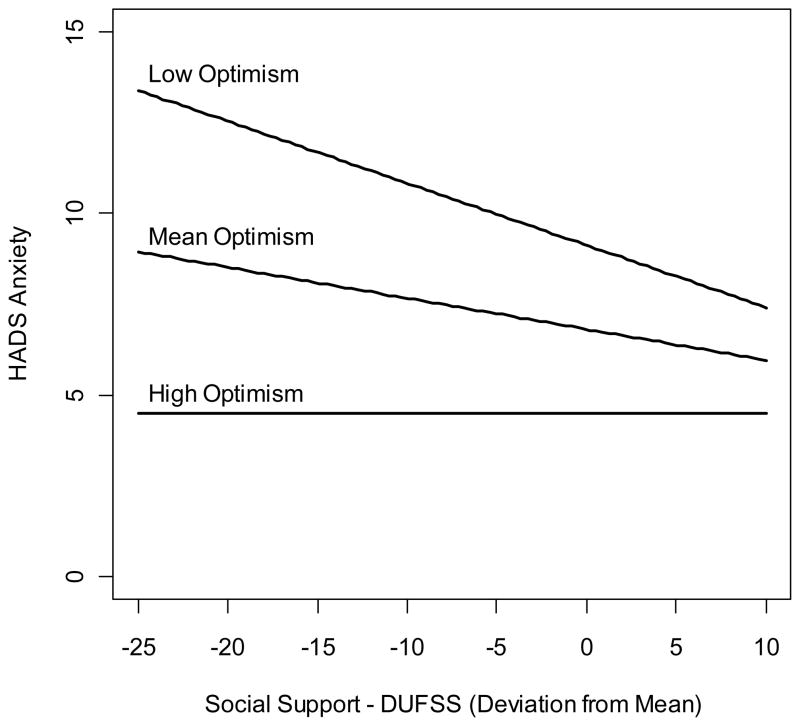
Results: Higher levels of optimism were significantly associated with fewer anxious and depressive symptoms, less hopelessness, and better QOL. Higher levels of perceived social support were also significantly associated with better QOL. Additionally, optimism moderated the relationship between social support and anxiety, such that there was a strong negative association between social support and anxiety for participants with low optimism.
Conclusions: This study highlights the importance of optimism and social support in the QOL of patients with advanced cancer. As such, interventions that attend to patients' expectations for positive experiences and the expansion of social support should be the focus of future clinical and research endeavors.
Keywords: advanced cancer; optimism; psychological distress; quality of life; social support.
Copyright © 2013 John Wiley & Sons, Ltd.
Conflict of interest statement
Conflict of interest:
There is no conflict of interest.
References
-
- Bonanno GA. Loss, trauma, and human resilience: Have we underestimated the human capacity to thrive after extremely aversive events? The American Psychologist. 2004;59(1):20–28. - PubMed
-
- Bonanno GA, Kennedy P, Galatzer-Levy IR, Lude P, Elfstrom ML. Trajectories of resilience, depression, and anxiety following spinal cord injury. Rehabilitation Psychology. 2012;57(3):236–247. - PubMed
-
- Bonanno GA, Westphal M, Mancini AD. Resilience to loss and potential trauma. Annual Review of Clinical Psychology. 2011;7:511–535. - PubMed
-
- Wu LM, Sheen JM, Shu HL, Chang SC, Hsiao CC. Predictors of anxiety and resilience in adolescents undergoing cancer treatment. Journal of Advanced Nursing. 2013;69(1):158–166. - PubMed
-
- Schrier M, Amital D, Arnson Y, Rubinow A, Altaman A, Nissenabaum B, et al. Association of fibromyalgia characteristics in patients with non-metastatic breast cancer and the protective role of resilience. Rheumatology International. 2012;32(10):3017–3023. - PubMed
Publication types
MeSH terms
Grants and funding
LinkOut - more resources
Full Text Sources
Other Literature Sources
Medical
