


Bacteriophage orphan DNA methyltransferases: insights from their bacterial origin, function, and occurrence
- PMID: 24123737
- PMCID: PMC3837797
- DOI: 10.1128/AEM.02229-13
Bacteriophage orphan DNA methyltransferases: insights from their bacterial origin, function, and occurrence
Abstract
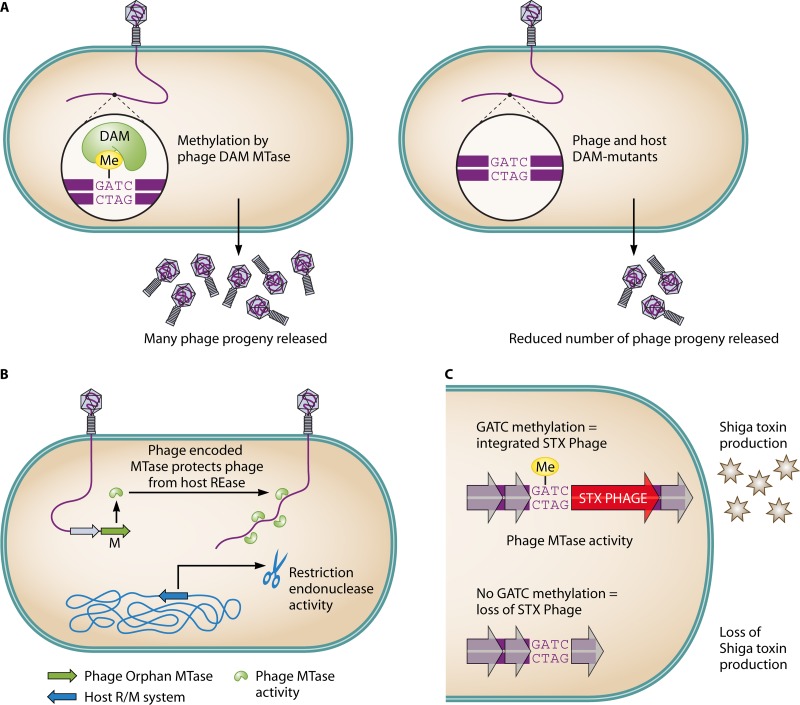
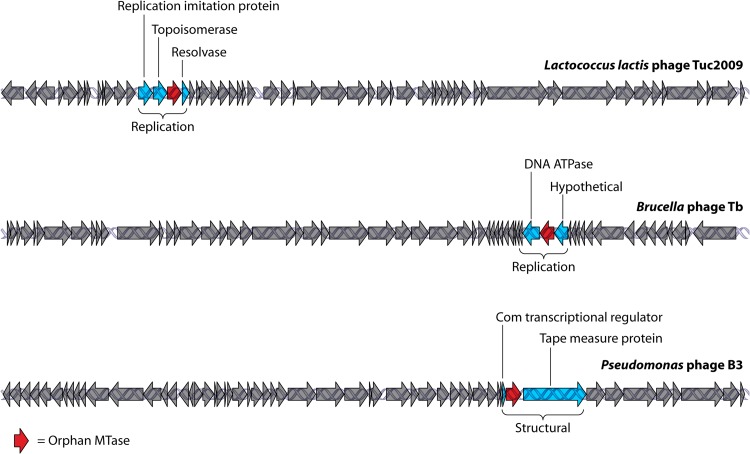
Type II DNA methyltransferases (MTases) are enzymes found ubiquitously in the prokaryotic world, where they play important roles in several cellular processes, such as host protection and epigenetic regulation. Three classes of type II MTases have been identified thus far in bacteria which function in transferring a methyl group from S-adenosyl-l-methionine (SAM) to a target nucleotide base, forming N-6-methyladenine (class I), N-4-methylcytosine (class II), or C-5-methylcytosine (class III). Often, these MTases are associated with a cognate restriction endonuclease (REase) to form a restriction-modification (R-M) system protecting bacterial cells from invasion by foreign DNA. When MTases exist alone, which are then termed orphan MTases, they are believed to be mainly involved in regulatory activities in the bacterial cell. Genomes of various lytic and lysogenic phages have been shown to encode multi- and mono-specific orphan MTases that have the ability to confer protection from restriction endonucleases of their bacterial host(s). The ability of a phage to overcome R-M and other phage-targeting resistance systems can be detrimental to particular biotechnological processes such as dairy fermentations. Conversely, as phages may also be beneficial in certain areas such as phage therapy, phages with additional resistance to host defenses may prolong the effectiveness of the therapy. This minireview will focus on bacteriophage-encoded MTases, their prevalence and diversity, as well as their potential origin and function.
Figures





References
-
- Labrie SJ, Samson JE, Moineau S. 2010. Bacteriophage resistance mechanisms. Nat. Rev. Microbiol. 8:317–327 - PubMed
-
- Youell J, Firman K. 2012. Mechanistic insight into type I restriction endonucleases. Front. Biosci. 17:2122–2139 - PubMed
-
- Roberts RJ, Belfort M, Bestor T, Bhagwat AS, Bickle TA, Bitinaite J, Blumenthal RM, Degtyarev S, Dryden DT, Dybvig K, Firman K, Gromova ES, Gumport RI, Halford SE, Hattman S, Heitman J, Hornby DP, Janulaitis A, Jeltsch A, Josephsen J, Kiss A, Klaenhammer TR, Kobayashi I, Kong H, Kruger DH, Lacks S, Marinus MG, Miyahara M, Morgan RD, Murray NE, Nagaraja V, Piekarowicz A, Pingoud A, Raleigh E, Rao DN, Reich N, Repin VE, Selker EU, Shaw PC, Stein DC, Stoddard BL, Szybalski W, Trautner TA, Van Etten JL, Vitor JM, Wilson GG, Xu SY. 2003. A nomenclature for restriction enzymes, DNA methyltransferases, homing endonucleases and their genes. Nucleic Acids Res. 31:1805–1812 - PMC - PubMed
Publication types
MeSH terms
Substances
LinkOut - more resources
Full Text Sources
Other Literature Sources
Molecular Biology Databases
