


Feeding the probiotic Enterococcus faecium strain NCIMB 10415 to piglets specifically reduces the number of Escherichia coli pathotypes that adhere to the gut mucosa
- PMID: 24123741
- PMCID: PMC3837809
- DOI: 10.1128/AEM.03138-13
Feeding the probiotic Enterococcus faecium strain NCIMB 10415 to piglets specifically reduces the number of Escherichia coli pathotypes that adhere to the gut mucosa
Abstract
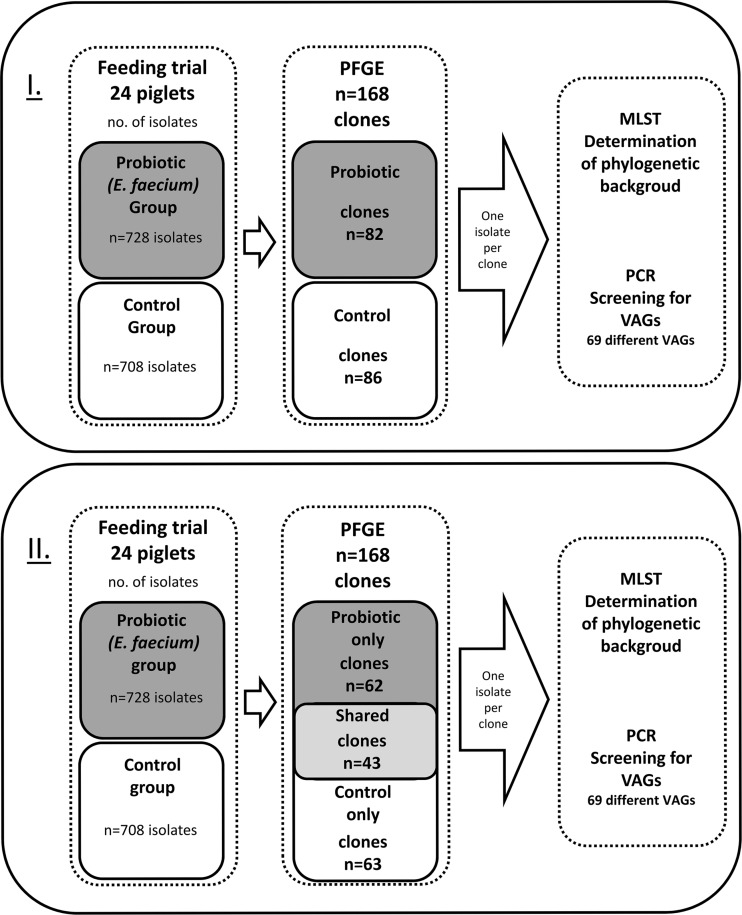
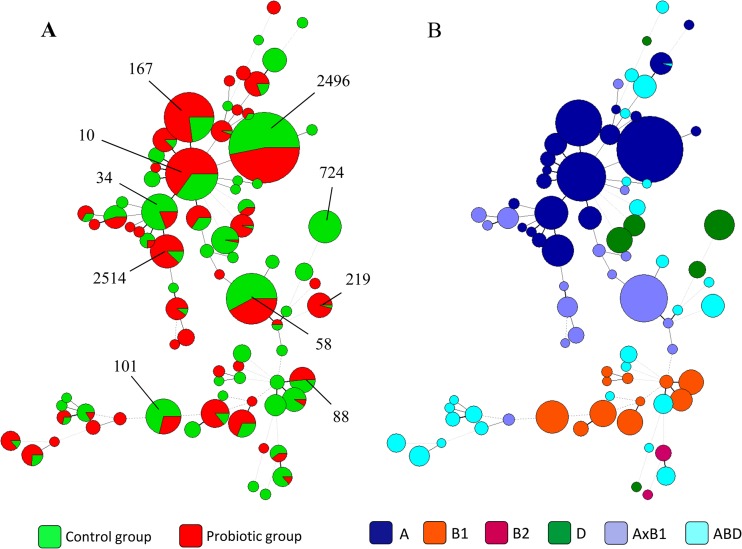
Feed supplementation with the probiotic Enterococcus faecium for piglets has been found to reduce pathogenic gut microorganisms. Since Escherichia coli is among the most important pathogens in pig production, we performed comprehensive analyses to gain further insight into the influence of E. faecium NCIMB 10415 on porcine intestinal E. coli. A total of 1,436 E. coli strains were isolated from three intestinal habitats (mucosa, digesta, and feces) of probiotic-supplemented and nonsupplemented (control) piglets. E. coli bacteria were characterized via pulsed-field gel electrophoresis (PFGE) for clonal analysis. The high diversity of E. coli was reflected by 168 clones. Multilocus sequence typing (MLST) was used to determine the phylogenetic backgrounds, revealing 79 sequence types (STs). Pathotypes of E. coli were further defined using multiplex PCR for virulence-associated genes. While these analyses discerned only a few significant differences in the E. coli population between the feeding groups, analyses distinguishing clones that were uniquely isolated in either the probiotic group only, the control group only, or both groups (shared group) revealed clear effects at the habitat level. Interestingly, extraintestinal pathogenic E. coli (ExPEC)-typical clones adhering to the mucosa were significantly reduced in the probiotic group. Our data show a minor influence of E. faecium on the overall population of E. coli in healthy piglets. In contrast, this probiotic has a profound effect on mucosa-adherent E. coli. This finding further substantiates a specific effect of E. faecium strain NCIMB 10415 in piglets against pathogenic E. coli in the intestine. In addition, these data question the relevance of data based on sampling fecal E. coli only.
Figures
References
-
- Gaskins HR, Collier CT, Anderson DB. 2002. Antibiotics as growth promotants: mode of action. Anim. Biotechnol. 13:29–42 - PubMed
-
- Dibner JJ, Richards JD. 2005. Antibiotic growth promoters in agriculture: history and mode of action. Poult. Sci. 84:634–643 - PubMed
-
- Casewell M, Friis C, Marco E, McMullin P, Phillips I. 2003. The European ban on growth-promoting antibiotics and emerging consequences for human and animal health. J. Antimicrob. Chemother. 52:159–161 - PubMed
-
- Casey PG, Gardiner GE, Casey G, Bradshaw B, Lawlor PG, Lynch PB, Leonard FC, Stanton C, Ross RP, Fitzgerald GF, Hill C. 2007. A five-strain probiotic combination reduces pathogen shedding and alleviates disease signs in pigs challenged with Salmonella enterica serovar Typhimurium. Appl. Environ. Microbiol. 73:1858–1863 - PMC - PubMed
-
- Taras D, Vahjen W, Simon O. 2007. Probiotics in pigs—modulation of their intestinal distribution and of their impact on health and performance. Livestock Sci. 108:229–231
Publication types
MeSH terms
Substances
LinkOut - more resources
Full Text Sources
Other Literature Sources
Molecular Biology Databases
