Local cAMP signaling in disease at a glance
- PMID: 24124191
- PMCID: PMC3795333
- DOI: 10.1242/jcs.133751
Local cAMP signaling in disease at a glance
Abstract
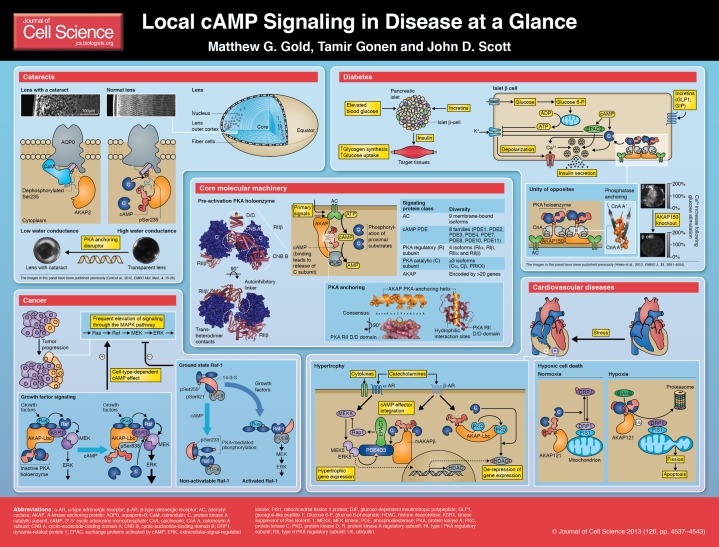
The second messenger cyclic AMP (cAMP) operates in discrete subcellular regions within which proteins that synthesize, break down or respond to the second messenger are precisely organized. A burgeoning knowledge of compartmentalized cAMP signaling is revealing how the local control of signaling enzyme activity impacts upon disease. The aim of this Cell Science at a Glance article and the accompanying poster is to highlight how misregulation of local cyclic AMP signaling can have pathophysiological consequences. We first introduce the core molecular machinery for cAMP signaling, which includes the cAMP-dependent protein kinase (PKA), and then consider the role of A-kinase anchoring proteins (AKAPs) in coordinating different cAMP-responsive proteins. The latter sections illustrate the emerging role of local cAMP signaling in four disease areas: cataracts, cancer, diabetes and cardiovascular diseases.
References
-
- Bauman A. L., Soughayer J., Nguyen B. T., Willoughby D., Carnegie G. K., Wong W., Hoshi N., Langeberg L. K., Cooper D. M., Dessauer C. W. et al. (2006). Dynamic regulation of cAMP synthesis through anchored PKA-adenylyl cyclase V/VI complexes. Mol. Cell 23, 925–931 10.1016/j.molcel.2006.07.025 - DOI - PMC - PubMed
-
- Bernstein H. G., Dobrowolny H., Schott B. H., Gorny X., Becker V., Steiner J., Seidenbecher C. I., Bogerts B. (2013). Increased density of AKAP5-expressing neurons in the anterior cingulate cortex of subjects with bipolar disorder. J. Psychiatr. Res. 47, 699–705 10.1016/j.jpsychires.2012.12.020 - DOI - PubMed
Publication types
MeSH terms
Substances
Grants and funding
LinkOut - more resources
Full Text Sources
Other Literature Sources