. 2013 Oct 4;8(10):e75072.
doi: 10.1371/journal.pone.0075072. eCollection 2013.

Comparative genomics reveals insight into virulence strategies of plant pathogenic oomycetes

Affiliations

Comparative genomics reveals insight into virulence strategies of plant pathogenic oomycetes

Bishwo N Adhikari et al. PLoS One. .

Abstract

The kingdom Stramenopile includes diatoms, brown algae, and oomycetes. Plant pathogenic oomycetes, including Phytophthora, Pythium and downy mildew species, cause devastating diseases on a wide range of host species and have a significant impact on agriculture. Here, we report comparative analyses on the genomes of thirteen straminipilous species, including eleven plant pathogenic oomycetes, to explore common features linked to their pathogenic lifestyle. We report the sequencing, assembly, and annotation of six Pythium genomes and comparison with other stramenopiles including photosynthetic diatoms, and other plant pathogenic oomycetes such as Phytophthora species, Hyaloperonospora arabidopsidis, and Pythium ultimum var. ultimum. Novel features of the oomycete genomes include an expansion of genes encoding secreted effectors and plant cell wall degrading enzymes in Phytophthora species and an over-representation of genes involved in proteolytic degradation and signal transduction in Pythium species. A complete lack of classical RxLR effectors was observed in the seven surveyed Pythium genomes along with an overall reduction of pathogenesis-related gene families in H. arabidopsidis. Comparative analyses revealed fewer genes encoding enzymes involved in carbohydrate metabolism in Pythium species and H. arabidopsidis as compared to Phytophthora species, suggesting variation in virulence mechanisms within plant pathogenic oomycete species. Shared features between the oomycetes and diatoms revealed common mechanisms of intracellular signaling and transportation. Our analyses demonstrate the value of comparative genome analyses for exploring the evolution of pathogenesis and survival mechanisms in the oomycetes. The comparative analyses of seven Pythium species with the closely related oomycetes, Phytophthora species and H. arabidopsidis, and distantly related diatoms provide insight into genes that underlie virulence.


Conflict of interest statement

Competing Interests: The authors have declared that no competing interests exist.

Figures

Figure 1
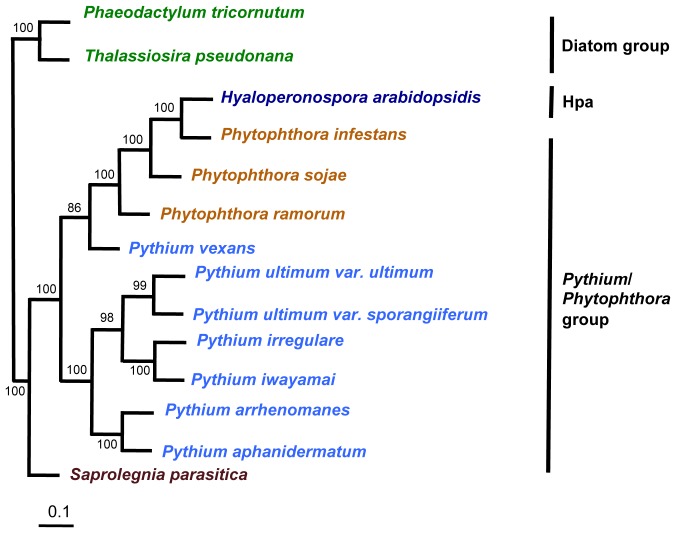
Figure 1. Phylogeny of oomycetes.
Phylogeny of the large rDNA subunit of select oomycetes as inferred by Bayesian analysis. The phylogenetic tree was constructed using rDNA sequences from 14 stramenopiles. Numbers on the branches are Bayesian posterior probability values calculated using MrBayes . Hpa, Hyaloperonospora arabidopsidis.
Figure 2
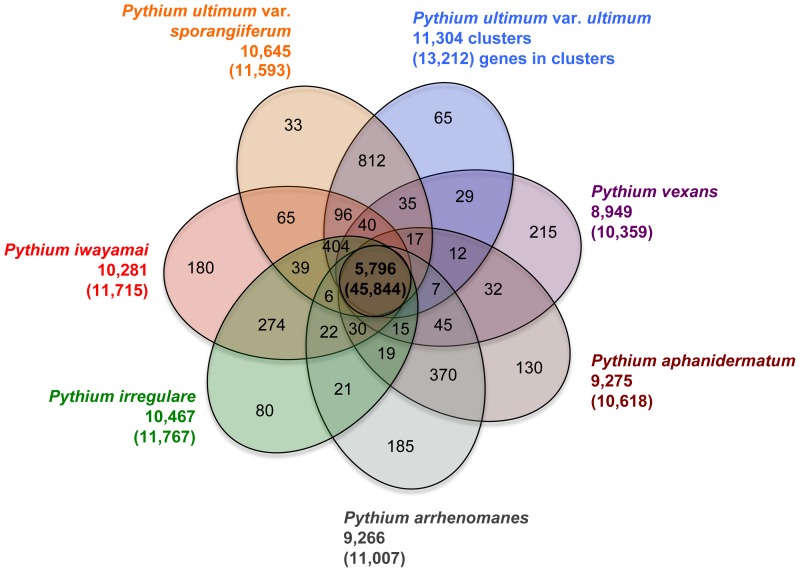
Figure 2. Gene families shared by Pythium species.
The predicted proteomes of the seven Pythium species were clustered using OrthoMCL to identify orthologs and close paralogs. The number of gene families shared between the species and total number of clustered genes (numbers in parentheses) are indicated. The numbers outside the Venn diagram show the total number of orthologous clusters and number of genes (in parentheses) within those clusters for each species. Pap, Pythium aphanidermatum; Par, Pythium arrhenomanes; Pir, Pythium irregulare; Piw, Pythium iwayamai; Puls, Pythium ultimum var. sporangiiferum; Pult, Pythium ultimum var. ultimum; Pve, Pythium vexans.
Figure 3
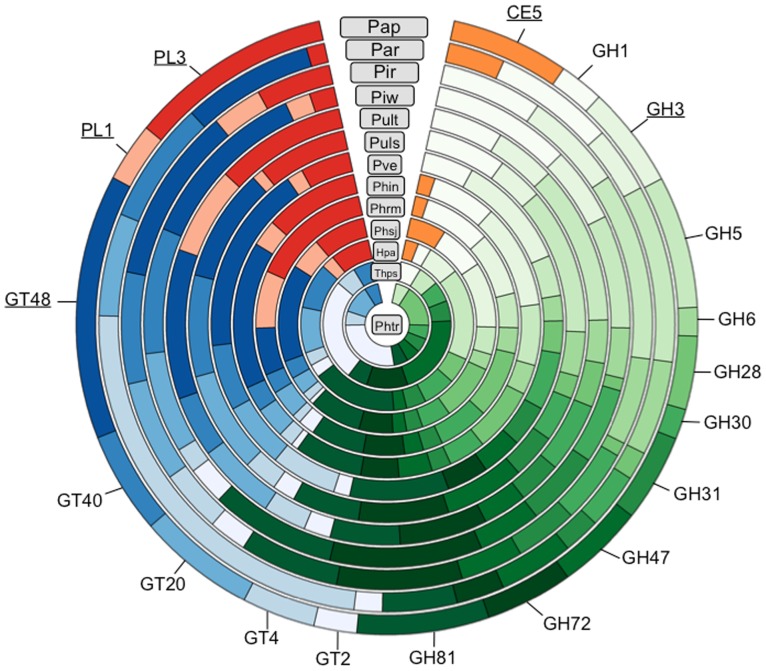
Figure 3. Distribution of various carbohydrate-active enzymes (CAZymes) in stramenopile genomes.
The CAZymes coding genes were annotated using the CAZymes Analysis Toolkit- CAT according to the CAZy database in combination with protein family domain analyses. Gene families absent in at least 2 species are underlined. Comparison of total CAZymes from different classes is listed in Table S6. CE, carbohydrate esterase; GH, glycoside hydrolase; GT, glycosyl transferase; PL, polysaccharide lyase; Pap, Pythium aphanidermatum; Par, Pythium arrhenomanes; Pir, Pythium irregulare; Piw, Pythium iwayamai; Pult, Pythium ultimum var. ultimum; Puls, Pythium ultimum var. sporangiiferum; Pve, Pythium vexans; Phin, Phytophthora infestans; Phrm, Phytophthora ramorum; Phsj, Phytophthora sojae; Hpa, Hyaloperonospora arabidopsidis; Thps, Thalassiosira pseudonana; Phtr, Phaeodactylum tricornutum.
Figure 4
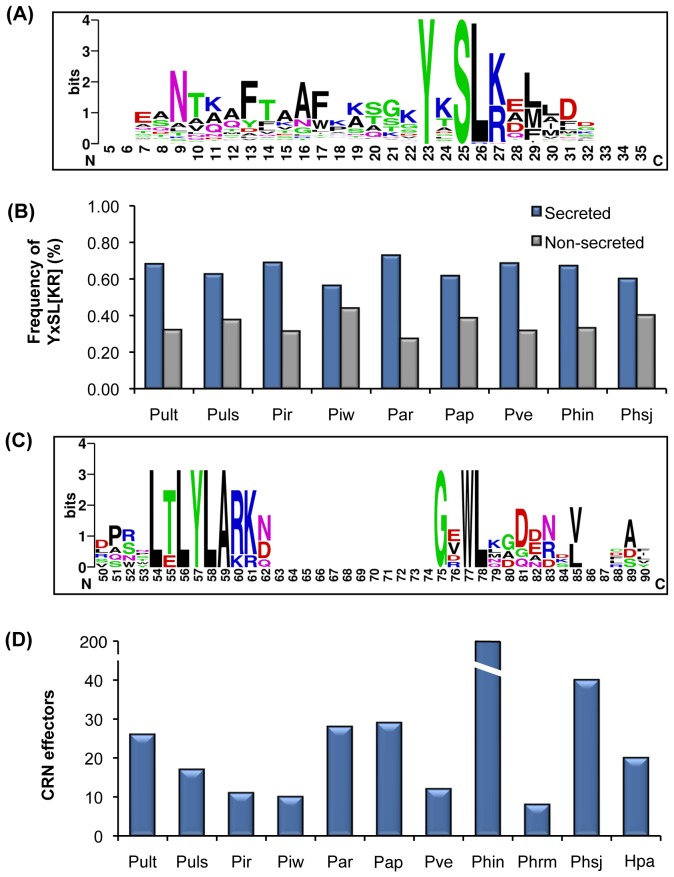
Figure 4. Candidate effector proteins from Pythium.
(A) The typical architecture of a YxSL[RK] effector candidate inferred from 141 sequences from seven Pythium species, Phytophthora infestans, and Phytophthora sojae. The consensus sequence pattern of the YxSL[RK] motif was calculated using WebLogo . The bigger the letter, the more conserved the amino acid site. Please note that the numbers in the sequence logo refer to the corresponding positions in the alignment and thus differ from the average position of the motifs. (B) The YxSL[RK] motif distribution in the proteomes of Pythium species, Phytophthora infestans and Phytophthora sojae is shown. The YxSL[RK] sequence is over-represented in the secretome of Pythium and Phytophthora species relative to the non-secreted proteome (P≤0.05). The YxSL[RK] motifs were counted only if they were within the first 30 to 150 residues from the signal peptide. The frequency was calculated as percentage of either all secreted proteins or all non-secreted proteins. Pult, Pythium ultimum var. ultimum; Puls, Pythium ultimum var. sporangiiferum; Pir, Pythium irregulare; Piw, Pythium iwayamai; Par, Pythium arrhenomanes; Pap, Pythium aphanidermatum; Pve, Pythium vexans; Phin, Phytophthora infestans; Phrm, Phytophthora ramorum; Phsj, Phytophthora sojae; Hpa, Hyaloperonospora arabidopsidis. (C) The typical architecture of an LxLYLAR/K effector motif inferred from 129 sequences from 7 Pythium species. The consensus sequence pattern of the LxLYLAR/K motif was calculated using WebLogo . The bigger the letter, the more conserved the amino acid site. Please note that the numbers in the sequence logo are referring to the corresponding positions in the alignment and thus differ from the average position of the motifs. (D) Number of CRN effector proteins in oomycetes. The number of candidate CRN effectors estimated by Hidden Markov Model (HMM) searches in combination with two other computational methods is shown. The number of CRN effectors from Pythium ultimum var. ultimum, Phytophthora species and H. arabidopsidis were taken from published genome datasets , , , . Pult, Pythium ultimum var. ultimum; Puls, Pythium ultimum var. sporangiiferum; Pir, Pythium irregulare; Piw, Pythium iwayamai; Par, Pythium arrhenomanes; Pap, Pythium aphanidermatum; Pve, Pythium vexans; Phin, Phytophthora infestans; Phrm, Phytophthora ramorum; Phsj, Phytophthora sojae; Hpa, Hyaloperonospora arabidopsidis.
Figure 5
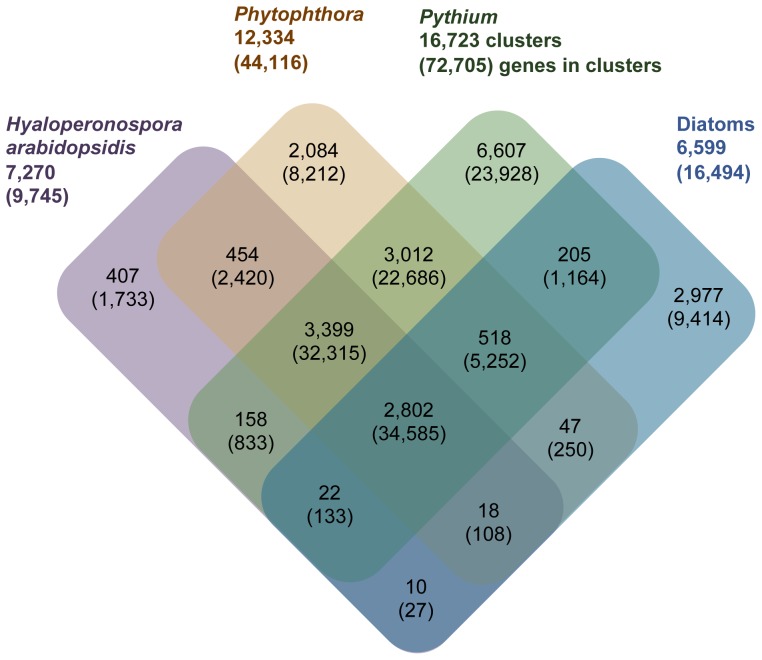
Figure 5. Orthologous gene families of Pythium species, Phytophthora species, Hyaloperonospora arabidopsidis and two diatom species.
Protein-coding genes from seven Pythium, three Phytophthora, two diatom species and Hyaloperonospora arabidopsidis were clustered using OrthoMCL . The number of gene families (clusters) and the total number of clustered genes (in parentheses) are indicated for each taxon and their interactions in the Venn diagram. The numbers outside the Venn diagram indicate the total number of orthologous clusters and number of genes (in parentheses) in the clusters for each taxon.
Figure 6
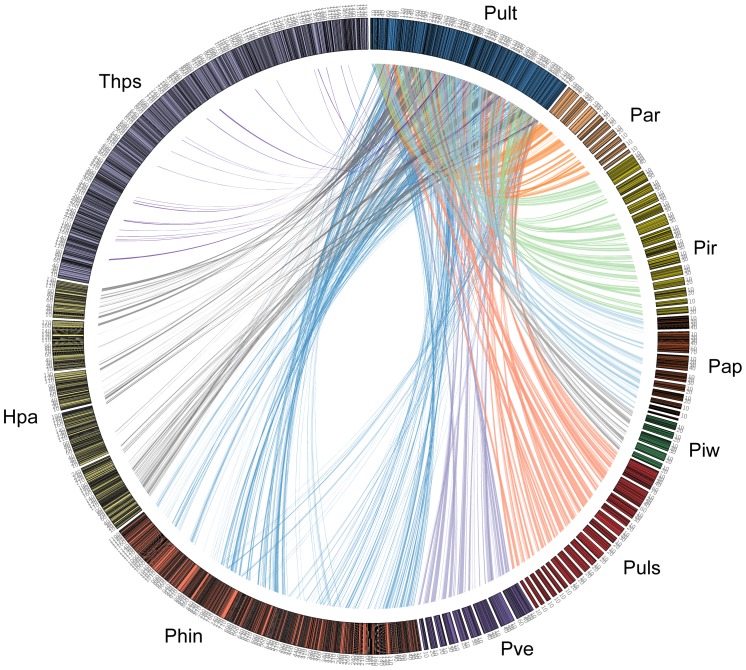
Figure 6. Syntenic analyses of stramenopile genomes.
The circle is a graphical representation of the selected regions from Pythium arrhenomanes (contigs 8, 17, 26, 41, 68, 131, 170, 285, 707) Pythium irregulare (contigs 28, 92, 103, 106, 119, 123, 129, 132, 140, 163, 195, 226, 372, 396), Pythium aphanidermatum (scaffolds 4, 6, 23, 80, 88, 96, 115, 150, 327), Pythium iwayamai (contigs 18, 28, 29, 61, 235), Pythium ultimum var. sporangiiferum (contigs 4, 6, 34, 106, 121, 134, 150, 173, 181, 222, 231, 257, 319, 404, 437, 458, 533, 726), Pythium vexans (contigs 9, 31,42, 94, 151, 160, 209, 220, 347), Phytophthora infestans (supercontig 1.2), Hyaloperonospora arabidopsidis (scaffolds 5, 6, 7, 8, 9) and Thalassiosira pseudonana (chromosome 3). Numbers along each ideogram are sequence lengths in kbp. Syntenic regions were identified through reciprocal best matches between gene models and block identification using MCscan . Each line radiating from Py. ultimum var. ultimum (scf1117875581354) links a syntenic gene pair. Each species is represented by a genus-species abbreviation and colored as Pythium ultimum var. ultimum (Pult) in blue, Pythium arrhenomanes (Par) in orange, Pythium irregulare (Pir) in yellow, Pythium aphanidermatum (Pap) in dark brown, Pythium iwayamai (Piw) in green, Pythium ultimum var. sporangiiferum (Puls) in dark red, Pythium vexans (Pve) in purple, Phytophthora infestans (Phin) in brick red, Hyaloperonospora arabidopsidis (Hpa) in olive green, and Thalassiosira pseudonana (Thaps) in light purple.

References

    1. Beakes GW, Glockling SL, Sekimoto S (2012) The evolutionary phylogeny of the oomycete “fungi”. Protoplasma 249: 3–19. - PubMed
    1. Cavalier-Smith T, Chao E (2006) Phylogeny and megasystematics of phagotrophic heterokonts (Kingdom Chromista). J Mol Evol 62: 388–420. - PubMed
    1. Dick MW (2001) Straminipilous Fungi: systematics of the Peronosporomycetes including accounts of the marine straminipilous protists, the Plasmodiophorids and similar organisms. Dordrecht: Kluwer Academic Publishers.
    1. Baldauf SL, Roger AJ, Wenk-Siefert I, Doolittle WF (2000) A kingdom-level phylogeny of eukaryotes based on combined protein data. Science 290: 972–977. - PubMed
    1. Yoon HS, Hackett JD, Pinto G, Bhattacharya D (2002) The single, ancient origin of chromist plastids. Proc Natl Acad Sci U S A 99: 15507–15512. - PMC - PubMed

Publication types