


Review
doi: 10.1089/rej.2013.1512.
Epub 2014 Apr 8.
Caenorhabditis elegans in Chinese medicinal studies: making the case for aging and neurodegeneration
Affiliations
- PMID: 24125529
- PMCID: PMC3995508
- DOI: 10.1089/rej.2013.1512
Item in Clipboard
Review
Caenorhabditis elegans in Chinese medicinal studies: making the case for aging and neurodegeneration
Rejuvenation Res.
2014 Apr.
Abstract
Aging is a progressive process with degenerative changes of various tissues and organs. As a classic model organism in genetics and neurobiology, Caenorhabditis elegans is also a powerful system in aging and behavioral studies and can be used at both the molecular and organismal levels to evaluate potential therapeutics for age-related neurodegeneration, owing to its short life span, relative simplicity, and high degree of experimental tractability as well as significant conservation of disease genes and signaling pathways with humans. We attempt here to summarize the use of C. elegans models in exploring traditional Chinese medicine for potential remedies against aging and neurodegeneration.
Figures
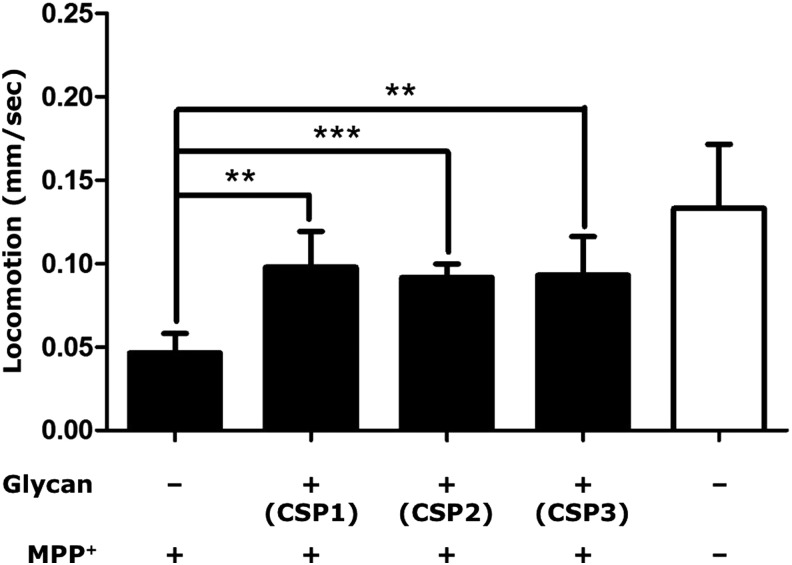
Pharmacologic suppression of 1-methyl-4-phenylpyridine (MPP+)-induced locomotion defect in Caenorhabditis elegans by polysaccharides from Chaenomeles speciosa. Synchronized L1 wild-type nematodes were treated with MPP+ (200 μg/mL) and polysaccharides (150 μg/mL) for 48 hr at 20°C, and locomotion of the nematodes was analyzed from recorded movies on fresh plates. CPS1–3, fractions of C. speciosa polysaccharides from anion-exchange chromatography eluted with H2O, 1 M NaCl and 2 M NaCl, respectively. (**) p<0.01; (***) p<0.001.
References
-
- Blagosklonny MV. Prospective treatment of age-related diseases by slowing down aging. Am J Pathol 2012;181:1142–1146 - PubMed
-
- Sluder AE, Baumeister R. From genes to drugs: Target validation in Caenorhabditis elegans. Drug Discov Today Technol 2004;1:171–177 - PubMed
-
- Shoyama T, Shimizu Y, Suda H. Decline in oxygen consumption correlates with lifespan in long-lived and short-lived mutants of Caenorhabditis elegans. Exp Gerontol 2009;44:784–791 - PubMed
-
- Zhang H, Pan N, Xiong S, Zou S, Li H, Xiao L, Cao Z, Tunnacliffe A, Huang Z. Inhibition of polyglutamine-mediated proteotoxicity by Astragalus membranaceus polysaccharide through the DAF-16/FOXO transcription factor in Caenorhabditis elegans. Biochem J 2012;441:417–424 - PubMed
Publication types
MeSH terms
LinkOut - more resources
Full Text Sources
Other Literature Sources
Medical
