. 2013 Aug 30:13:68.
doi: 10.1186/1472-6750-13-68.

The effects of statins on the mevalonic acid pathway in recombinant yeast strains expressing human HMG-CoA reductase

The effects of statins on the mevalonic acid pathway in recombinant yeast strains expressing human HMG-CoA reductase

Agata Maciejak et al. BMC Biotechnol. .

Abstract

Background: The yeast Saccharomyces cerevisiae can be a useful model for studying cellular mechanisms related to sterol synthesis in humans due to the high similarity of the mevalonate pathway between these organisms. This metabolic pathway plays a key role in multiple cellular processes by synthesizing sterol and nonsterol isoprenoids. Statins are well-known inhibitors of 3-hydroxy-3-methylglutaryl-CoA reductase (HMGR), the key enzyme of the cholesterol synthesis pathway. However, the effects of statins extend beyond their cholesterol-lowering action, since inhibition of HMGR decreases the synthesis of all products downstream in the mevalonate pathway. Using transgenic yeast expressing human HMGR or either yeast HMGR isoenzyme we studied the effects of simvastatin, atorvastatin, fluvastatin and rosuvastatin on the cell metabolism.

Results: Statins decreased sterol pools, prominently reducing sterol precursors content while only moderately lowering ergosterol level. Expression of genes encoding enzymes involved in sterol biosynthesis was induced, while genes from nonsterol isoprenoid pathways, such as coenzyme Q and dolichol biosynthesis or protein prenylation, were diversely affected by statin treatment. Statins increased the level of human HMGR protein substantially and only slightly affected the levels of Rer2 and Coq3 proteins involved in non-sterol isoprenoid biosynthesis.

Conclusion: Statins influence the sterol pool, gene expression and protein levels of enzymes from the sterol and nonsterol isoprenoid biosynthesis branches and this effect depends on the type of statin administered. Our model system is a cheap and convenient tool for characterizing individual statins or screening for novel ones, and could also be helpful in individualized selection of the most efficient HMGR inhibitors leading to the best response and minimizing serious side effects.


Figures
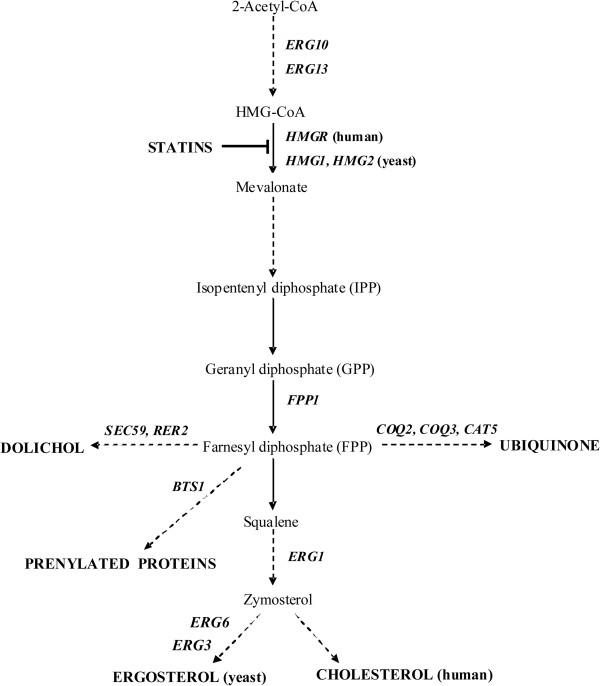
Figure 1
Figure 1
The mevalonate pathway. The enzymes selected for gene expression analysis are shown at the corresponding steps of the pathway. The dashed lines indicate multicomponent pathways. ERG10 – acetyl-CoA acetyltransferase, ERG13 – 3-hydroxy-3-methylglutaryl-CoA synthase, human (HMGR) and yeast (HMG1, HMG2) 3-hydroxy-3-methylglutaryl-Co A reductase 1 and 2, FPP1 – farnesyl pyrophosphate synthase, ERG1 – squalene monooxygenase, ERG6 – delta(24)-sterol C-methyltransferase, ERG3 – C-5 sterol desaturase, COQ3 – 3,4-dihydroxy-5-hexaprenylbenzoatemethyltransferase, COQ2para-hydroxybenzoate-polyprenyl transferase, CAT5 – ubiquinone biosynthesis monooxygenase, BTS1 – geranylgeranyl diphosphate synthase, RER2cis-prenyltransferase, SEC59 – dolichol kinase.
Figure 2
Figure 2
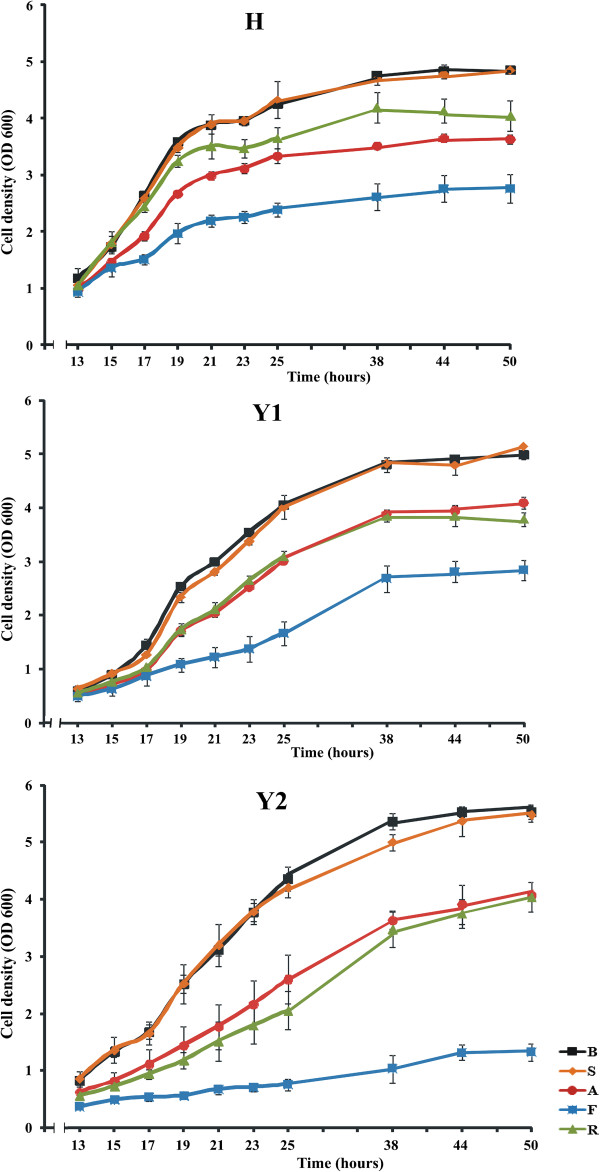
Statins inhibit growth of yeast strains. Growth kinetics of yeast strains cultured in liquid minimal media supplemented with either statins or buffer. OD600 of each culture was measured at intervals. Data represent mean ± SD of triplicate experiments. When the error bars are absent; SD falls within the size of symbols. B – buffer, S – simvastatin, A – atorvastatin, F – fluvastatin, R – rosuvastatin.
Figure 3
Figure 3
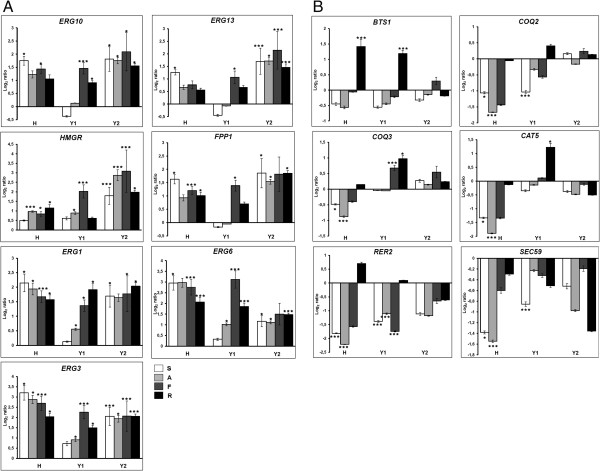
Statins induce expression of genes encoding enzymes of sterol and nonsterol biosynthesis pathways. mRNA levels in statin-treated cells relative to control (buffer-treated cells) are shown using log2 scale. Results are mean ± SEM obtained by qRT-PCR. *p < 0.05, ***p < 0.001. Real-time PCR data, were normalize to 35S rRNA, a housekeeping gene. S – simvastatin, A – atorvastatin, F – fluvastatin, R – rosuvastatin. A) Quantitative real-time RT-PCR analysis of selected genes encoding enzymes of sterol biosynthesis pathway after statin treatment compared to buffer-treated cells. ERG10 – acetyl-CoA acetyltransferase, ERG13 – 3-hydroxy-3-methylglutaryl-CoA synthase, HMGR – human 3-hydroxy-3-methylglutaryl-Co A reductase, HMG1 and HMG2 – yeast 3-hydroxy-3-methylglutaryl-Co A reductase 1 and 2, FPP1 – farnesyl pyrophosphate synthase, ERG1 – squalene monooxygenase, ERG6 – delta(24)-sterol C-methyltransferase, ERG3 – C-5 sterol desaturase. B) Quantitative real-time RT-PCR analysis of genes from ubiquinone and dolichol synthesis and protein prenylation pathways. CAT5 ubiquinone biosynthesis monooxygenase, COQ3 – 3,4-dihydroxy-5-hexaprenylbenzoate-O-methyltransferase, COQ2para-hydroxybenzoate-polyprenyl transferase, BTS1 – geranylgeranyl diphosphate synthase, RER2cis-prenyltransferase, SEC59 – dolichol kinase.
Figure 4
Figure 4
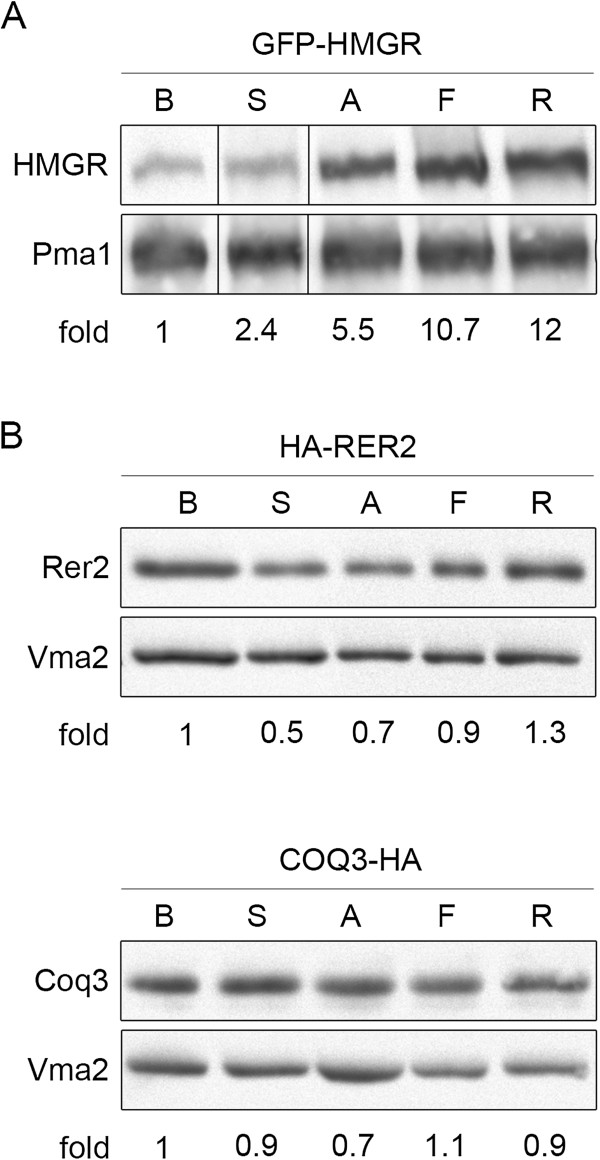
Statins affect levels of human HMGR and yeast Rer2 and Coq3 proteins. Strains expressing GFP-HMGR, HA-Rer2 or Coq3-HA proteins were grown for 24 hours in the presence of buffer (B) or one of the statins: atorvastatin (A), fluvastatin (F), rosuvastatin (R) or simvastatin (S). Protein extracts were prepared and analyzed by Western blotting. The level of plasma membrane ATPase Pma1p is shown as a loading control. A) Steady state level of human HMGR is higher after statin treatment with the highest increase after rosuvastatin treatment. Western blot was analyzed with anti-GFP or, for loading control, anti-Pma1 antibody. Ratio of respective signals is shown below. B) Levels of yeast Rer2 and Coq3 proteins are marginally affected by statin treatment. Western blots were analyzed with anti-HA or, for loading control, anti-Vma2 antibody.

References

    1. Shepherd J, Cobbe SM, Ford I, Isles CG, Lorimer AR, Macfarlane PW, McKillop JH, Packard CJ. Prevention of coronary heart disease with pravastatin in men with hypercholesterolemia. N Engl J Med. 1995;333:1301–1308. doi: 10.1056/NEJM199511163332001. - DOI - PubMed
    1. Prosser LA, Stinnett AA, Goldman PA, Williams LW, Hunink MG, Goldman L, Weinstein MC. Cost-effectiveness of cholesterol-lowering therapies according to selected patient characteristics. Ann Intern Med. 2000;132:769–779. - PubMed
    1. Sever PS, Dahlöf B, Poulter NR, Wedel H, Beevers G, Caulfield M, Collins R, Kjeldsen SE, Kristinsson A, McInnes GT, Mehlsen J, Nieminen M, O’Brien E, Ostergren J. ASCOT investigators. Prevention of coronary and stroke events with atorvastatin in hypertensive patients who have average or lower-than-average cholesterol concentrations, in the Anglo-Scandinavian Cardiac Outcomes Trial-Lipid Lowering Arm (ASCOT-LLA): a multicentre randomised controlled trial. Lancet. 2003;361:1149–1158. doi: 10.1016/S0140-6736(03)12948-0. - DOI - PubMed
    1. Buhaescu I, Izzedine H. Mevalonate pathway: a review of clinic and therapeutical implications. Clin Biochem. 2007;40:575–584. doi: 10.1016/j.clinbiochem.2007.03.016. - DOI - PubMed
    1. Evans M, Rees A. Effects of HMG-CoA reductase inhibitors on skeletal muscle. Drug Saf. 2002;25:649–663. doi: 10.2165/00002018-200225090-00004. - DOI - PubMed

Publication types

MeSH terms