


Counseling and provision of long-acting reversible contraception in the US: national survey of nurse practitioners
- PMID: 24128950
- PMCID: PMC3890255
- DOI: 10.1016/j.ypmed.2013.10.005
Counseling and provision of long-acting reversible contraception in the US: national survey of nurse practitioners
Abstract
Objective: Nurse practitioners (NPs) provide frontline care in women's health, including contraception, an essential preventive service. Their importance for contraceptive care will grow, with healthcare reforms focused on affordable primary care. This study assessed practice and training needs to prepare NPs to offer high-efficacy contraceptives - intrauterine devices (IUDs) and implants.
Method: A US nationally representative sample of nurse practitioners in primary care and women's health was surveyed in 2009 (response rate 69%, n=586) to assess clinician knowledge and practices, guided by the CDC US Medical Eligibility Criteria for Contraceptive Use.
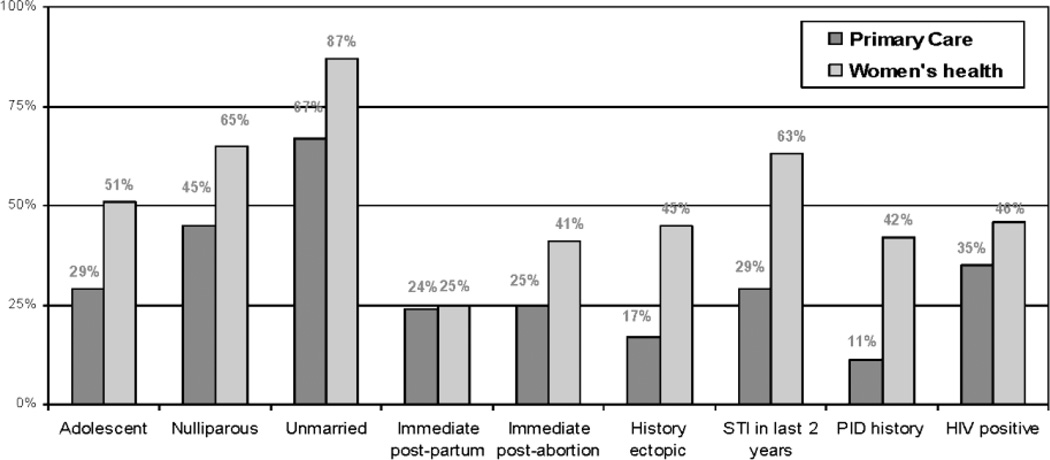
Results: Two-thirds of women's health NPs (66%) were trained in IUD insertions, compared to 12% of primary care NPs. Contraceptive counseling that routinely included IUDs was low overall (43%). Nurse practitioners used overly restrictive patient eligibility criteria, inconsistent with CDC guidelines. Insertion training (aOR=2.4, 95%CI: 1.10 5.33) and knowledge of patient eligibility (aOR=2.9, 95%CI: 1.91 4.32) were associated with IUD provision. Contraceptive implant provision was low: 42% of NPs in women's health and 10% in primary care. Half of NPs desired training in these methods.
Conclusion: Nurse practitioners have an increasingly important position in addressing high unintended pregnancy in the US, but require specific training in long-acting reversible contraceptives.
Keywords: Contraceptive care; Contraceptive implant; IUD; Long-acting reversible contraception; Nurse practitioners.
© 2013.
Figures
References
-
- Berwick DM. Disseminating innovations in health care. JAMA. 2003;289:1969–1975. - PubMed
-
- Burkman R, Bell C, Serfaty D. The evolution of combined oral contraception: improving the risk-to-benefit ratio. Contraception. 2011;84:19–34. - PubMed
-
- Centers for Disease Control and Prevention. United States medical eligibility criteria for contraceptive use, 2010. MMWR. 2010;59:1–6.
-
- Centers for Disease Control and Prevention. U.S. Selected Practice Recommendations for Contraceptive Use, 2013. 2013a;62:1–46.
-
- Centers for Disease Control and Prevention. Unintended Pregnancy Prevention. 2013b http://www.cdc.gov/reproductivehealth/UnintendedPregnancy/.
Publication types
MeSH terms
Grants and funding
LinkOut - more resources
Full Text Sources
Other Literature Sources
Medical
