


Heritabilities of directional asymmetry in the fore- and hindlimbs of rabbit fetuses
- PMID: 24130770
- PMCID: PMC3794934
- DOI: 10.1371/journal.pone.0076358
Heritabilities of directional asymmetry in the fore- and hindlimbs of rabbit fetuses
Abstract
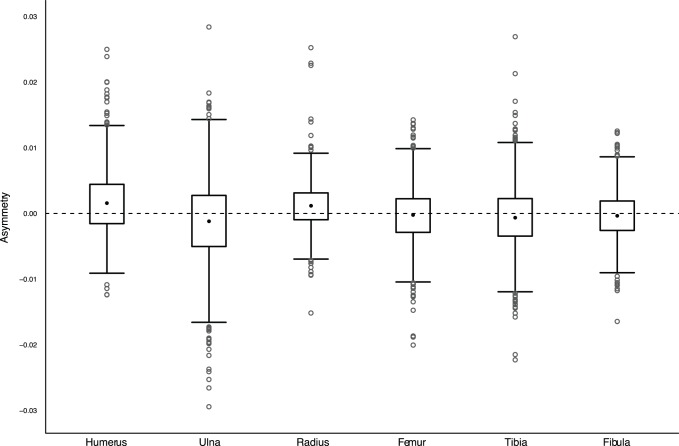
Directional asymmetry (DA), where at the population level symmetry differs from zero, has been reported in a wide range of traits and taxa, even for traits in which symmetry is expected to be the target of selection such as limbs or wings. In invertebrates, DA has been suggested to be non-adaptive. In vertebrates, there has been a wealth of research linking morphological asymmetry to behavioural lateralisation. On the other hand, the prenatal expression of DA and evidences for quantitative genetic variation for asymmetry may suggest it is not solely induced by differences in mechanic loading between sides. We estimate quantitative genetic variation of fetal limb asymmetry in a large dataset of rabbits. Our results showed a low but highly significant level of DA that is partially under genetic control for all traits, with forelimbs displaying higher levels of asymmetry. Genetic correlations were positive within limbs, but negative across bones of fore and hind limbs. Environmental correlations were positive for all, but smaller across fore and hind limbs. We discuss our results in light of the existence and maintenance of DA in locomotory traits.
Conflict of interest statement
Figures

References
-
- Ribeiro AS, Eales BA, Biddle FG (2011) Learning of paw preference in mice is strain dependent, gradual and based on short-term memory of previous reaches. Anim Behav 81: 249–257 10.1016/j.anbehav.2010.10.014 - DOI
-
- Leamy LJ (1999) Heritability of directional and fluctuating asymmetry for mandibular characters in random-bred mice. Journal of evolutionary Biology 12: 146–155 10.1046/j.1420-9101.1999.00023.x - DOI
Publication types
MeSH terms
LinkOut - more resources
Full Text Sources
Other Literature Sources
