


Severe asymptomatic non-alcoholic fatty liver disease in routine diabetes care; a multi-disciplinary team approach to diagnosis and management
- PMID: 24131545
- PMCID: PMC3869293
- DOI: 10.1093/qjmed/hct198
Severe asymptomatic non-alcoholic fatty liver disease in routine diabetes care; a multi-disciplinary team approach to diagnosis and management
Abstract
Objectives: To prospectively use a non-invasive algorithm to identify asymptomatic, advanced non-alcoholic fatty liver disease (NAFLD) in a secondary care diabetes clinic and to determine the short-term effect of a multi-disciplinary team (MDT) approach in a liver clinic.
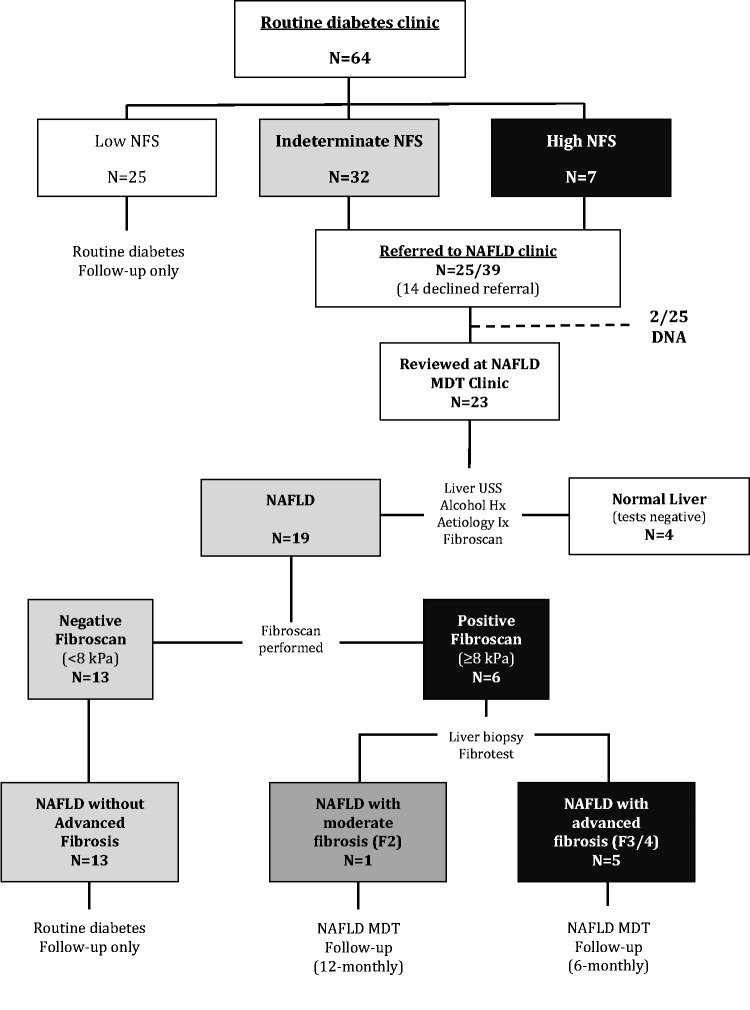
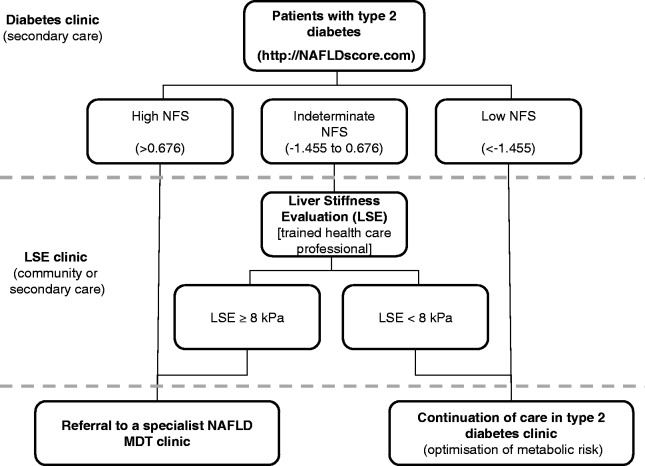
Research design and methods: NAFLD Fibrosis Score (NFS) was calculated in 64 asymptomatic patients with type 2 diabetes. Advanced fibrosis was identified using transient elastography and confirmed with liver biopsy. In a subsequent retrospective study, 95 patients newly referred to the NAFLD MDT clinic were investigated and the impact of the MDT approach assessed.
Results: 25/64 (39.0%) of patients with diabetes had a low NFS (<-1.455). 39/64 (61.0%) patients had a high or indeterminate NFS and were referred for review in the NAFLD MDT clinic, of which 23/39 attended for assessment. 19/23 (82.6%) were diagnosed with NAFLD, of which 6/19 (31.6%) patients had a positive transient elastography (≥8 kPa). Liver biopsy confirmed advanced fibrosis in 5/6 cases, with moderate fibrosis in 1 case. In the retrospective study, 65/95 (68.4%) new referrals to the NAFLD MDT clinic had a diagnosis of NAFLD. Over a median 98 days (IQR 70-182) follow-up, there was a significant improvement in weight (-0.8 kg; P = 0.024), total cholesterol (-0.2 mmol/L; P = 0.044), ALT (alanine transmaminase, -12.5 IU/L; P < 0.001) and GGT (gammu-glutamyl transferase, -13.0 IU/L; P < 0.0001). 7/28 (25%) of patients with diabetes achieved >5% weight loss.
Conclusions: A significant proportion of asymptomatic patients attending type 2 diabetes clinics have undiagnosed advanced NAFLD fibrosis. An MDT approach to NAFLD results in short-term improvements in metabolic and liver parameters.
Figures
References
-
- Ong JP, Pitts A, Younossi ZM. Increased overall mortality and liver-related mortality in non-alcoholic fatty liver disease. J Hepatol. 2008;49:608–12. - PubMed
-
- Targher G, Day CP, Bonora E. Risk of cardiovascular disease in patients with nonalcoholic fatty liver disease. N Engl J Med. 2010;363:1341–50. - PubMed
-
- El-Serag HB, Tran T, Everhart JE. Diabetes increases the risk of chronic liver disease and hepatocellular carcinoma. Gastroenterology. 2004;126:460–8. - PubMed
-
- Choi JH, Rhee EJ, Bae JC, Park SE, Park CY, Cho YK, et al. Increased risk of type 2 diabetes in subjects with both elevated liver enzymes and ultrasonographically diagnosed nonalcoholic fatty liver disease: a 4-year longitudinal study. Arch Med Res. 2013;44:115–20. - PubMed
-
- Targher G, Bertolini L, Rodella S, Tessari R, Zenari L, Lippi G, et al. Nonalcoholic fatty liver disease is independently associated with an increased incidence of cardiovascular events in type 2 diabetic patients. Diabetes Care. 2007;30:2119–21. - PubMed
Publication types
MeSH terms
Grants and funding
LinkOut - more resources
Full Text Sources
Other Literature Sources
Medical
Miscellaneous
