Review
. 2013 Nov;19(11):1461-73.
doi: 10.1261/rna.037390.112.

On the importance of cotranscriptional RNA structure formation

Review

On the importance of cotranscriptional RNA structure formation

Daniel Lai et al. RNA. 2013 Nov.

Abstract

The expression of genes, both coding and noncoding, can be significantly influenced by RNA structural features of their corresponding transcripts. There is by now mounting experimental and some theoretical evidence that structure formation in vivo starts during transcription and that this cotranscriptional folding determines the functional RNA structural features that are being formed. Several decades of research in bioinformatics have resulted in a wide range of computational methods for predicting RNA secondary structures. Almost all state-of-the-art methods in terms of prediction accuracy, however, completely ignore the process of structure formation and focus exclusively on the final RNA structure. This review hopes to bridge this gap. We summarize the existing evidence for cotranscriptional folding and then review the different, currently used strategies for RNA secondary-structure prediction. Finally, we propose a range of ideas on how state-of-the-art methods could be potentially improved by explicitly capturing the process of cotranscriptional structure formation.

Keywords: RNA secondary-structure prediction; RNA structure formation in vivo; cotranscriptional RNA folding.


Figures
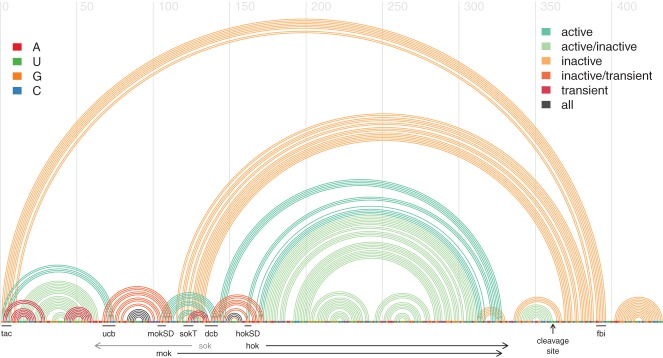
FIGURE 1.
FIGURE 1.
RNA structure features for the reference sequence from E. coli plasmid R1 encoding the hok and mok proteins. The horizontal line depicts the plasmid's sequence with its nucleotides color-coded according to the legend on the top left. Underneath the sequence line, black arrows indicate the protein-coding regions of the hok and mok proteins. The gray arrow shows the sequence region that is complementary to the sok anti-sense RNA, which is part of a different transcript. Each arc above the horizontal line represents a base pair between the two corresponding positions along the sequence and is color-coded according to the structure conformation to which it belongs (active, inactive, or transient; see the legend on the top right). Below the horizontal sequence line, black lines indicate the location of known sequence motifs: (tac) translational activator element; (ucb) upstream complementary box; (dcb) downstream complementary box; (mokSD) mok Shine-Dalgarno sequence; (hokSD) hok Shine-Dalgarno sequence; (fbi) fold-back inhibitory element. This arc-diagram was first published by Steif and Meyer (2012) and generated using the R-chie web server (Lai et al. 2012).
FIGURE 2.
FIGURE 2.
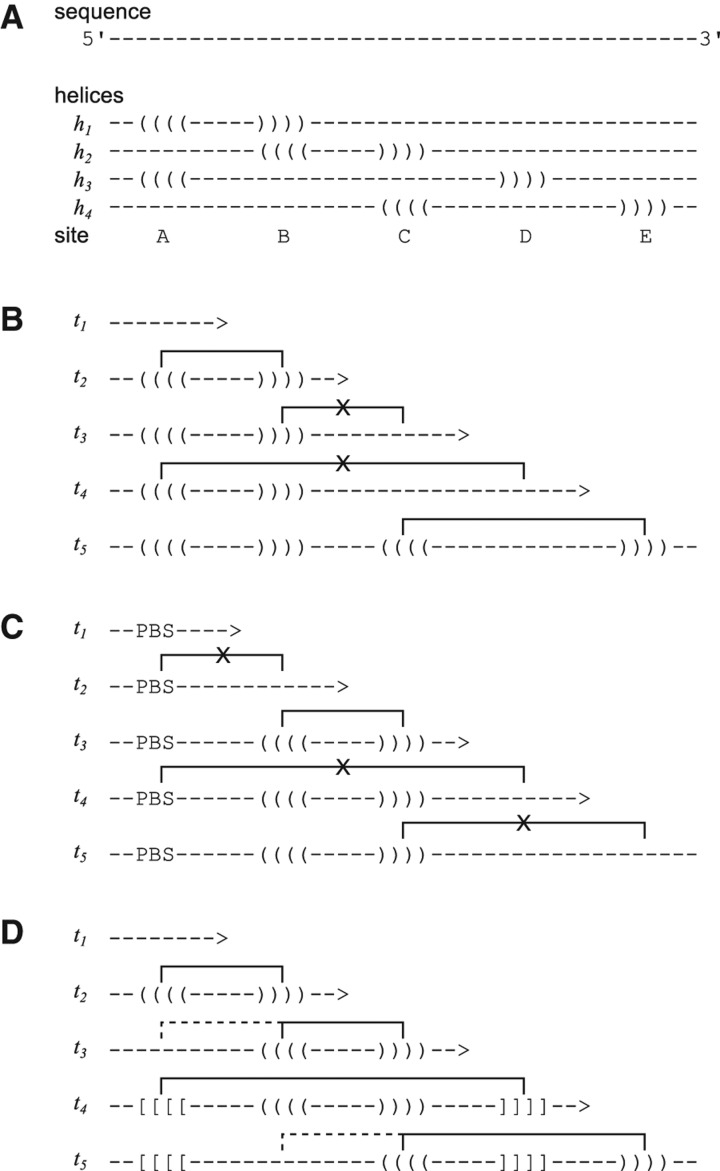
Examples of cis and trans interactions during cotranscriptional folding. (A) Hypothetical RNA sequence, capable of forming helices h1h4, at sites A–E. (B) Transcription of the sequence across time points t1t5, with the sequential lengthening of the 3′ end. The transcription process limits the available sites for helix formation, imposing an order on helix formation. If an early-formed helix is stable, it can serve to block the formation of subsequent helices by occupying specific sites. (C) Sites may also be occupied due to interactions with other molecules; in this case, a protein-binding site (PBS) occupies site A, leading to a very different result. (D) If early helices are relatively unstable, they can be seen as transient helices that yield to new helices. This mechanism can aid the robust formation of desired structure features. Note that some of the conformations shown above correspond to the ones introduced and defined by Meyer and Miklós (2004). These are as follows: In B, h1 () and h3 (ic) are 3′-trans, where h1 is stable, preventing the formation of h3, and h1 (īi) and h2 (ic) are 3′-cis, where h1 is stable, preventing the formation of h2; in D, h1 (ci) and h2 () are 5′-cis, where h1 is an intermediate for h2, and h2 (ci) and h3 () are 5′-cis, where h2 is an intermediate for h3.

References

    1. Adilakshmi T, Bellur D, Woodson S 2008. Concurrent nucleation of 16S folding and induced fit in 30S ribosome assembly. Nature 455: 1268–1272 - PMC - PubMed
    1. Adilakshmi T, Soper S, Woodson S 2009. Structural analysis of RNA in living cells by in vivo synchrotron X-ray footprinting. Methods Enzymol 468: 239–258 - PMC - PubMed
    1. Alexander R, Innocente S, Barrass J, Beggs J 2010. Splicing-dependent RNA polymerase pausing in yeast. Mol Cell 40: 582–593 - PMC - PubMed
    1. Alexander R, Barrass J, Dichtl B, Kos M, Obtulowicz T, Robert M, Koper M, Karkusiewicz I, Mariconti L, Tollervey D, et al. 2011. RiboSys, a high-resolution, quantitative approach to measure the in vivo kinetics of pre-mRNA splicing and 3′-end processing in Saccharomyces cerevisiae. RNA 16: 2570–2580 - PMC - PubMed
    1. Al-Hashimi HM, Walter NG 2008. RNA dynamics: It is about time. Curr Opin Struct Biol 18: 321–329 - PMC - PubMed

Publication types