


Seasonal microbial community dynamics correlate with phytoplankton-derived polysaccharides in surface coastal waters
- PMID: 24132076
- PMCID: PMC3869024
- DOI: 10.1038/ismej.2013.178
Seasonal microbial community dynamics correlate with phytoplankton-derived polysaccharides in surface coastal waters
Abstract
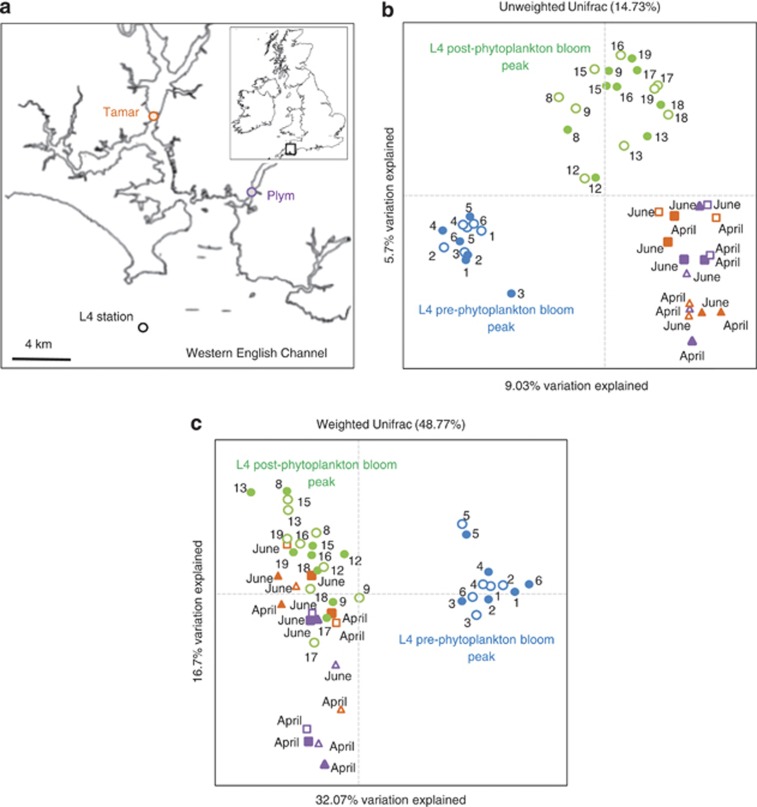
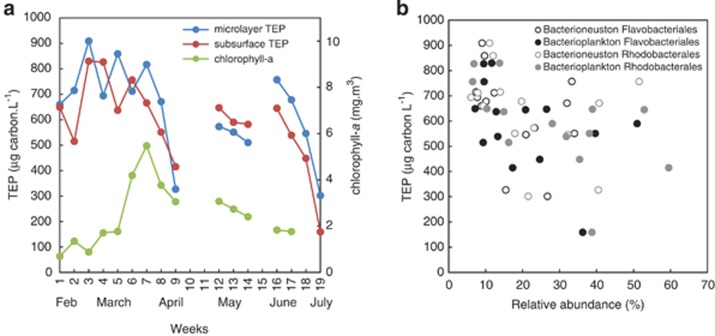
Phytoplankton produce large amounts of polysaccharide gel material known as transparent exopolymer particles (TEP). We investigated the potential links between phytoplankton-derived TEP and microbial community structure in the sea surface microlayer and underlying water at the English Channel time-series station L4 during a spring diatom bloom, and in two adjacent estuaries. Major changes in bacterioneuston and bacterioplankton community structure occurred after the peak of the spring bloom at L4, and coincided with the significant decline of microlayer and water column TEP. Increased abundance of Flavobacteriales and Rhodobacterales in bacterioneuston and bacterioplankton communities at L4 was significantly related to the TEP decline, indicating that both taxa could be responsible. The results suggest that TEP is an important factor in determining microbial diversity in coastal waters, and that TEP utilisation could be a niche occupied by Flavobacteriales and Rhodobacterales.
Figures
References
-
- Azetsu-Scott K, Passow U. Ascending marine particles: significance of transparent exopolymer particles (TEP) in the upper ocean. Limnol Oceanogr. 2004;49:741–748.
-
- Cunliffe M, Engel A, Frka S, Gašparović B, Guitart C, Murrell JC, et al. Sea surface microlayers: A unified physicochemical and biological perspective of the air–ocean interface. Prog Oceanogr. 2013;109:104–116.
Publication types
MeSH terms
Substances
LinkOut - more resources
Full Text Sources
Other Literature Sources
