


Dynamic control of posture across locomotor tasks
- PMID: 24132838
- PMCID: PMC3801425
- DOI: 10.1002/mds.25592
Dynamic control of posture across locomotor tasks
Abstract
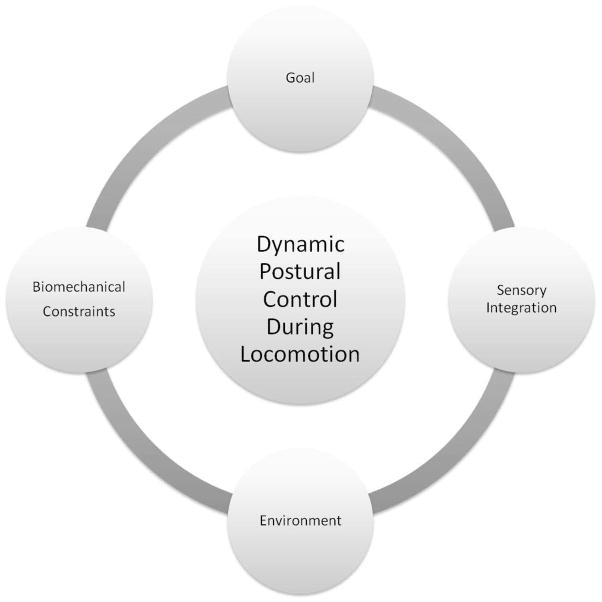
Successful locomotion depends on postural control to establish and maintain appropriate postural orientation of body segments relative to one another and to the environment and to ensure dynamic stability of the moving body. This article provides a framework for considering dynamic postural control, highlighting the importance of coordination, consistency, and challenges to postural control posed by various locomotor tasks, such as turning and backward walking. The impacts of aging and various movement disorders on postural control are discussed broadly in an effort to provide a general overview of the field and recommendations for assessment of dynamic postural control across different populations in both clinical and research settings. Suggestions for future research on dynamic postural control during locomotion also are provided and include discussion of opportunities afforded by new and developing technologies, the need for long-term monitoring of locomotor performance in everyday activities, gaps in our knowledge of how targeted intervention approaches modify dynamic postural control, and the relative paucity of literature regarding dynamic postural control in movement disorder populations other than Parkinson's disease.
Keywords: Parkinson's disease; gait; locomotion; motor control; posture.
© 2013 Movement Disorder Society.
Figures

References
-
- Feldman AG, Krasovsky T, Banina MC, Lamontagne A, Levin MF. Changes in the referent body location and configuration may underlie human gait, as confirmed by findings of multi-muscle activity minimizations and phase resetting. Exp Brain Res. 2011;210(1):91–115. - PubMed
-
- Chong RK, Chastan N, Welter ML, Do MC. Age-related changes in the center of mass velocity control during walking. Neurosci Lett. 2009;458(1):23–7. - PubMed
-
- Chastan N, Do MC, Bonneville F, Torny F, Bloch F, Westby GW, et al. Gait and balance disorders in Parkinson’s disease: impaired active braking of the fall of centre of gravity. Mov Disord. 2009;24(2):188–95. - PubMed
Publication types
MeSH terms
Grants and funding
LinkOut - more resources
Full Text Sources
Other Literature Sources
Medical
