


The voltage-dependent K(+) channels Kv1.3 and Kv1.5 in human cancer
- PMID: 24133455
- PMCID: PMC3794381
- DOI: 10.3389/fphys.2013.00283
The voltage-dependent K(+) channels Kv1.3 and Kv1.5 in human cancer
Abstract
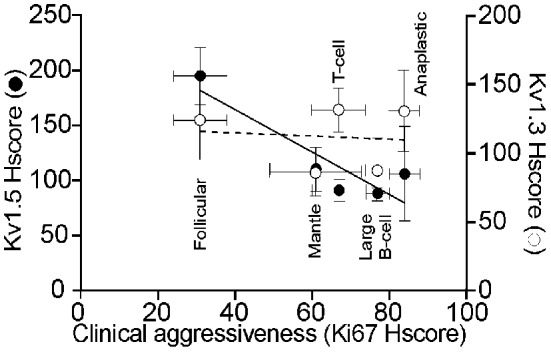
Voltage-dependent K(+) channels (Kv) are involved in a number of physiological processes, including immunomodulation, cell volume regulation, apoptosis as well as differentiation. Some Kv channels participate in the proliferation and migration of normal and tumor cells, contributing to metastasis. Altered expression of Kv1.3 and Kv1.5 channels has been found in several types of tumors and cancer cells. In general, while the expression of Kv1.3 apparently exhibits no clear pattern, Kv1.5 is induced in many of the analyzed metastatic tissues. Interestingly, evidence indicates that Kv1.5 channel shows inversed correlation with malignancy in some gliomas and non-Hodgkin's lymphomas. However, Kv1.3 and Kv1.5 are similarly remodeled in some cancers. For instance, expression of Kv1.3 and Kv1.5 correlates with a certain grade of tumorigenicity in muscle sarcomas. Differential remodeling of Kv1.3 and Kv1.5 expression in human cancers may indicate their role in tumor growth and their importance as potential tumor markers. However, despite of this increasing body of information, which considers Kv1.3 and Kv1.5 as emerging tumoral markers, further research must be performed to reach any conclusion. In this review, we summarize what it has been lately documented about Kv1.3 and Kv1.5 channels in human cancer.
Keywords: K+ channels; agressiveness; cancer; proliferation; tumor markers.
Figures
References
-
- Abdul M., Santo A., Hoosein N. (2003). Activity of potassium channel-blockers in breast cancer. Anticancer Res. 23, 3347–3351 - PubMed
Publication types
LinkOut - more resources
Full Text Sources
Other Literature Sources
