Review
. 2013 Sep 26:4:664.
doi: 10.3389/fpsyg.2013.00664.

Sensitive and critical periods in visual sensory deprivation

Affiliations
Review

Sensitive and critical periods in visual sensory deprivation

Patrice Voss. Front Psychol. .

Abstract

While the demonstration of crossmodal plasticity is well established in congenital and early blind individuals, great debate still surrounds whether those who acquire blindness later in life can also benefit from such compensatory changes. No proper consensus has been reached despite the fact that a proper understanding of the developmental time course of these changes, and whether their occurrence is limited to-or within-specific time windows, is crucial to our understanding of the crossmodal phenomena. An extensive review of the literature reveals that while the majority of investigations to date have examined the crossmodal plasticity available to late blind individuals in quantitative terms, recent findings rather suggest that this reorganization also likely changes qualitatively compared to what is observed in early blindness. This obviously could have significant repercussions not only for the training and rehabilitation of blind individuals, but for the development of appropriate neuroprostheses designed to aid and potentially restore vision. Important parallels will also be drawn with the current state of research on deafness, which is particularly relevant given in the development of successful neuroprostheses (e.g., cochlear implants) for providing auditory input to the central nervous system otherwise aurally deafferented. Lastly, this paper will address important inconsistencies across the literature concerning the definition of distinct blind groups based on the age of blindness onset, and propose several alternatives to using such a categorization.

Keywords: blindness; critical periods; crossmodal plasticity; early and late blind; sensitive periods.


Figures
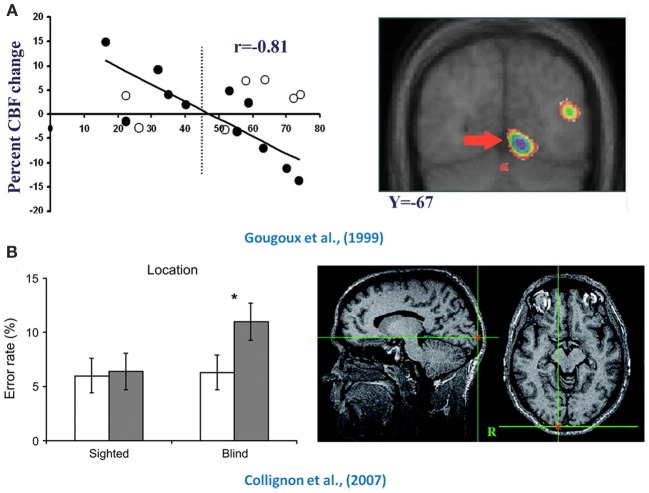
Figure 1
Figure 1
Functional relevance of crossmodal plasticity. Illustrated here are demonstrations of the functional role played by the occipital cortex in spatial hearing tasks in early blind individuals. The top row (panel A) depicts the finding that occipital activity in early blind individuals (black dots) was predictive of their performance in a sound localization task (Gougoux et al., 2005). The bottom row (panel B) illustrates the effect that TMS has when applied to the occipital cortex (black bars) when both blind and sighted subjects were asked to localize sounds (Collignon et al., 2007). Compared to Sham-TMS (white bars), TMS applied over occipital cortex reduced the performance of early blind subjects only, which is indicative that this region is functionally relevant for spatial processing in the early blind. Adapted with permission from Gougoux et al. (2005) and Collignon et al. (2007). *P < 0.05.
Figure 2
Figure 2
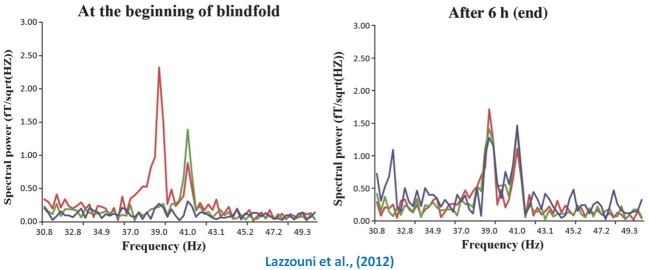
Crossmodal plasticity in temporarily deprived sighted individuals. This figure portrays a recent MEG finding that testifies to the impressive speed at which the visual cortex can display auditory cortex-like functioning following a short period of visual deprivation. The left graph shows that prior to blindfolding the two spectral peaks (left temporal in red; right temporal in green) associated with modulation rate of the auditory stimuli presented to both ears (39 and 41 Hz) are clearly restricted to the temporal electrodes (auditory cortex). However, as shown in the right graph, the same peaks can now be found in visual cortex (purple peaks) following a 6 h visual deprivation period. Adapted with permission from Lazzouni et al. (2012).
Figure 3
Figure 3
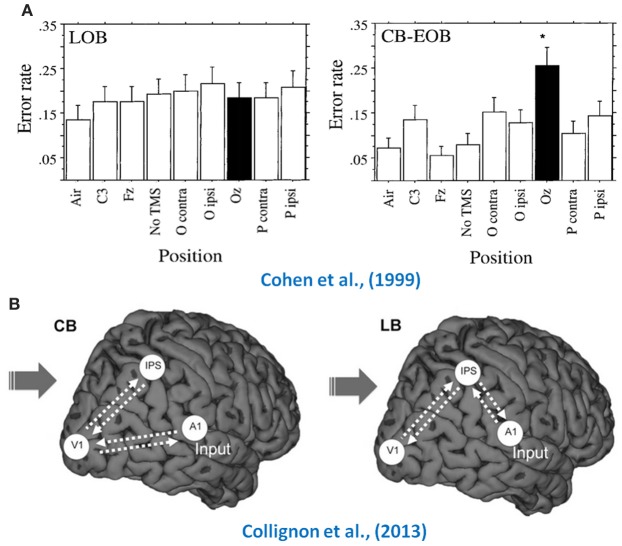
How early and late blind differ. Illustrated here are two examples of how the crossmodal plasticity observed in early and late blind individuals differs. The top row (panel A) illustrates the differential effect TMS has when applied over the occipital cortex (black bars) of LB (first bar graph) and EB (second bar graph) on their performance in a Braille task, where only the early blind showed an increase in error rate (Cohen et al., 1999). The bottom row (panel B) consists in a schematic representation of how auditory information flows toward V1 in the congenitally blind and late blind, illustrating the DCM findings of Collignon et al. (2013). Adapted with permission from Cohen et al. (1999) and Collignon et al. (2013). *p < 0.001.

References

    1. Amedi A., Floel A., Knecht S., Zohary E., Cohen L. G. (2004). Transcranial magnetic stimulation of the occipital pole interferes with verbal processing in blind subjects. Nat. Neurosci. 7, 1266–1270 10.1038/nn1328 - DOI - PubMed
    1. Amedi A., Raz N., Azulay H., Malach R., Zohary E. (2010). Cortical activity during tactile exploration of objects in blind and sighted humans. Restor. Neurol. Neurosci. 28, 143–156 - PubMed
    1. Amedi A., Raz N., Pianka P., Malach R., Zohary E. (2003). Early ‘visual’ cortex activation correlates with superior verbal memory in the blind. Nat. Neurosci. 6, 758–766 10.1038/nn1072 - DOI - PubMed
    1. Amedi A., Stern W. M., Camprodon J. A., Bermpohl F., Merabet L., Rotman S., et al. (2007). Shape conveyed by visual-to-auditory sensory substitution activates the lateral occipital complex. Nat. Neurosci. 10, 687–689 10.1038/nn1912 - DOI - PubMed
    1. Arno P., De Volder A. G., Vanlierde A., Wanet-Defalque M. C., Streel E., Robert A., et al. (2001). Occipital activation by pattern recognition in the early blind using auditory substitution for vision. Neuroimage 13, 632–645 10.1006/nimg.2000.0731 - DOI - PubMed

LinkOut - more resources